The professional ecosystem in the United States operates on a foundation of trust, but more importantly, it operates on the clarity provided by written documentation. A service agreement acts as the formal blueprint for any business interaction where one party provides a skill or labor in exchange for compensation. This document is not merely a formality, rather it is a sophisticated tool for risk management and operational alignment.
Defining the Professional Standard
Service agreements are utilized by a diverse range of professionals including freelancers, small business owners, consultants, and large scale agencies. For a freelancer, the agreement provides the leverage needed to ensure they are paid on time and that their intellectual property remains protected. For a business or agency, it establishes the standards of performance and the legal boundaries of their liability.
Strategic Relationship Management
The strategic importance of these agreements cannot be overstated in modern professional relationships. They serve to replace vague verbal promises with immutable written terms that both parties can reference. By defining the parameters of the work from the outset, the agreement fosters a more collaborative and less adversarial relationship. This proactive approach to legal documentation is a hallmark of successful American enterprises.
What Is a Service Agreement?
At its core, a service agreement is a legally binding contract between a service provider and a client that creates mutual obligations enforceable by law. It is the physical or digital manifestation of the meeting of the minds, where two or more parties agree to a set of specific terms and conditions. The agreement serves to define the scope of the work, the expectations for quality, and the responsibilities of everyone involved.
Foundation of Enforceability
In the United States, for this agreement to be valid, it must contain certain essential elements rooted in common law and statutory principles. These elements include a clear offer, a definitive acceptance, and the exchange of consideration, which is something of value such as money or labor. Without these building blocks, an agreement may not hold up in a court of law if a dispute arises.
Core Requirements for US Contracts
A legally valid service agreement is built on a few core elements that ensure both parties are clearly bound and protected.
It begins with an offer, where one party proposes specific terms, followed by acceptance, where the other party agrees without changes, forming a binding relationship.
Consideration ensures that something of value, usually payment for services, is exchanged, making the agreement enforceable rather than a gift.
Mutual assent confirms that both parties fully understand and agree to the terms, while capacity ensures they are legally able to enter into a contract.
Finally, legality requires that the agreement’s purpose is lawful, ensuring it can be upheld in court.
Key Parties Involved
The first party in any service agreement is the service provider, who is the individual or entity responsible for delivering the work. This party could be a sole proprietor, an independent contractor, or a corporate entity. It is vital that the provider has the legal authority to enter into the agreement and the capacity to fulfill the duties described within the document.
The Client Perspective
The second party is the client, which can also be an individual person or a business organization. The client is the recipient of the services and typically holds the primary responsibility for providing payment and any necessary access or data required by the provider. Identifying these parties clearly by their legal names and addresses is the first step in creating a document that can be defended in court.
Why Is a Service Agreement Required?
Establishes Clear Expectations
The primary functional requirement of a service agreement is to establish clear and measurable expectations for the project. By documenting the scope of work in detail, the agreement ensures that the client knows exactly what they are receiving and the provider knows exactly what they must produce. This level of detail is the most effective way to prevent the project from diverging from its original goals.
Nuances of Project Scoping
Expectations are further solidified through the inclusion of specific deliverables and timelines. A deliverable is a tangible work product, such as a report, a piece of software, or a marketing strategy, that is handed over to the client. The timeline provides the schedule for these handovers, allowing both parties to plan their operations and resource allocation with precision.
Prevents Misunderstandings and Disputes
Written clarity is the most powerful tool available to reduce ambiguity in a business relationship. Verbal agreements are susceptible to differing interpretations and the fading of human memory over time. A service agreement acts as a permanent record of the original intent of the parties, providing a single source of truth that can be consulted whenever a question about the work arises.
Conflict Mitigation Strategies
When a conflict does occur, the service agreement provides a structured framework for resolving it without immediate escalation. It defines the standards of performance and the procedures for addressing deficiencies. By having these rules in place before a problem starts, parties can often find a resolution through simple reference to the contract, thereby preserving the business relationship and avoiding the high costs of litigation.
Provides Legal Protection
In the US legal system, an enforceable contract is the primary shield against liability and financial loss. The agreement provides a clear legal basis for a party to seek remedies if the other side fails to fulfill their promises. These remedies can include monetary damages to compensate for losses or specific performance requirements where a court orders the completion of a task.
Managing Liability Risks
Beyond basic enforcement, the agreement defines the liabilities and remedies available to each party. For instance, a provider may include clauses that limit their responsibility for indirect or consequential damages. This ensures that a single project error does not lead to the total financial ruin of the business. Defining these boundaries is a critical aspect of professional risk management.
Ensures Payment Security
For the service provider, the agreement is the primary mechanism for ensuring they are paid for their expertise and labor. It specifies the total fee, the payment schedule, and the accepted methods of payment. This creates a clear legal debt that the client is obligated to settle according to the terms of the document. Without this written obligation, recovering unpaid fees becomes significantly more difficult.
Financial Penalties and Incentives
To further secure payment, many service agreements include provisions for late fees and interest on overdue balances. These terms act as a deterrent against late payments and compensate the provider for the administrative time spent on collection efforts. By setting these financial boundaries early, the provider establishes a professional expectation for how the business side of the relationship will be managed.
Key Elements of a Service Agreement
Scope of Services
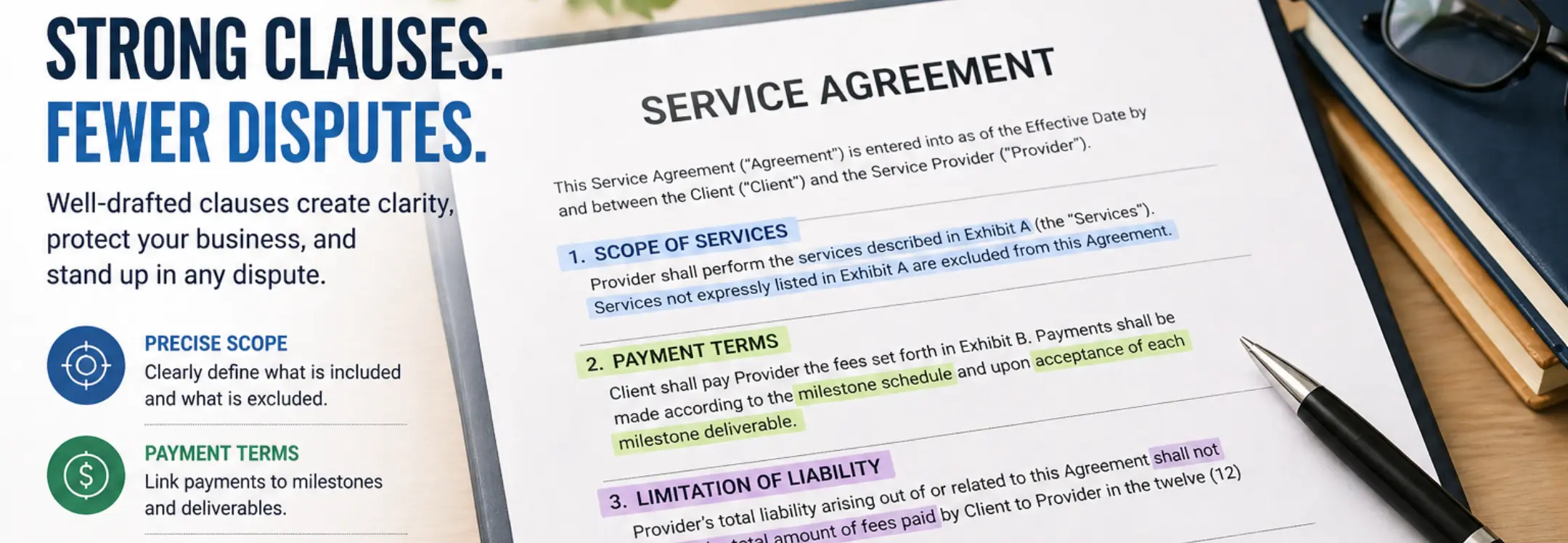
The scope of services section provides a comprehensive and detailed description of the work to be performed. It is the most critical part of the agreement for project management purposes because it defines the boundaries of the engagement. A well drafted scope will include the specific tasks, the methodology to be used, and the final results that the client can expect to receive.
The Importance of Exclusions
A sophisticated scope of services also includes a section on exclusions, which lists the tasks that the provider will not be doing. This prevents the client from assuming that additional, related work is included in the base price. By clearly stating what is out of scope, the provider protects their time and ensures that any additional requests lead to a formal change order and additional compensation.
Payment Terms
The payment terms section outlines the financial core of the agreement, detailing the fees, milestones, and due dates. It should explicitly state whether the compensation is a fixed fee for the entire project or based on an hourly rate. This section also describes the invoicing process, including what information must be included in each invoice and how long the client has to pay after receiving it.
Structuring Milestone Payments
Milestones are particularly useful for large projects because they link payment to the completion of specific phases of work. This provides the provider with necessary cash flow during a long engagement and gives the client a sense of security that they are only paying for progress. The agreement should define each milestone with enough detail so that there is no ambiguity about when the payment has been earned.
Duration and Termination
The duration of the agreement specifies the start and end dates of the contract period. Some service agreements are for a set term, such as six months, while others are project based and end upon the completion of the final deliverable. This section provides the necessary temporal boundaries for the professional relationship and helps both parties manage their long term schedules.
Defining Exit Conditions
Termination clauses are essential because they outline the conditions under which either party can end the relationship before the work is finished. These clauses typically require a notice period, such as thirty days, to allow for a smooth transition. They also specify what happens to any work in progress and whether any fees are due for services rendered up to the point of termination.
Confidentiality Clause
Service providers often have access to sensitive client information including trade secrets, customer data, and internal business strategies. A confidentiality clause is a legally binding promise to protect this information from unauthorized disclosure. This protection is vital for maintaining the competitive advantage of the client and for building a high level of trust between the parties.
Scope of Protected Information
The clause should define exactly what information is considered confidential and the duration of the protection. In many cases, the obligation of confidentiality continues for several years after the contract itself has ended. This ensures that sensitive data remains safe even if the service provider eventually works for a competitor of the client.
Liability and Indemnity
Liability and indemnity clauses are the primary tools for allocating risk in a service agreement. A limitation of liability clause sets a maximum amount that one party can recover from the other in the event of a breach or error. This cap is often tied to the total amount of fees paid under the contract, which prevents a single mistake from causing catastrophic financial harm to the service provider.
Understanding Indemnification
Indemnification is a specific type of protection where one party agrees to pay for any losses or legal costs that the other party incurs due to certain events, such as a third party lawsuit. For example, a provider might indemnify a client against claims that the provider's work violates someone else's copyright. These clauses are complex and require careful drafting to ensure the risks are balanced fairly between both sides.
Dispute Resolution
The dispute resolution section establishes the mandatory process for handling disagreements that cannot be settled through simple conversation. It often requires parties to engage in mediation, where a neutral third party helps them find a compromise. If mediation fails, the clause might require binding arbitration rather than a public court trial. This can save time and maintain the privacy of the business dispute.
Governing Law and Jurisdiction
Finally, the agreement must specify which state's laws will be used to interpret the contract. This is particularly important for interstate business relationships where the laws of the provider's state might differ from those of the client's state. Choosing the governing law and the physical location for any legal proceedings ensures that both parties know exactly which legal framework applies to their deal.
When Do You Need a Service Agreement?
Freelance or Consulting Work
Individual freelancers and independent consultants should use a service agreement for every engagement they undertake. In the gig economy, where work is often performed remotely and for various clients, a written contract provides the only solid foundation for professional behavior. It clarifies the scope of the consultant's advice and ensures they are paid for their specialized expertise.
Protecting the Gig Worker
For freelancers, the agreement is also a critical tool for managing their time and energy. It prevents clients from expecting constant availability or additional tasks that were not agreed upon. By setting clear boundaries from the start, the freelancer can maintain a healthy work life balance and ensure that their business remains profitable over the long term.
Agency or Vendor Services
Agencies and vendors providing specialized services such as IT support, marketing, or construction must rely on service agreements to manage the high level of complexity involved in their work. These projects often involve multiple team members and external subcontractors, making clear documentation essential for coordination. The agreement ensures that everyone is working toward the same goals and adhering to the same standards.
Scaling Through Documentation
As an agency scales, standardized service agreements become a vital part of their operational efficiency. They allow the agency to onboard new clients quickly while ensuring that every contract includes the necessary legal protections. Using a consistent contract framework also makes it easier for the agency's management and legal teams to review and track their various obligations across a large client portfolio.
Long-Term Business Relationships
When two organizations enter into a long term partnership, the service agreement provides the stability needed for that relationship to thrive. It establishes the recurring duties of each party and the procedures for regular performance reviews. These agreements often include mechanisms for adjusting pricing over time to account for inflation or changes in the cost of doing business.
Strategic Partnership Frameworks
In these long term scenarios, the agreement serves as more than just a legal document; it is a strategic framework for collaboration. It defines how the two businesses will integrate their workflows and share resources. By having these rules in writing, the partners can avoid the petty disputes that often derail long term relationships and focus on their shared strategic objectives.
High-Value or Ongoing Projects
Any project involving a significant financial investment or a long timeline requires the formal structure of a service agreement. High value projects carry higher risks, and the cost of a misunderstanding can be devastating for a small or mid sized business. The agreement provides the necessary safeguards to ensure that such a significant investment is handled with the appropriate level of care and oversight.
Continuous Service Delivery
Ongoing projects, such as monthly software maintenance or subscription based services, also require the protection of a contract. These agreements define the service levels that the client can expect and the provider's obligations regarding uptime and support. For services that are critical to a client's daily operations, the service agreement provides the peace of mind that their business will not be interrupted.
Risks of Not Having a Service Agreement
Payment Disputes and Financial Loss
The most immediate and obvious risk of working without a service agreement is the high probability of payment disputes. Without a signed document that explicitly states the fee and the payment schedule, a client can easily claim they misunderstood the pricing or that the work was not completed as requested. This often results in the service provider being forced to accept less money than they are owed or losing the payment entirely.
Impact on Cash Flow
These disputes can have a severe impact on a small business's cash flow and overall financial stability. Chasing down unpaid invoices without a contract is an administrative nightmare that takes time away from billable work. In many cases, the cost of hiring a lawyer to collect a debt without a written agreement can exceed the value of the debt itself, making the loss permanent.
Scope Creep and Operational Drift
Without a clearly defined scope of services, projects are highly susceptible to scope creep, where the client keeps adding small tasks that were not part of the original deal. Because there is no written boundary, the provider often feels pressured to complete this extra work for free to keep the client happy. This leads to project delays, reduced profitability, and frustration for the service provider's team.
Loss of Project Control
Scope creep also makes it nearly impossible to accurately measure the success of a project. When the goals are constantly shifting, the provider cannot prove that they have fulfilled their obligations. This leaves them vulnerable to claims of poor performance, even if they have done a significant amount of extra work. A written agreement is the only way to maintain control over the project's parameters.
Legal Uncertainty and Exposure
Operating without a written agreement creates a dangerous level of legal uncertainty. If a dispute reaches a court, a judge will have to determine the terms of the deal based on conflicting testimony and incomplete evidence. This makes the outcome of the case highly unpredictable. Furthermore, without a contract to limit liability, a service provider could be held responsible for an unlimited amount of damages if something goes wrong.
Intellectual Property Risks
In the US, the ownership of intellectual property created during a service relationship is often determined by the written agreement. Without a contract that specifies who owns the work, a client might find themselves in a position where they have paid for a product but do not actually own the copyright. This can lead to expensive legal battles over the right to use, modify, or sell the work in the future.
Damage to Business Relationships
Paradoxically, avoiding a formal contract in the name of simplicity often leads to the destruction of the business relationship. Misunderstandings about deadlines, quality, or communication are much more likely when nothing is in writing. These small frustrations can quickly grow into a major conflict that ruins the trust between the parties. A clear service agreement prevents these issues and allows the relationship to remain professional and productive.
Types of Service Agreements
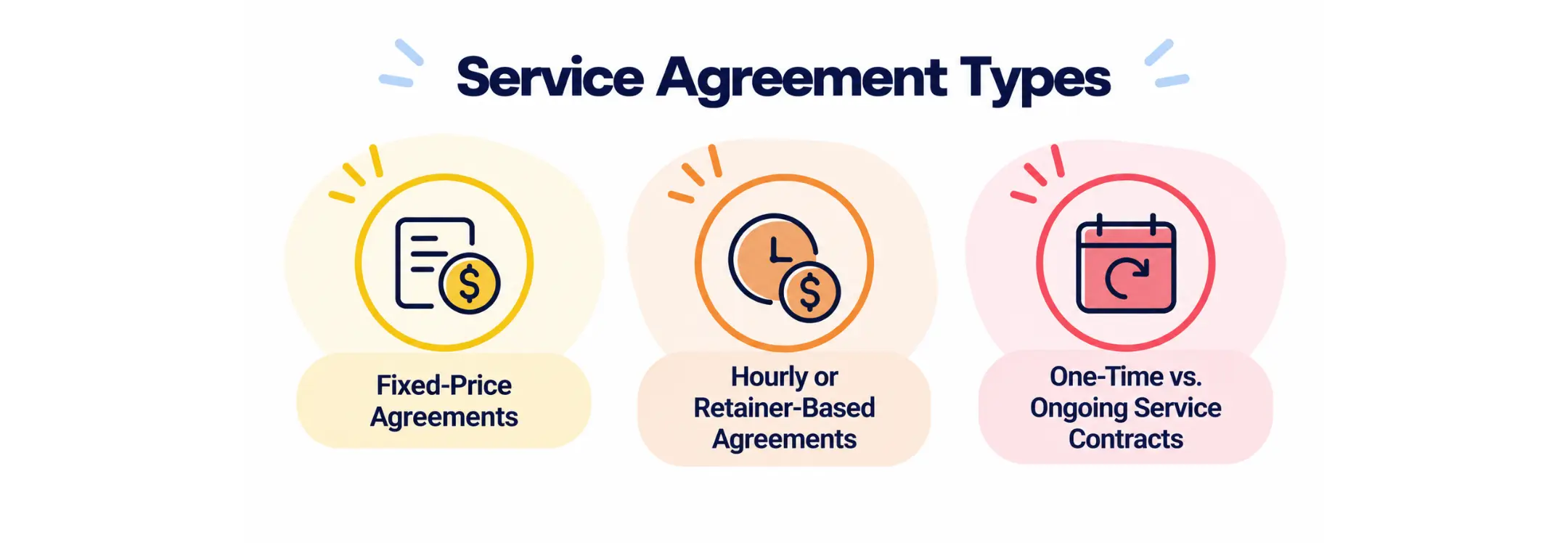
Fixed-Price Agreements
Fixed price agreements are used when the scope of work is very clearly defined and the provider can accurately estimate the time and resources required. The client pays a set amount for the entire project, which provides them with budget certainty. This type of agreement rewards the provider for efficiency, as they keep the entire fee regardless of how quickly they finish the work.
Hourly or Retainer-Based Agreements
Hourly agreements are best for projects where the total amount of work is unpredictable or the client's needs are likely to change. The provider bills for the actual time spent on the project, ensuring they are fairly compensated for all their work. Retainer based agreements involve the client paying a recurring monthly fee to guarantee the provider's availability for a set number of hours. This model is common for legal, accounting, and ongoing marketing services.
One-Time vs. Ongoing Service Contracts
One time contracts are designed for discrete projects with a clear beginning and end, such as a construction project or a single software installation. Ongoing service contracts, on the other hand, are intended for continuous relationships where the provider performs recurring tasks. These ongoing agreements often include automatic renewal clauses and provisions for periodic price adjustments to ensure the relationship remains sustainable for both sides.
Creating a Service Agreement with Ziji Legal Forms
Streamlining Legal Documentation
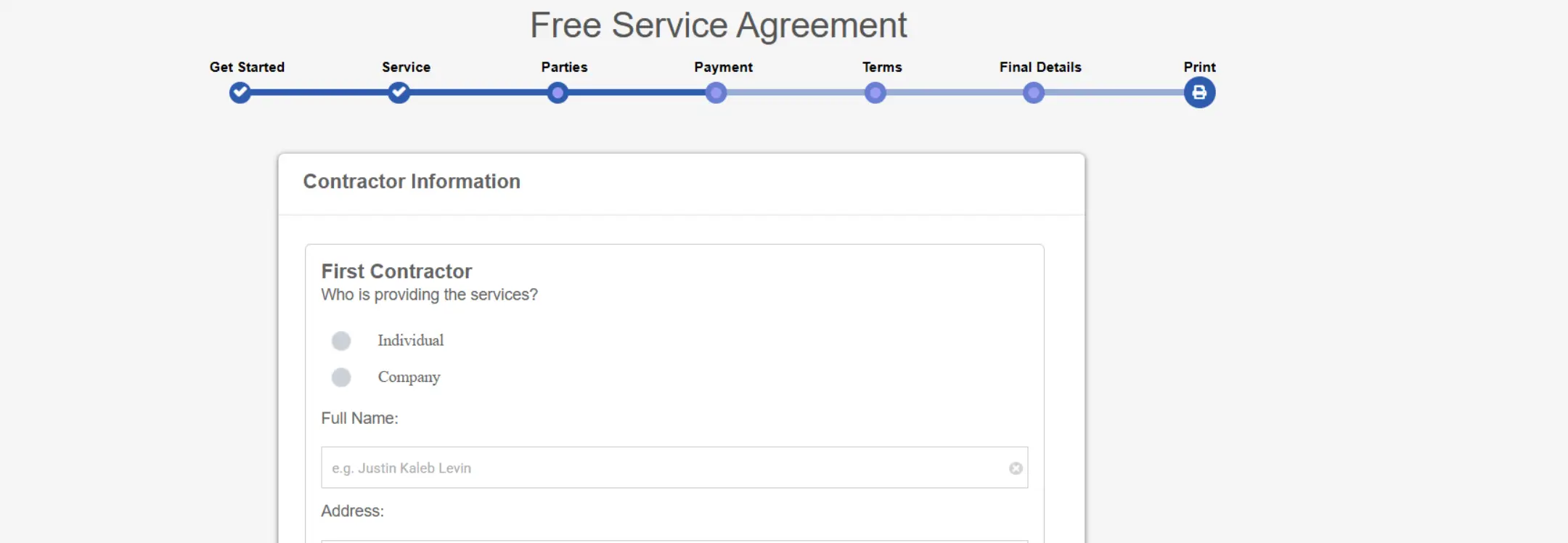
Creating a professional and legally sound service agreement does not have to be a complex or expensive process. By using Ziji Legal Forms, professionals can leverage pre-designed templates that incorporate the necessary legal protections for the US market. This allows even those without a legal background to produce documents that look professional and provide robust protection for their business. The 5-Step Generation Process
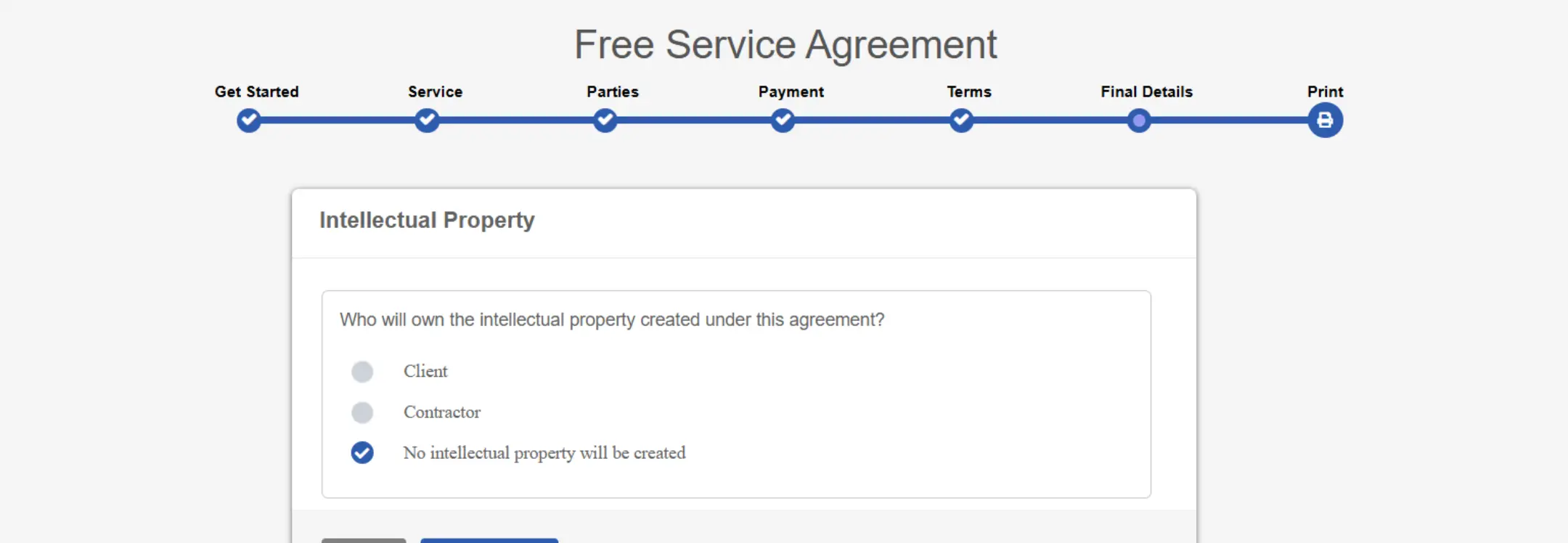
1. Select Template
Choose the Service Agreement template from the top menu under the business category on Ziji Legal Forms.
2. Enter Party Information
Add party details including the legal names and addresses of both the provider and the client.
3. Provide Payment
Information
Add payment details clearly stating the fees, the schedule of payments, and any late fees.
4. Enter Term
Information
Add term details specifying the start date, the end date, and the conditions for termination.
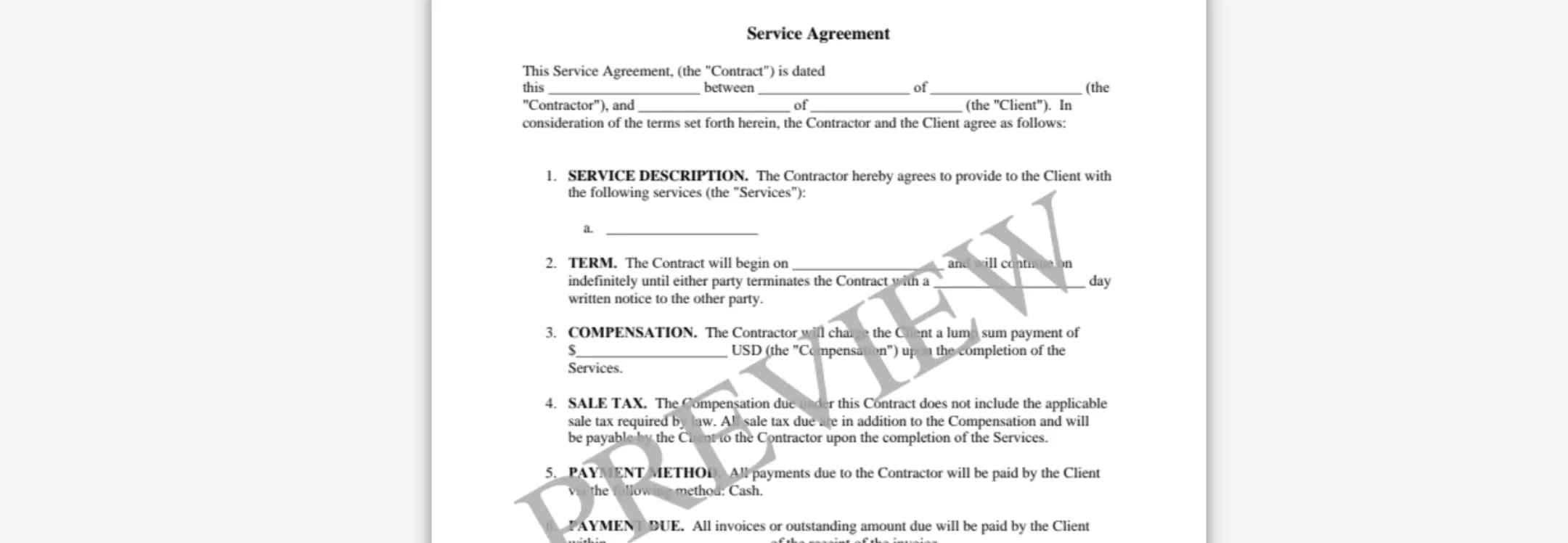
5. Preview Document
Preview and print the final document to ensure everything is correct before signing.
Benefits of Digital Standardized Forms
Using a structured online platform ensures that critical clauses such as confidentiality and dispute resolution are not accidentally omitted. It also provides a consistent format that makes it easier for clients to review and approve the agreement. In today's fast paced business environment, the ability to generate a high quality contract in minutes is a significant competitive advantage.
Common Mistakes to Avoid
Vague Scope of Work
The most common and most dangerous mistake in any service agreement is a vague scope of work. Using broad terms like "consulting" or "support" without defining specific tasks leads directly to scope creep and disputes. To avoid this, providers should use detailed task lists, set measurable goals, and explicitly list what is not included in the project. The more specific the scope, the less likely a misunderstanding will occur.
Missing Payment Terms
Failing to define the exact financial terms of the deal is a recipe for disaster. A contract must specify the total price, the invoicing cycle, and the due date for every payment. It is also important to include the consequences for late payments, such as a percentage based late fee. Clear payment terms protect the provider's income and ensure that the client understands their financial obligations from the beginning.
Ignoring Termination Clauses
Many professionals enter into a new relationship with high hopes and fail to plan for the possibility that things might not work out. A missing or poorly drafted termination clause can leave a party trapped in a bad contract or result in a sudden loss of income. A strong termination clause should provide a clear and fair way for either party to exit the relationship with adequate notice.
Not Defining Dispute Resolution
Assuming that you will always be able to work things out through conversation is a naive approach to business. Every service agreement should include a mandatory dispute resolution process that prioritizes mediation or arbitration over a public lawsuit. This protects both parties from the massive costs and reputational damage that often accompany traditional litigation in the United States.
Improper Worker Classification
A growing risk in the US is the misclassification of employees as independent contractors. The Department of Labor recently introduced a new 2024 rule that uses a multifactor economic reality test to determine a worker's status. If a service agreement is drafted in a way that gives the client too much control over the provider's work, the provider might be legally considered an employee. This can lead to heavy penalties for the client regarding unpaid taxes and benefits.
Neglecting Digital Signature Laws
With the shift toward remote work, most service agreements are now signed electronically. However, many businesses fail to ensure that their digital signing process complies with the E-SIGN Act and UETA. To be legally binding, the process must demonstrate a clear intent to sign, obtain consent to do business electronically, and ensure that a permanent record of the signed document is retained and accessible to all parties.
A well drafted service agreement is the single most important tool for ensuring the success of a professional relationship in the United States. It provides the clarity, security, and legal protection that both providers and clients need to operate with confidence. By utilizing structured templates and avoiding common drafting mistakes, you can safeguard your business interests and build a foundation for long term professional growth.
Service Agreement FAQs
1. What is a Service Agreement?
A Service Agreement is a legal contract that defines the terms of a working relationship between a client and an independent contractor.
2. When should I use a Service Agreement?
You should use a Service Agreement whenever you hire or provide services as an independent contractor to clearly define each party's rights and responsibilities.
3. How is a Service Agreement different from an Employment Agreement?
A Service Agreement is used for independent contractors, while an Employment Agreement is intended for employees and includes employment rights and obligations.
4. Is a written Service Agreement necessary?
Although verbal agreements may sometimes be enforceable, a written Service Agreement provides greater clarity and helps reduce the risk of disputes.
5. Can a Service Agreement be updated after signing?
Yes. Both parties can modify the agreement at any time, provided the changes are made in writing and agreed to by everyone involved.
6. Which jurisdictions can use the Ziji Legal Forms Service Agreement?
The Ziji Legal Forms Service Agreement is applicable in all jurisdictions across the United States.
Author
Mandar Sonavane
|
Legal Content Writer at Ziji Legal Forms Inc.
Symbiosis International University
Mandar is a legal content writer specializing in the development of clear, practical, and easy-to-understand legal resources. With a strong focus on legal research, content creation, and plain-language writing, he works closely with our legal professionals to ensure that legal documents and educational materials are accurate, accessible, and user-friendly. At Ziji Legal Forms Inc., Mandar is responsible for researching legal topics, drafting and reviewing content, and helping transform complex legal concepts into straightforward guidance that empowers individuals and businesses to confidently navigate their legal needs.
Reviewed By
Histon Shek
|
General Counsel and Co-Founder at Ziji Legal Forms Inc.
University of Alberta
Histon Shek was called to the Alberta Bar in 2006. He holds a BA in Sociology and Philosophy and an LLB from the University of Alberta. As co-founder of Ziji Legal Forms Inc., he focuses on making legal documents accessible and affordable, overseeing legal integrity and content development.




 United States
 Canada