
SERVICE AGREEMENT
Payment Terms in Service Agreements
Master professional payment terms in your service agreement to secure cash flow and prevent disputes using modern US standards.
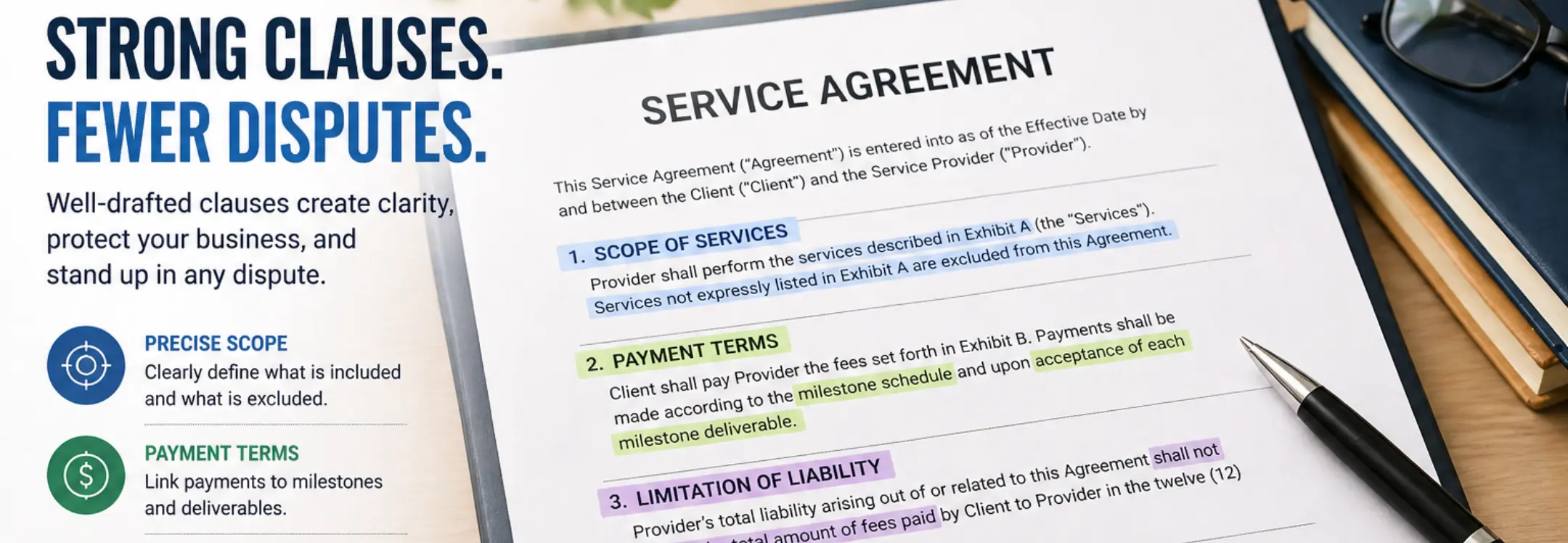
The scope of services is the most critical section of any agreement because it defines the boundaries of the work. A common mistake is to describe the services in general terms, which allows for scope creep where the client expects additional tasks for the same price. To write this effectively, the drafter should break the project down into specific tasks and deliverables. It is also highly effective to include a list of exclusions, which states exactly what the provider will not be doing.
A bad example of a scope of services clause would state that the provider will give marketing services and help with the brand launch. This is ineffective because it lacks deliverables and specific project boundaries. A good example would state that the provider will create three social media profiles and write ten blog posts of one thousand words each. It would also clearly mention that services do not include data migration or third party license fees to avoid any assumptions from the client side.
Payment clauses should be designed to maintain a healthy cash flow and prevent disagreements over the timing of compensation. A weak clause uses open ended language like payment is due upon completion, which can be problematic if the project is delayed or the definition of completion is contested. A strong clause links payments to specific, verifiable milestones or calendar dates. This creates a logical progression where the client pays as value is delivered.
An ineffective payment approach would be to state that the client will pay the invoice as soon as possible after receiving it. A more effective approach would be to specify that payment is due within fifteen calendar days of the invoice date. Furthermore, rather than saying the final balance is due when the project is finished, a strong clause would state that twenty percent of the total fee is due upon the successful delivery of the prototype. This level of detail ensures everyone knows the exact financial expectations.
A termination clause provides the necessary exit strategy for a business relationship that is no longer productive. Without a clear path to exit, the parties may find themselves trapped in an unfavorable deal or facing massive penalties for leaving. An effective termination clause distinguishes between termination for convenience and termination for cause. Termination for cause should be triggered by a material breach of the agreement that remains uncured after a specified notice period.
A weak termination example would state that either party can stop the work if they are not satisfied. A strong alternative would be to state that either party may terminate for convenience with sixty days prior written notice. It should also specify that termination for cause is allowed if a breach is not cured within ten business days. Additionally, a well drafted clause should address the return of company property and final payment for work completed up to the termination date.
Confidentiality provisions are essential for protecting proprietary information and trade secrets in a Service Agreement. A weak clause often uses an overly broad definition that covers all information, which may lead a court to find it unreasonable and thus unenforceable. To be effective, the clause must define exactly what is considered confidential and specify the permitted uses of that information. It should also include a duration for the obligation that is reasonable for the type of information being protected.
A bad approach to confidentiality would be to say that everything told to the provider is a deep secret. A better approach would be to specify that confidential information includes non public financial data and software source code. Rather than saying secrets must be kept forever, a strong clause would state that the duty of confidentiality shall continue for three years after the agreement terminates. It should also note that confidentiality does not apply to information that is required to be disclosed by law.
A major blind spot in poorly drafted service agreements is the failure to clearly define who owns the final work product. By default, independent contractors retain the copyright to their creations unless the contract includes explicit "work made for hire" language or a clear assignment of intellectual property rights.
To prevent disputes over ownership, the agreement must state precisely when the transfer of rights occurs, typically only after the client has paid the final invoice in full. If the provider uses proprietary tools or pre-existing code to complete the project, the clause should instead grant the client a non-exclusive, perpetual license to use those specific elements rather than transferring full ownership.
Limitation of liability clauses are designed to manage the maximum financial risk of a contract. They are among the most scrutinized clauses in a dispute because they can prevent a party from recovering full damages. A clause that is too restrictive, such as one that waives all liability for any reason, is frequently struck down by courts. To be enforceable, the clause should set a reasonable cap on damages and exclude indirect or consequential losses like lost profits.
An ineffective approach would be to claim that the provider will never be liable for any money to the client. A strong approach would cap total liability at the total amount of fees paid during the twelve months before the claim. It would also clarify that neither party is liable for indirect or consequential damages like lost revenue. Crucially, the liability limit must not apply to gross negligence or willful misconduct, and it should be formatted in bold or capital letters to be conspicuous.
A dispute resolution clause sets the rules for how legal fights will be handled. Many agreements fail because they do not specify a location for the trial or they choose a forum that is highly inconvenient for one side. A strong clause often utilizes a tiered approach that requires the parties to try to settle the issue before going to court. This usually begins with executive negotiations, followed by mandatory mediation, and ends with binding arbitration or litigation in a specific venue.
A weak dispute clause would simply say that any problems will be solved in a court of law. A much stronger version would specify that all disputes will be heard in the federal or state courts located in the home city of the provider. It would also mandate that parties must engage in a four hour mediation session before filing any formal legal claim. Finally, if arbitration is preferred, the clause should state that it will be administered by the American Arbitration Association under its commercial rules to provide a predictable framework.
Choosing where a dispute will be resolved is only half the battle; specifying which state's laws govern the contract is equally critical. In the United States, contract enforcement varies significantly by state. For example, a non-compete or strict indemnification clause that is perfectly valid under New York law might be completely void under California law.
To ensure predictability, a strong agreement must explicitly state both the governing law (the rules used to interpret the contract) and the venue (the specific court where a lawsuit must be filed). Neglecting this clause can force parties into a costly pre-trial battle just to determine where and how the actual legal dispute will be litigated.
Unexpected events like natural disasters, government shutdowns, or major cyberattacks can make contractual performance temporarily impossible. Without a robust force majeure clause, a service provider could be held in material breach for delays caused entirely by circumstances beyond their control.
A legally resilient clause should explicitly define what qualifies as an extraordinary event and outline the exact procedure for notifying the other party when such an event occurs. Crucially, it must also specify the consequences of a prolonged delay, such as allowing either party to terminate the agreement without penalty if the disruptive event continues for more than thirty consecutive days.
The phrase reasonable efforts is a staple of American legal drafting, but it is often a trap. Without an objective definition, it is impossible to know what level of effort is required. A court might look at industry standards, but those standards can be vague themselves. Drafters should consider replacing this with specific actions, such as making three separate delivery attempts. If the phrase must be used, it is vital to include a list of things that are not required, such as incurring a financial loss.
Contracts that use words like immediately or as soon as possible are also inherently weak. These terms are subjective and cannot be used to prove a breach of contract based on timing. A strong agreement uses specific periods of time, such as within five business days, to define all obligations. This clarity ensures that both parties are on the same page regarding the urgency of tasks and allows for the accurate calculation of damages if a deadline is missed.
Terms that are excessively favorable to one party are often a red flag for judges. For instance, a contract that requires the client to indemnify the provider for the provider's own negligence is likely to be viewed as unfair. Similarly, clauses that allow for automatic renewals without notice can be seen as predatory in certain contexts. A balanced contract that shares risk appropriately is much more likely to be upheld in a court of law. It also helps build trust and a more productive long term relationship between the parties.
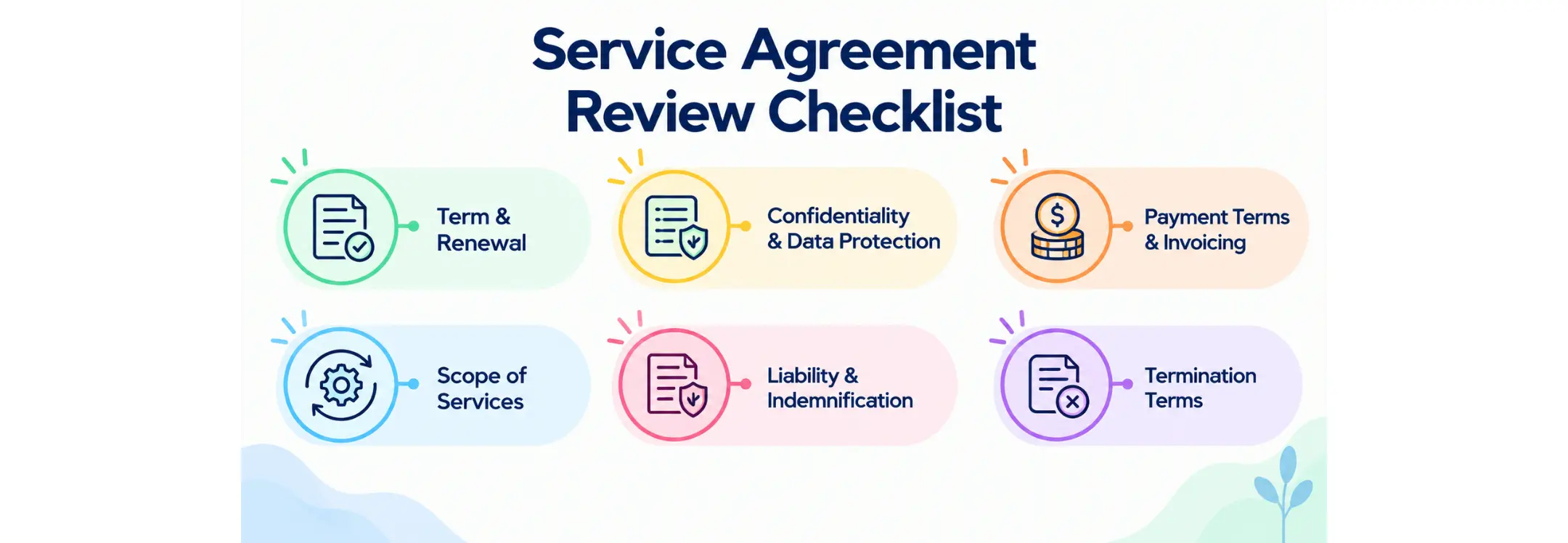
A final review is essential to catch errors that could undermine the entire agreement. This audit should focus on consistency and the practical application of the terms. Many legal disputes arise from simple administrative errors, such as using the wrong corporate name or referencing an exhibit that was never attached. A checklist approach can ensure that no critical detail is overlooked before the document is finalized.
The review process should involve multiple departments, including legal, finance, and operations, to ensure the contract reflects the reality of how the business works. A collaborative approach helps identify risks that a single reviewer might miss.
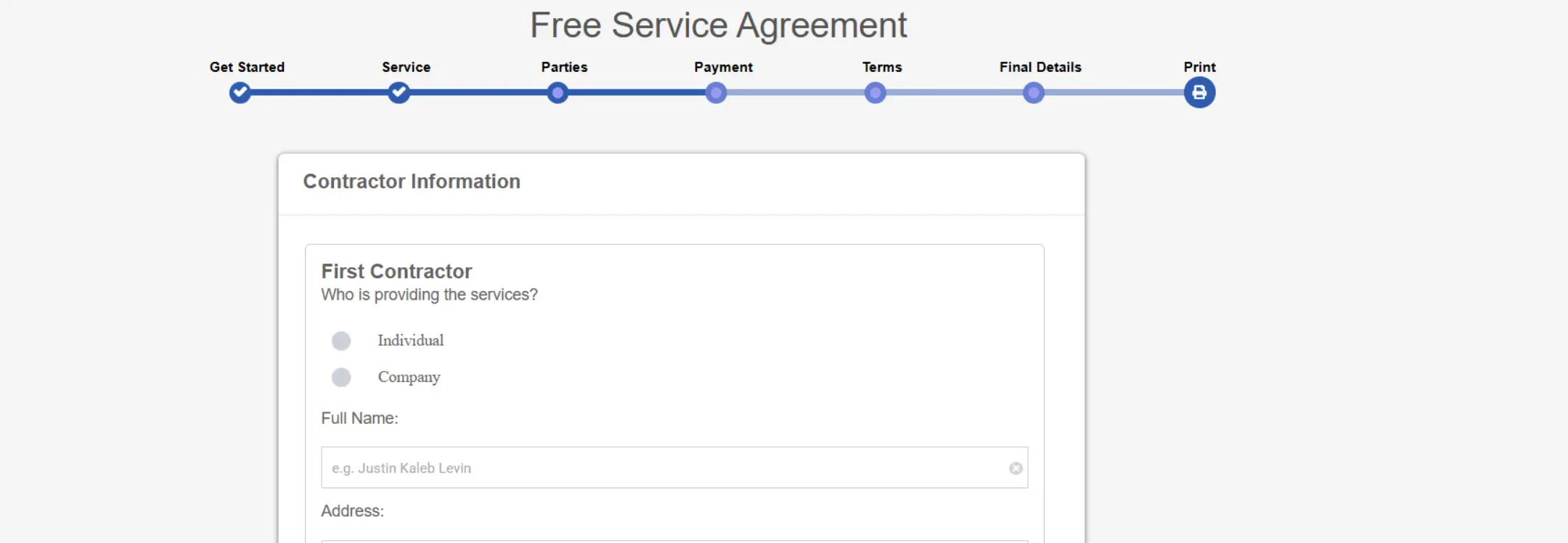
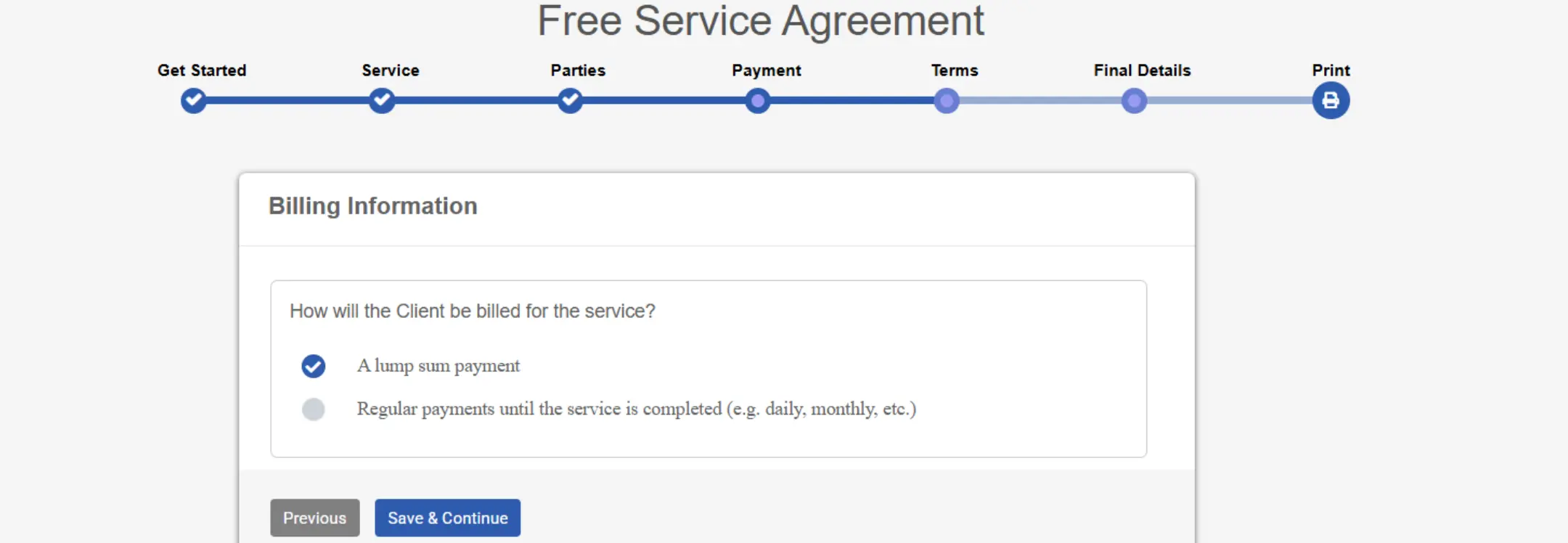
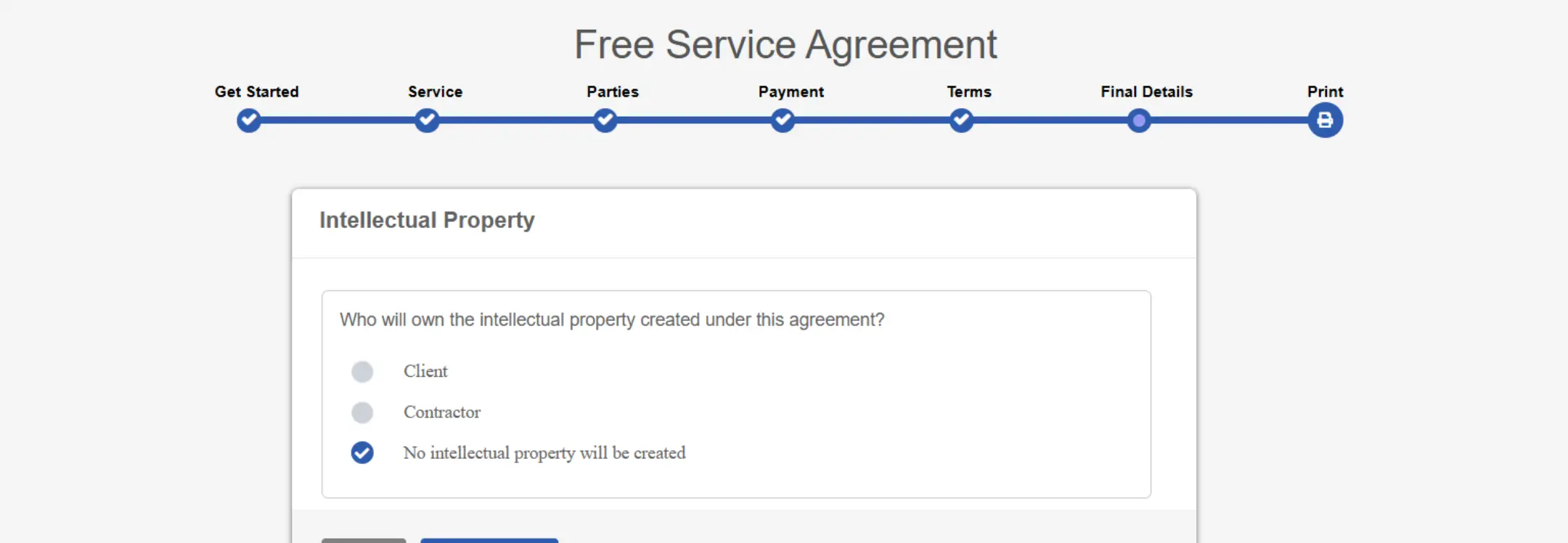
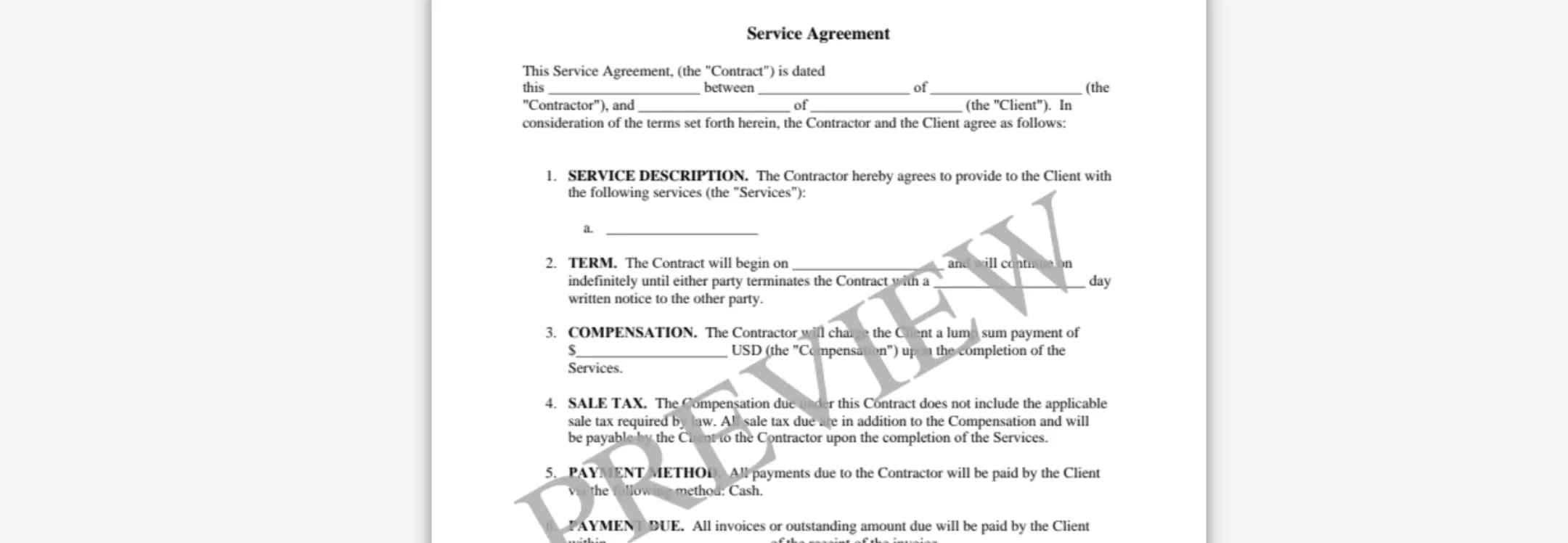
Master professional payment terms in your service agreement to secure cash flow and prevent disputes using modern US standards.

Expert guide on US service agreements, payment security, legal protection, and using Ziji templates to draft binding contracts.
Your review helps others make informed decisions and helps us improve our platform for everyone.

Ziji Legal Forms offers custom legal forms that are simple and easy to draft for use at very affordable prices.
We offer legal documents to help millions of users across the country that our customers can rely upon and trust.
 United States
 Canada