TL;DR- There is no single federal rule in the USA that sets a legal validity period for a Child Travel Consent Form, so practical acceptance depends on airlines, border officers, and organizations reviewing it.
- Single trip consent covering exact departure and return dates is the most widely accepted approach, especially for international travel with stricter scrutiny.
- Multi trip or recurring travel consent letters can work for repeated domestic trips, but older documents and vague date ranges are more likely to be questioned.
- Expired dates, long gaps between trips, changes in destination, or changes in the accompanying adult are common reasons officials expect a fresh Child Travel Consent Form.
- Best practice is to align the Child Travel Consent Form expiry with the planned trip window, add a short buffer, and renew for new trips rather than reusing an old letter.
- A Child Travel Consent Form created with a Ziji Legal Form Child template is easier to update, notarize, and present during checks.
Why Validity Is Easy to Misunderstand
Many parents assume that once a Child Travel Consent Form is signed, it remains usable indefinitely as long as parental authority has not changed. In reality, people who review these forms care a lot about timing. Airline staff, immigration officers, and school trip organizers look at how well the dates on the consent align with the actual trip and how recent the signature is.
When dates are missing, extremely broad, or several years old, officials may treat the consent as effectively expired, even without a formal legal expiry rule.
Is There a Legal Validity Period for Child Travel Consent Forms
No Single Federal Rule
United States federal law does not prescribe a universal expiry period for Child Travel Consent Forms. Agencies such as US Customs and Border Protection encourage parents to carry consent letters when a child travels without both parents but do not set a fixed legal validity window.
Because there is no single statutory date, practical validity is driven by how cautious each airline, immigration authority, or program decides to be.
Why Airlines and Authorities Apply Their Own Standards
Airlines and border officers are primarily concerned with preventing child abduction and ensuring that the adults traveling with the child have current authorization. If a consent letter is old, lacks specific dates, or refers to a prior trip, staff may question whether it still reflects the parents’ intent.
Schools, camps, and youth programs apply the same logic. They want assurance that the consent is clearly tied to the trip they are supervising now, not something signed years ago for unrelated travel.
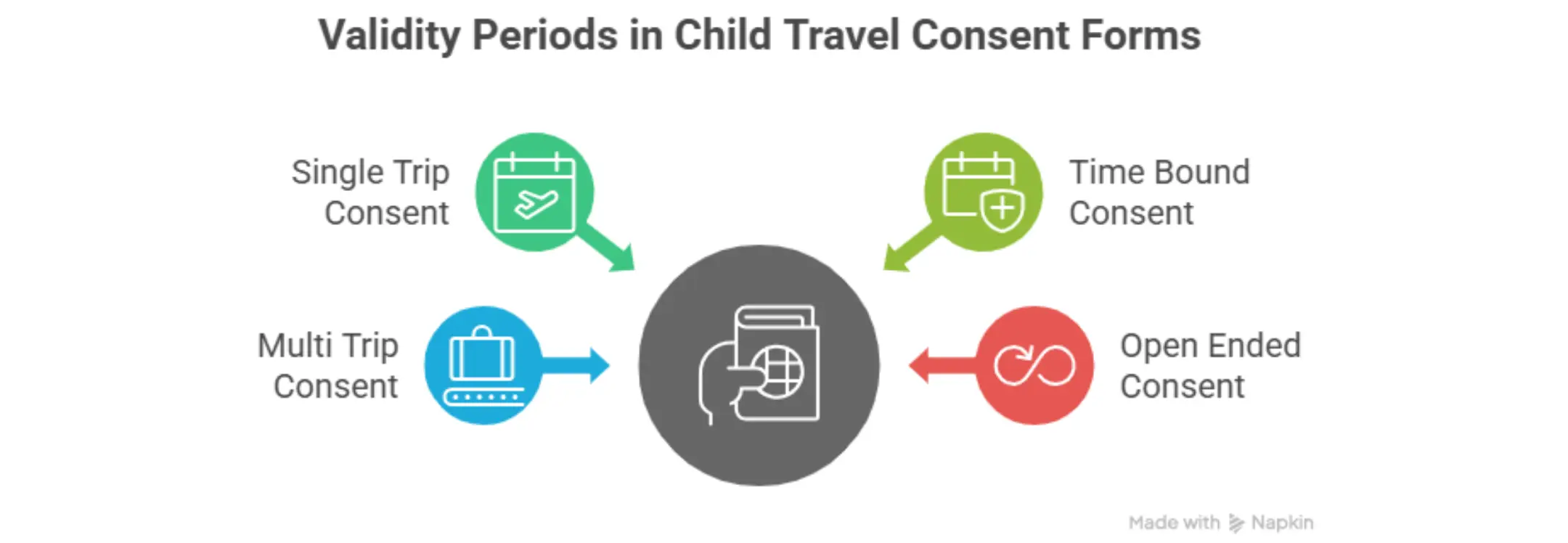
Common Validity Periods Used in Practice
Single Trip Consent
Single trip consent is a Child Travel Consent Form that clearly covers only one defined journey. It usually states specific departure and return dates, destination cities or countries, and the adult who will accompany the child.
This approach leaves little room for doubt. If the form dates match the itinerary, officials can see that the consent was given specifically for that trip.
Time Bound Consent with Specific Dates
Some parents prepare time bound letters that cover a broader window, such as “valid for travel with grandparents within the month of July” or “valid for travel in the 2026 summer vacation period.” This can work for multiple domestic trips, so long as the travel falls squarely within the stated range.
For international travel, shorter and more precise ranges are safer, because border officers tend to view tight date matching as a sign of authenticity and current intent.
Multi Trip or Recurring Travel Consent
In recurring travel situations, like regular visits between parents in different cities, parents sometimes issue multi trip consents covering a series of planned journeys in a defined period. When carefully drafted with clear start and end dates and a limited scope, this can be accepted, particularly for domestic travel or school term shuttles.
The more general the wording and the longer the period, the higher the chance that an official will question whether the parent truly gave advance consent to each specific trip.
Open Ended Consent and Why It Is Risky
Open ended consent phrases such as “valid until revoked” or consent without any dates may seem convenient. However, officials often view these as red flags. They offer no assurance that the parent still approves recent travel plans, especially if the letter is old or family circumstances have changed.
Because of this, open ended Child Travel Consent Forms are more likely to be doubted or effectively treated as expired in practice.
One Time Travel Versus Multiple Trips
When One Time Consent Is Recommended
For international trips, special events, or situations involving high scrutiny, a single trip Child Travel Consent Form is usually the safest choice. It precisely matches the itinerary, minimizing questions about the scope of parental authorization.
This is especially important when a child travels with only one parent, with relatives, or with non family chaperones.
When Multi Trip Consent May Be Acceptable
Multi trip consent can work well for repeated domestic travel in a short period, such as regular visits during one school term or multiple weekend tournaments for the same sports team. In those cases, the consent can list the general period and type of travel while still being reasonably specific.
Even then, parents should refresh the letter at least annually, so that officials and organizers see recent signatures and up to date details.
Risks of Reuse Across Different Destinations or Carriers
Reusing the same consent letter for new trips that involve different destinations, airlines, or supervising adults increases the risk of rejection. Officials may consider the reuse a mismatch between the original consent and the new travel context.
To reduce this risk, it is better to generate a new online Child Travel Consent Form for each major itinerary or change in carrier, especially when crossing borders.
Domestic Versus International Travel Validity Expectations
Short Domestic Trips and Camps
Domestic travel with children often encounters lighter scrutiny, especially for short flights or bus trips within the same country. Youth camps and school trips typically require consent that covers the duration of the trip or the season plus safety and medical authorizations.
Even for domestic travel, organizers frequently expect the consent to match the specific program dates, not just say “summer travel.”
International Travel and Shorter Acceptance Windows
For international travel, border officials are more cautious. They may look for consent letters signed close in time to the trip, especially for children traveling with one parent or with non parents. Older letters are more likely to draw questions.
Because of this, parents often treat Child Travel Consent Form expiry for international trips as one trip only and draft new letters for subsequent journeys.
Why Older Consent Letters Are Questioned
As more time passes, the chance increases that custody, parental relationships, or the child’s living situation has changed. Officials cannot easily verify whether a letter signed years ago still reflects the parents’ wishes. A recent Child Travel Consent Form template with updated dates and contact details gives them more confidence than a very old document.
How Expiry Dates Are Interpreted by Authorities
Airline Staff Versus Immigration Officers
Airline staff review travel documents to ensure that passengers meet basic requirements before boarding, often using internal policies to decide what is acceptable. Immigration officers assess whether documentation satisfies legal standards for entry or exit and whether there is any sign of abduction or trafficking risk.
Both groups may look at validity dates and signature dates, but immigration staff have broader authority to question or decline inadequate consent.
Why “Valid Until Revoked” Language Often Fails
Language that says a letter is “valid until revoked” offers no concrete timeframe. From an enforcement perspective, such wording leaves too much uncertainty. Officials cannot tell whether the parent still approves the specific trip taking place today.
Specific date ranges make it easier for them to see that the consent was written with this trip in mind.
Importance of Matching Dates with Tickets and Passports
The most credible Child Travel Consent Forms are those whose validity dates clearly align with the travel itinerary and passport dates. When officers see matching departure and return dates and a recent signature, the form appears intentional and current.
If the consent mentions a different year, different destination, or an outdated passport, they may treat it as expired or irrelevant.
Situations That Require a Fresh Child Travel Consent Form
Change in Travel Destination
If the child will be traveling to a different country or significantly different region than originally planned, a new consent form should be prepared to reflect that destination explicitly. A letter written for prior travel may not cover the new itinerary in the view of security staff or immigration officers.
Change in Accompanying Adult
If a child was originally meant to travel with one adult but will now travel with someone else, a fresh Child Travel Consent Form is essential. The form should always name the specific adult authorized to accompany the child on each trip.
Change in Custody or Legal Authority
Any change in custody, guardianship, or parental rights should trigger a new consent letter. Documents that predate such changes could be inconsistent with current legal authority, making officials reluctant to rely on them.
Long Gaps Between Trips
Even for multi trip situations, long gaps between trips are a reason to renew. A consent issued several years ago is more likely to be questioned, especially for international travel. Renewing for each season or year keeps expiry aligned with reality.
Best Practices for Setting the Right Validity Period
Choosing Realistic Travel Dates
Parents should match the Child Travel Consent Form expiry to real travel dates, listing a departure date and a return date that align with tickets and accommodation bookings. For single trips, the best practice is to set the validity slightly wider than the exact flights, but not excessively long.
Adding Buffer Days
Adding a modest buffer, such as a few days before departure and after return, accounts for schedule changes or delays. For example, a trip running from June 10 to June 20 might be covered by consent valid from June 8 to June 25.
This avoids technical expiry if travel plans move slightly without creating an overly broad window.
Aligning Consent Duration with Trip Purpose
For camps, school exchanges, or programs, validity should cover the entire program plus reasonable travel days. For recurring domestic travel over a term, a term based consent may work, so long as it remains short enough that officials still see it as current.
Aligning expiry with purpose helps everyone reading the form understand exactly which travel the parents have in mind.
Supporting Details That Strengthen Perceived Validity
Notarization and Its Impact
Notarizing a Child Travel Consent Form does not by itself set a validity date, but it signals that the parent’s signature was verified by an independent officer. Many carriers and border authorities view notarized consent as stronger evidence of authenticity, especially for international journeys.
Attaching Travel Itineraries
Including copies of flight confirmations or trip itineraries with the consent letter allows reviewers to see that the dates align. It gives them quick context about where the child is going, with whom, and for how long.
This extra documentation can reduce questions at check in or border control.
Including Passport Details
A good Child Travel Consent Form template will prompt for the child’s full name, date of birth, and passport number. Matching those details with the passport presented at the border reassures officers that the consent applies to this specific child, not just a generic name.
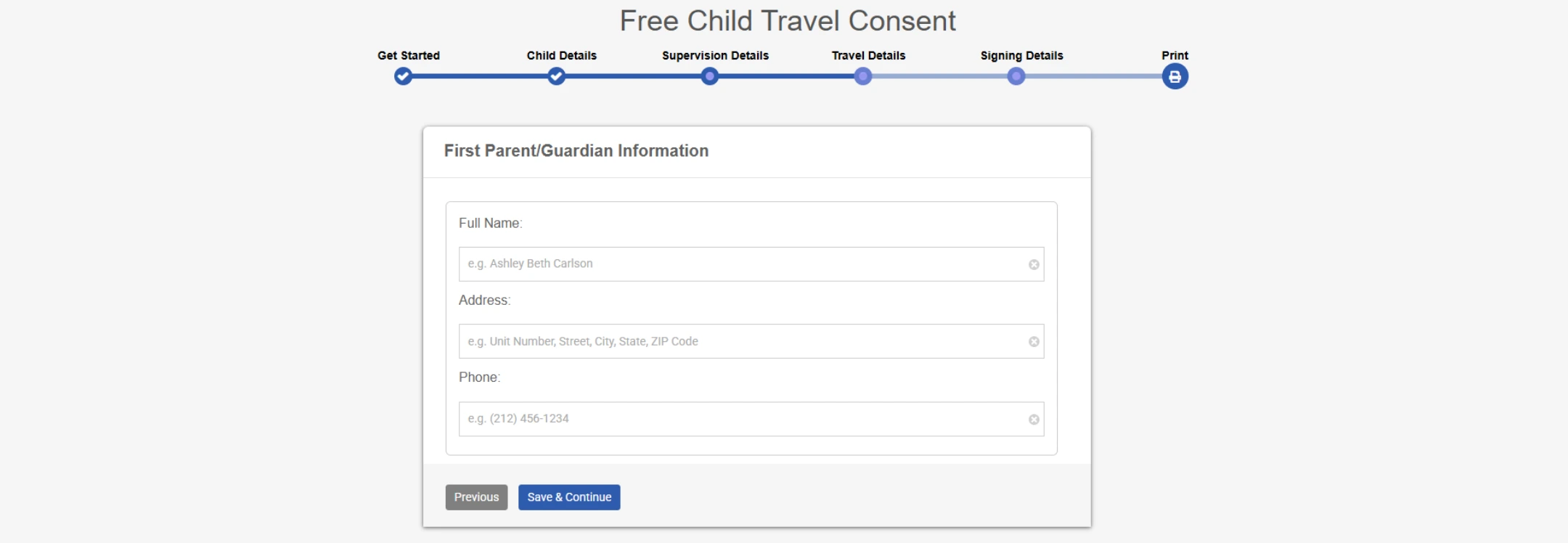
How to Create a Child Travel Consent Form Using Ziji Legal Forms
1. Choose template
2. Add Child Details
Enter the child’s full legal name, date of birth, passport details, and citizenship information so the form clearly identifies the traveler.
3. Add Supervision Details
Specify the accompanying adult’s full name, relationship to the child, contact details, and any temporary accommodation address so authorities know who is responsible during the trip.
4. Add Travel Details
Input departure and return dates, destinations, airline or carrier information, and whether the consent applies to a single journey or a defined period, making sure validity dates match the actual itinerary.
5. Signing Details, Preview and print
Add parent or guardian information, sign and date the form, consider notarization for international travel, then preview and download a clear Child Travel Consent Form PDF for printing and sharing with airlines, schools, and border officials.
Ziji’s online Child Travel Consent Form template guides parents to set specific validity periods, list correct destinations, and tailor consent to single or recurring travel, making it easier to refresh the form for each new trip instead of reusing outdated letters.
Conclusion: Treat Consent Validity as a Travel Detail, Not an Afterthought
How long a Child Travel Consent Form stays usable is less about a fixed law and more about whether the document clearly fits the trip at hand. Parents who align consent dates with actual itineraries, avoid open ended language, and refresh forms when destinations or caregivers change face fewer questions at airports and borders. With a well structured Child Travel Consent Form template and a simple process for generating updated letters, clarity on validity becomes a manageable part of travel planning rather than a last minute worry.
Child Travel Consent FAQs
What is a child travel consent also known as?
A child travel consent is also known as the following: child travel consent form, consent letter for travel, travel consent letter, or travel authorization letter/form.
What is a child travel consent form?
The child travel consent is a consent letter that grants authorization for a minor to travel alone or with another adult, and without their parents or legal guardians. This travel consent is required for both domestic and international travels when the parents or legal guardians are not present for the trip. Consider having a child travel consent form for each leg of the travel if the itinerary has multiple stops, especially for longer trips.
What age is considered a minor?
In most jurisdictions, once a person turns 18, that is the age of majority and that individual is considered an adult, however there are other jurisdictions that use 19 to 21 as the threshold. Typically, child travel consent forms are used for individuals under 18 years of age.
Why do you need a child travel consent form?
Child abduction is an issue that’s taken seriously by the authorities at the borders. A child travel consent is proof that the child has received parental consent to travel. Without signing a child travel consent, authorities at the border may prevent or delay your child’s travel plans.
There are many situations that require the use of a child travel consent, for example:
- When the parents are legally separated, the child is traveling with only one parent.
- When the child is traveling with a sports team, religious organization, or during a school trip.
- When the child is studying away from home in a boarding school.
- When the child is traveling with extended family such as aunts, uncles, and grandparents.
- When the child is traveling alone to meet extended family or parent/legal guardian.
Do I need to notarize my child travel consent form?
It is strongly recommended to have your child travel consent form notarized despite that it is not required in all jurisdictions. Having a notarized child travel consent form is the best proof that your child has permission to travel and will prevent any potential delays from border agents during your child’s travel.
Can a child travel consent cover multiple trips?
Yes. You can draft the form to cover more than one trip if the travel will be recurring, such as regular visits to relatives or ongoing participation in an extracurricular activity. However, including specific travel dates and destinations is recommended to avoid confusion with authorities.
Who can be authorized to travel with the child?
Any responsible adult who is at least 18 years old can be named in the form. This could include relatives, family friends, coaches, teachers, or group leaders. The chosen individual should be someone you trust to supervise your child and handle any travel-related issues that may arise.
What information should be included in a child travel consent form?
The form should list the child’s full name, date of birth, travel dates, destinations, and the accompanying adult’s full name and contact information. It should also include the parents’ or legal guardians’ names, contact details, and signatures, as well as any special instructions or relevant medical information.
Is a child travel consent required for domestic flights?
Some airlines may require additional documentation for minors traveling without both parents, even on domestic routes. It’s best to check with the airline in advance and have a consent form ready to avoid last-minute complications.
Why is notarizing a child travel consent recommended?
Notarization is not always required by law, but it adds an extra layer of authenticity to the document. A notarized form confirms that the signatures are genuine, which makes it more likely to be accepted by border officials, airline staff, and foreign authorities—reducing the risk of delays during travel.
What jurisdictions can use our child travel consent form?
You can use our template to create a legal and valid child travel consent form for the following jurisdictions:
Alabama Alaska Arizona Arkansas California Colorado Connecticut Delaware District of Columbia Florida Georgia Hawaii Idaho Illinois Indiana Iowa Kansas Kentucky Louisiana Maine Maryland Massachusetts Michigan Minnesota Mississippi Missouri Montana Nebraska Nevada New Hampshire New Jersey New Mexico New York North Carolina North Dakota Ohio Oklahoma Oregon Pennsylvania Rhode Island South Carolina South Dakota Tennessee Texas Utah Vermont Virginia Washington West Virginia Wisconsin Wyoming | AL AK AZ AR CA CO CT DE DC FL GA HI ID IL IN IA KS KY LA ME MD MA MI MN MS MO MT NE NV NH NJ NM NY NC ND OH OK OR PA RI SC SD TN TX UT VT VA WA WV WI WY |





 United States
 Canada