TL;DR- Child Medical Consent Forms do not have a single federal expiry rule in the USA, so validity depends on how each provider, school, or program interprets the document.
- Many schools, camps, and childcare programs treat consent forms as valid only for one school year or one program session, then require fresh forms.
- Hospitals and urgent care centers look at how old the signature is, whether the caregiver named is still current, and whether the information appears medically up to date.
- New or updated forms are usually needed when caregivers change, medical conditions or allergies change, custody status changes, or long gaps have passed since signing.
- Best practice is to treat Child Medical Consent Forms as time bound documents that are renewed at least annually or whenever key details change.
- An online Child Medical Consent Form created through Ziji Legal Forms' Child Medical Consent Form template is easy to update and reissue when validity periods expire.
Why Parents Assume Consent Forms Never Expire
Many parents treat a signed Child Medical Consent Form as a one time task that can sit in a folder indefinitely. The assumption is simple. If the signature is there, the form should work whenever a caregiver needs it. In real emergencies, however, medical staff and schools treat very old forms as questionable and sometimes unusable. They worry that medical conditions, caregivers, or custody may have changed since the form was signed.
Outdated consent can slow down decisions, force staff to track down parents by phone, or push providers to rely on narrow emergency consent rules instead of a clear written authorization.
Is There Any Official Expiry Date in the USA
No Single Federal Validity Rule
There is no single nationwide statute that sets a universal expiry period for a Child Medical Consent Form. Some federal and institutional medical consent documents use specific time frames, like 90 days or six months, but those limits apply to that document or policy rather than to all child medical consents in the country.
Private healthcare systems, camps, and schools therefore set their own policies around how long they will accept a signed consent as reliable. This is why the same Child Medical Consent Form PDF might be accepted for a year by one camp and only for a single session by another.
Why Different Organizations Apply Different Standards
Each organization faces different risk and operational pressures. Camps and schools want to be sure they have current allergy information and accurate emergency contacts. Hospitals want proof that the care giving arrangement is still accurate and that the signer still has legal authority to consent.
As a result, validity becomes a practical standard rather than a fixed legal expiry date. If a Child Medical Consent Form template does not specify dates, a cautious provider may still treat an old form as expired in practice.
Common Validity Periods Used in Practice
One Time or Event Specific Consent
Some consent forms are clearly event specific. A parent signs for a single field trip, weekend retreat, or camp session, and the consent language refers to that specific event window. Once the event is over, the consent is functionally expired, even if no formal end date is printed.
This structure is common where the risk profile is tied to a single activity, such as a camp or sports tournament.
Time Bound Consent with Start and End Dates
Many modern Child Medical Consent Form templates include explicit start and end dates. For example, a form might state that it is valid from June 1 through August 31 for a summer caregiver, or from the first day of school through the last day of that academic year.
By choosing clear dates, parents make it easy for medical staff to see that the consent matches the care giving period and is still intended to be in force.
Open Ended or Long Term Consent
Some forms are drafted without clear end dates, especially older or generic templates. While such consent might be technically valid in some settings, providers increasingly treat open ended forms with caution. If a form is several years old, staff may question whether the caregiver or medical conditions are still the same, even if no expiry is printed.
Open ended consent also complicates custody and guardianship changes. A caregiver listed years ago may no longer have legal authority today.
How Medical Providers Interpret Validity
What Hospitals Typically Check First
When a child arrives with a caregiver and a Child Medical Consent Form PDF, hospital staff usually check who signed the form, the date of signing, and the relationship between the signer, the child, and the current caregiver.
They also review whether the consent appears clearly intended for the situation at hand, such as routine treatment versus emergency procedures.
Why Old Signatures Raise Red Flags
A signature from many years ago suggests that medical conditions, medications, or custody could have changed. Hospitals know that outdated information can produce treatment errors or disputes about who had authority to consent. If a form appears stale, staff may try to reach a parent or legal guardian directly rather than relying solely on the old document, which can delay care.
Matching Consent Dates with Caregiving Arrangements
Providers also compare the dates on the form to the caregiving context. If a caregiver claims to have authority only for a particular summer, but the form date is outside that window, staff may doubt that the arrangement is still valid.
Time bound language in an online Child Medical Consent Form makes this much clearer and reduces the chance of hesitation during intake.
Situations That Require a New or Updated Consent Form
Change in Caregiver or Supervising Adult
If a child moves from one caregiver to another, such as from a grandparent to a nanny or from one camp to a different program, the old consent is not aligned with the new arrangement. A new Child Medical Consent Form should be issued to name the new supervising adult, including their contact information and authority scope.
Change in Medical Conditions or Allergies
New diagnoses such as asthma, epilepsy, diabetes, or serious food or drug allergies must be reflected in the consent form. An outdated form that omits these conditions gives providers incomplete information and may be treated as unreliable. Updating the medical details section is critical whenever a child’s health profile changes.
Change in Custody or Guardianship Status
If custody arrangements change through divorce, legal separation, guardianship orders, or adoption, the existing consent may no longer reflect who has authority to make medical decisions. In these cases, a new Child Medical Consent Form with updated legal relationships and signatures is essential.
Long Gaps Since the Form Was Signed
Even without specific changes in caregivers or conditions, a form signed several years ago is more likely to be questioned. Many organizations treat forms that are more than a year old as needing renewal to ensure addresses, phone numbers, and insurance data remain accurate.
School, Daycare, and Camp Validity Expectations
Annual Renewal Policies
Most schools, licensed childcare centers, and many camps require families to submit fresh Child Medical Consent Forms at least once per school year or program cycle. They do this to ensure they always have current medical details and emergency contact information.
Old forms from prior years are often rejected, even if nothing major has changed medically.
Field Trips and Overnight Programs
For field trips, overnight stays, and off site activities, programs often ask for separate event specific consent forms that cover that activity alone. This includes both permission to attend and consent for emergency treatment while away from the usual facility.
These forms usually carry dates that align with the trip and do not function as ongoing general medical consent.
Why Prior Year Forms Are Rejected
Programs understand that families move, phone numbers change, and insurance coverage shifts. If they rely on prior year forms, they risk calling wrong numbers or providing insurers with outdated policy information. Annual renewal reduces these risks and supports regulatory compliance.
Emergency Care and Implied Consent Limits
When Doctors Can Treat Without Written Consent
In genuine emergencies where delay would jeopardize life or cause serious harm, physicians can treat a minor without written parental consent under well established emergency doctrine principles. The focus is on immediate stabilization, not paperwork.
This doctrine allows care when no legal decision maker is available and when time spent searching for consent would be dangerous.
Why Implied Consent Does Not Cover Everything
Implied emergency consent is narrow. It does not automatically extend to non urgent procedures or ongoing treatment once the child is stabilized. For continued care, providers will still try to obtain explicit consent from a parent or authorized caregiver.
Relying solely on emergency doctrine therefore leaves gaps, particularly for complex care decisions.
How Written Consent Still Protects Decisions
A current, clearly drafted Child Medical Consent Form gives caregivers and providers a defensible basis for decisions that go beyond basic stabilization. It documents that an authorized adult considered and approved this delegation before the emergency occurred.
This can reduce disputes later about who had authority or what level of care was permitted.
Best Practices for Setting the Right Validity Period
Choosing Realistic Time Frames
For many families, a one year validity period works well, aligned with the school year or a recurring childcare arrangement. For short term travel or a single camp session, a narrower window tied to specific dates makes more sense.
Choosing realistic periods reduces the risk of both under coverage and over reliance on stale documents.
Aligning Consent Duration with Caregiving Needs
If a child stays with grandparents for a summer, the Child Medical Consent Form should clearly state dates that match that stay. If a nanny provides ongoing care during working hours, a one year consent that is revisited annually may be appropriate.
Aligning validity with real caregiving patterns helps medical providers trust that the form reflects actual day to day responsibility.
Adding Renewal Reminders
Because families are busy, it is helpful to add calendar reminders to update each Child Medical Consent Form PDF before it expires. Parents can set reminders at the start of each school year, before travel, or when medical reviews are scheduled.
Using an online Child Medical Consent Form makes these updates easier because parents can revise and reissue rather than drafting a new document from scratch. Before finalizing the document, review our guide on Mistakes to Avoid in a Child Medical Consent Form to prevent common drafting errors that cause delays or rejection by schools and healthcare providers.
How to Create or Update a Child Medical Consent Form Using Ziji Legal Forms
1. Choose Template
2. Add Parties Details
Enter the child’s full legal name, date of birth, address, parent or guardian details, and the caregiver’s name, relationship, and contact information to clearly identify everyone involved.
3. Add Medical Details
Record allergies, chronic conditions, current medications, immunization status, and physician contact information so providers have an accurate picture of the child’s health.
4. Add Consent Details
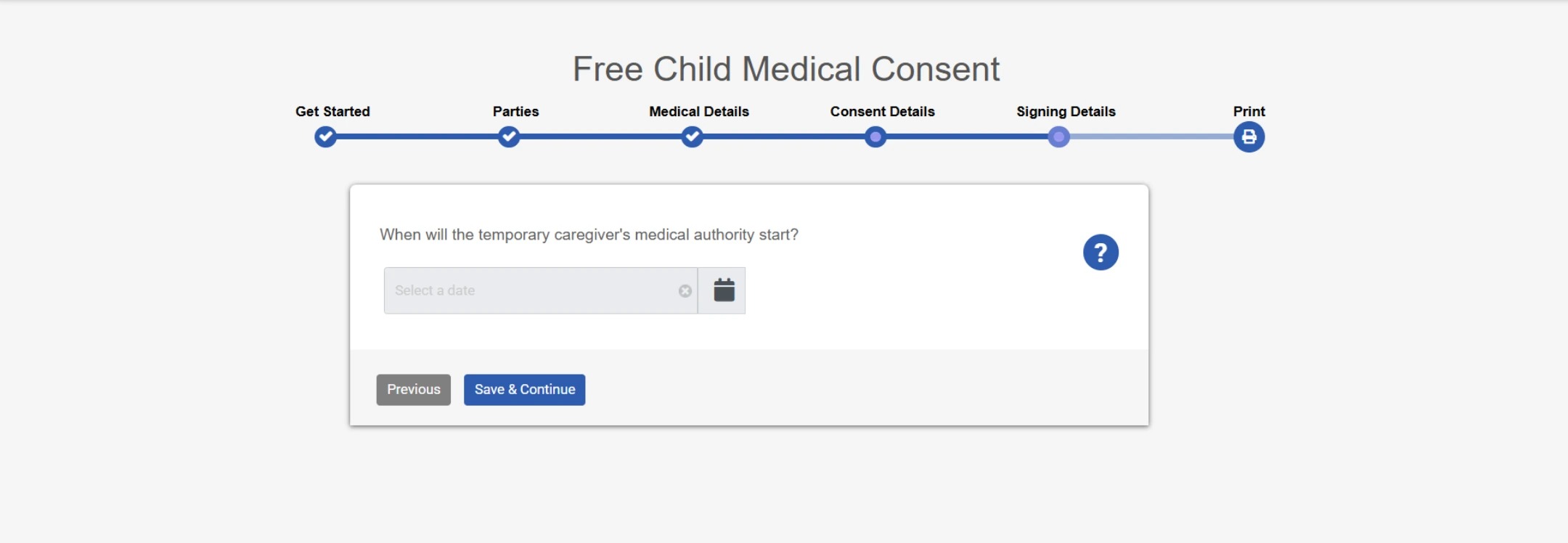
Specify what medical decisions the caregiver can make, define the validity period with clear start and end dates, and describe any limitations or procedures that require direct parental involvement.
5. Signing Details, Preview and print.
Have the parent or guardian sign and date the form, optionally add a notary for extra assurance, then preview and download in PDF format and share copies with caregivers, schools, and healthcare providers.
Ziji Legal Forms guided Child Medical Consent Form template helps parents set sensible validity periods, list the correct caregiver, and refresh existing forms quickly when circumstances change, rather than starting over every time. The result is an online Child Medical Consent Form that is current, clear, and ready for real world emergencies.
Conclusion: Keep Consent Current, Not Just Signed Once
A Child Medical Consent Form is only as useful as its accuracy and relevance to the child’s current life. Treating consent as a living document that is updated when caregivers, medical conditions, or school years change provides better protection than relying on a single old form. With a structured Child Medical Consent Form template and digital tools like Ziji Legal Forms, parents can maintain up to date consent that actually works when it matters most.
Child Medical Consent FAQs
1. What does a Child Medical Consent do?
It gives another trusted adult temporary authority to approve medical treatment for your child if you cannot be reached.
2. When is a Child Medical Consent recommended?
It is recommended whenever your child is staying with relatives, friends, caregivers, or traveling without you.
3. Who can serve as a temporary medical guardian?
You can appoint any trustworthy adult, including grandparents, relatives, family friends, teachers, or caregivers.
4. Should the consent form be notarized?
Although many states do not require notarization, having the form notarized can improve its acceptance during emergencies.
5. Can I withdraw the authorization later?
Yes. Parents or legal guardians may revoke the authorization whenever they choose.
6. Where can this Child Medical Consent form be used?
Ziji Legal Forms' Child Medical Consent form is applicable in all U.S. jurisdictions.
Author
Mandar Sonavane
|
Legal Content Writer at Ziji Legal Forms Inc.
Symbiosis International University
Mandar is a legal content writer specializing in the development of clear, practical, and easy-to-understand legal resources. With a strong focus on legal research, content creation, and plain-language writing, he works closely with our legal professionals to ensure that legal documents and educational materials are accurate, accessible, and user-friendly. At Ziji Legal Forms Inc., Mandar is responsible for researching legal topics, drafting and reviewing content, and helping transform complex legal concepts into straightforward guidance that empowers individuals and businesses to confidently navigate their legal needs.
Reviewed By
Histon Shek
|
General Counsel and Co-Founder at Ziji Legal Forms Inc.
University of Alberta
Histon Shek was called to the Alberta Bar in 2006. He holds a BA in Sociology and Philosophy and an LLB from the University of Alberta. As co-founder of Ziji Legal Forms Inc., he focuses on making legal documents accessible and affordable, overseeing legal integrity and content development.








 United States
 Canada