Independent Contractor Agreement FAQs
What is an independent contractor agreement also known as?
An independent contractor agreement is also known as the following: consulting service agreement, general service agreement, service agreement, or service contract.
What is an independent contractor agreement?
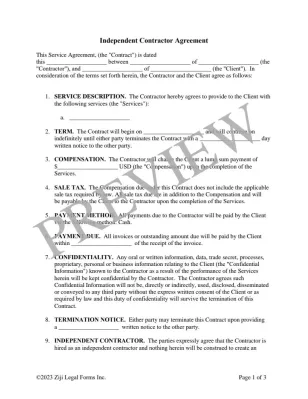
An independent contractor agreement is an agreement that outlines the terms and conditions of the service relationship between the contractor and the client. The independent contractor is not an employee of the client and generally will determine the process to achieve the client’s goal and target outcome.
What’s the difference between an employment agreement and an independent contractor agreement?
Employment agreement is reserved only for employees and it has specific tax implications and employment rights for the parties. Generally speaking, an independent contractor agreement should be used for contractors that are hired to perform certain services for the client. The contractor is independent from the client and will generally have more control in the work process used to meet the client’s goal, where as the employee’s work are directly under the control of the employer. Moreover, the employee never runs the risk of loss unlike an independent contractor. (e.g. Contractor agrees to provide catering to the client and agrees to having fresh lobster in the meal. The price of lobster more than double in the months leading up to the event so the food cost for the contractor increases from 30% to 55%)
When should I use an independent contractor agreement?
Virtually any service work provided by the contractor to the client will be applicable to the independent contractor agreement.
Some common work where an independent contractor agreement is used are:
- Photographer
- Musician
- Caterer
- Decorator
- Cleaner
- Landscaper
- Consultant
- IT service provider
- Web designer
- Construction and home renovator (e.g. plumber, electrician, carpenter etc)
- Child care worker (e.g. babysitter, nanny, daycare worker etc)
- Instructional provider (e.g. math tutor, music teacher, personal fitness trainer etc)
What should be listed in an independent contractor agreement?
Some general topics that should be covered in an independent contractor agreement are:
- The Parties: The name and address of the contractor and the client.
- The Work: Describe the service the contractor will be performing for the client. Itemize the duties in detail to ensure both sides understand what the expectations are for the agreement so there will not be an ambiguity in the agreement.
- Duration: How long the contract will last, whether it’s a fixed term that has a specific end date, or whether it’s for an indefinite period that has no end date for an ongoing service.
- Payment: List how much the service will cost and how the contractor will be paid, such as whether it’s a lump sum payment or whether it’s a regular periodic payment. Also list what payment method will be used to pay the contractor.
- Terms: What terms that the contractor and the client have agreed to in the contract in dealing with topics such as late payment and interest, work expenses, initial deposit, contract termination etc.
- Confidentiality: Prevents the contractor from sharing sensitive business information and trade secrets of the client.
- Intellectual property: Whether the service perform by the contractor will generate intellectual property rights and decide if the contractor or the client will own those intellectual property rights.
Can an independent contractor agreement be changed after it has been signed?
Yes. Any changes must be approved by both the contractor and the client. Amendments should always be documented in writing and signed by both parties to ensure the updated terms are clear and legally binding.
Is a written independent contractor agreement necessary?
While some jurisdictions may recognize verbal agreements, having a written contract is strongly recommended. A written agreement clearly sets out the rights, responsibilities, and expectations of both parties, reducing the chance of misunderstandings or disputes.
What happens if one party breaches the independent contractor agreement?
If either the contractor or client fails to follow the agreed terms, it may be considered a breach of contract. The non-breaching party may be entitled to remedies such as damages, termination of the agreement, or enforcement of the original terms, depending on the circumstances and applicable laws.
How is payment typically handled in an independent contractor agreement?
The agreement should specify how and when the contractor will be paid—whether as a lump sum, on an hourly basis, or in milestone payments. It should also outline the payment method and any applicable conditions, such as deposits, late fees, or reimbursement for expenses.
Does an independent contractor agreement need to follow local laws?
Absolutely. Regardless of the terms agreed upon, the contract must comply with the laws in the jurisdiction where the work is performed. Any clause that violates mandatory legal requirements—such as licensing rules, tax obligations, or health and safety standards—will generally be unenforceable.
What jurisdictions can use our independent contractor agreement?
You can use our template to create a legal and valid independent contractor agreement for the following jurisdictions:
|
Alabama
Alaska
Arizona
Arkansas
California
Colorado
Connecticut
Delaware
District of Columbia
Florida
Georgia
Hawaii
Idaho
Illinois
Indiana
Iowa
Kansas
Kentucky
Louisiana
Maine
Maryland
Massachusetts
Michigan
Minnesota
Mississippi
Missouri
Montana
Nebraska
Nevada
New Hampshire
New Jersey
New Mexico
New York
North Carolina
North Dakota
Ohio
Oklahoma
Oregon
Pennsylvania
Rhode Island
South Carolina
South Dakota
Tennessee
Texas
Utah
Vermont
Virginia
Washington
West Virginia
Wisconsin
Wyoming |
AL
AK
AZ
AR
CA
CO
CT
DE
DC
FL
GA
HI
ID
IL
IN
IA
KS
KY
LA
ME
MD
MA
MI
MN
MS
MO
MT
NE
NV
NH
NJ
NM
NY
NC
ND
OH
OK
OR
PA
RI
SC
SD
TN
TX
UT
VT
VA
WA
WV
WI
WY |






 United States
 Canada