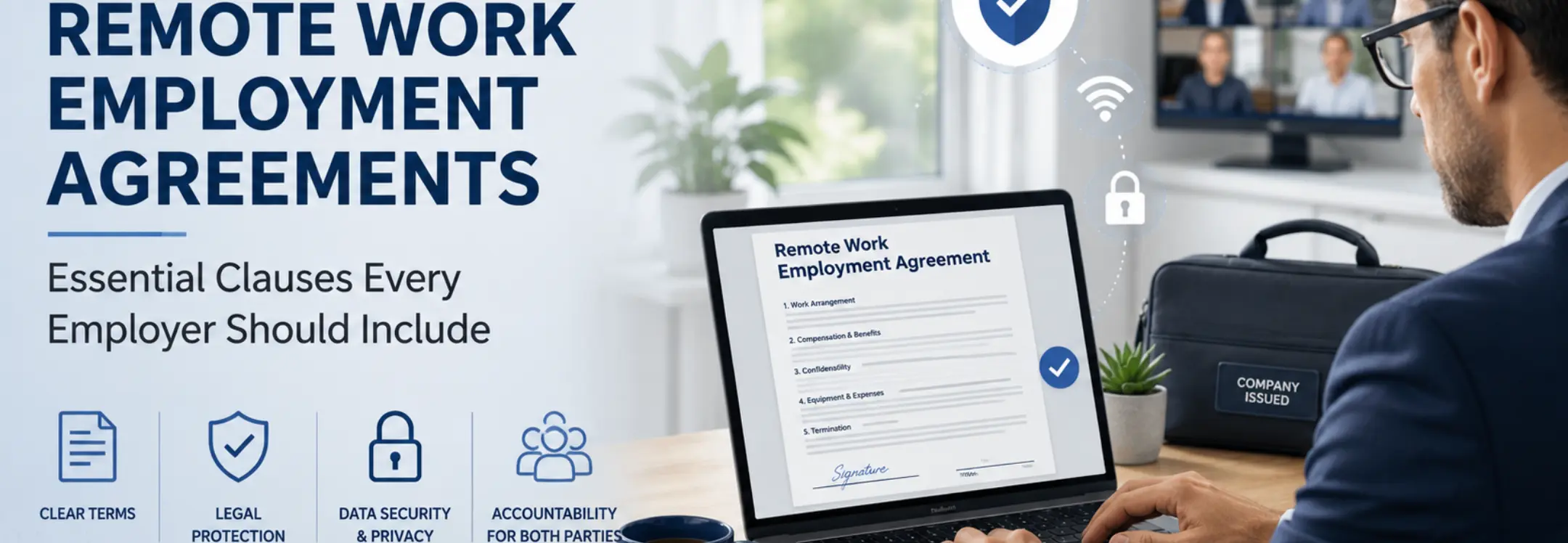
Remote and hybrid work arrangements have transitioned from temporary solutions into permanent features of the modern corporate landscape. Many businesses continue to hire off-site staff without adjusting their standard documentation, relying on traditional templates that fail to address the complexities of virtual work. This regulatory oversight exposes organizations to significant legal, financial, and operational liabilities.
A well-drafted Remote Work Employment Agreement helps establish clear expectations, protect vital company assets, and reduce costly legal risks. To secure compliance across a distributed team, employers should draft a dedicated Employment Contract USA to formalize the unique parameters of the off-site relationship.
What Is a Remote Work Employment Agreement?
Definition
A Remote Work Employment Agreement is a specialized contract or formal addendum designed specifically to address the terms of an off-site working relationship. This document modifies the standard employment terms by defining the exact parameters under which an employee performs their professional duties outside of a traditional corporate facility. By establishing a clear legal framework, this agreement ensures that both parties understand their rights and obligations in a virtual environment. It acts as a customized Online Employment Contract that governs remote daily operations while maintaining compliance with federal labor standards.
Why Standard Employment Contracts May Not Be Enough
Relying on standard documentation is often insufficient for virtual arrangements due to several critical operational shifts. Standard templates do not address the unique data security concerns that arise when employees access proprietary databases from residential networks. When sensitive company information is processed outside of physical corporate walls, businesses face heightened risks of data breaches and unauthorized access. Furthermore, equipment ownership issues frequently lead to disputes if the contract does not clearly state who is responsible for providing, maintaining, and returning high-value devices.
Additionally, standard agreements fail to clarify remote productivity and communication expectations, which can lead to performance declines and misunderstandings. Without explicit provisions, managing core working hours, virtual meeting participation, and prompt digital response guidelines becomes highly challenging. Finally, multi-state compliance considerations introduce severe regulatory risks when employees work across different jurisdictions. Because local tax rules, leave benefits, and wage standards vary significantly across state lines, employers must use a comprehensive Remote Work Employment Contract to address these diverse requirements.
Why Employers Need a Written Remote Work Agreement
Clarifies Expectations
Drafting a structured Remote Work Employment Agreement offers major benefits, starting with clarifying daily expectations. It establishes clear boundaries by defining exactly when the employee must be online, how output is measured, and what communication tools are acceptable. This structural clarity helps remote staff maintain professional standards and align with corporate goals.
Protects Confidential Information
Protecting confidential information is another key reason to establish a written Online Employment Agreement. Residential workspaces present unique security challenges, making it essential to formalize data protection rules. A dedicated contract details the exact technical safeguards, such as encrypted connections and secure document storage, required to protect trade secrets.
Reduces Workplace Disputes
A detailed contract also reduces workplace disputes by proactively resolving common points of friction. Disagreements regarding equipment maintenance, personal internet expenses, and shift schedules can quickly escalate into formal grievances or wage claims. Addressing these items in writing ensures that both parties share a unified understanding from the first day of employment.
Supports Legal and Regulatory Compliance
A tailored contract supports legal and regulatory compliance under federal labor standards. Federal regulations govern remote employee rights, guaranteeing fair wages, medical leave, and equal opportunity. A written agreement provides essential documentation demonstrating that the business complies with mandatory hours-worked tracking and overtime laws.
Creates Accountability for Both Parties
Finally, a formal agreement creates accountability for both parties, establishing a balanced professional partnership. It outlines the specific responsibilities of the worker and the employer, ensuring that operational flexibility does not undermine administrative control. This mutual commitment helps protect the organization from liability while supporting a productive off-site culture.
Essential Clauses Every Remote Work Employment Agreement Should Include
Employee Work Location Clause
The employee work location clause is a foundational element that defines the primary physical worksite, typically the employee's residence. Employers must include strict notification and approval requirements before a worker can relocate their home office to another address or state. This location lock is essential to manage multi-state tax and compliance implications. Unapproved relocations can unexpectedly trigger corporate tax nexus and subject the business to unfamiliar state labor laws.
Work Schedule and Availability Clause
A precise work schedule and availability clause should establish core working hours and availability expectations during the business day. The agreement must address time zone differences, especially when managing a team distributed across multiple regions. For non-exempt workers, the clause must outline strict policies regarding overtime authorization to comply with the Fair Labor Standards Act, which mandates overtime pay for hours worked over forty in a workweek.
Job Duties and Performance Expectations
This section must reinforce that basic job duties and performance expectations remain completely unchanged despite the virtual setup. Employers should define clear, objective performance metrics to evaluate the worker's contributions effectively. Outlining regular reporting requirements and deliverables ensures that managers can track productivity without relying on constant physical supervision.
Communication Requirements
To maintain operational cohesion, the agreement must specify approved communication channels, such as secure corporate messaging applications or video platforms. It should outline clear virtual meeting attendance expectations, ensuring that remote workers remain integrated with the broader team. Additionally, defining response time guidelines prevents communication delays and keeps workflows moving efficiently.
Equipment and Technology Clause
The equipment and technology clause must define the terms of employer-provided equipment, specifying who owns, maintains, and replaces the hardware. It should also govern the use of employee-owned devices, establishing clear security controls. Crucially, the agreement must outline strict procedures for the prompt return of all company property upon the termination of employment.
Expense Reimbursement Clause
Under federal guidelines, employers must address business-related expenses like home internet and mobile phone usage. While federal law does not mandate general reimbursement, the Fair Labor Standards Act kickback rule prohibits employers from shifting business expenses to workers if doing so drops their net pay below the minimum wage or cuts into overtime. To maintain compliance, companies often provide a flat monthly stipend coupled with a process to request additional reimbursement.
Confidentiality and Data Security Clause
A comprehensive confidentiality clause must mandate specific protocols for handling sensitive corporate data in a home setting. The contract should require strong password standards and restrict the use of public Wi-Fi networks unless a secure virtual private network is utilized. It must also establish clear data breach reporting obligations, requiring the employee to notify the IT department immediately of any security incident.
Intellectual Property Ownership Clause
To protect proprietary innovations, the agreement must establish clear intellectual property ownership rules. It must state that all software, designs, content, and inventions created during employment belong exclusively to the employer. By applying a clear work for hire framework, the business ensures that it retains full legal rights to any work product developed by the employee during working hours.
Monitoring and Privacy Clause
Employers must carefully draft the monitoring and privacy clause to comply with the Electronic Communications Privacy Act and the Stored Communications Act. The agreement should clarify that employees have a reduced expectation of privacy when using company-owned devices and networks. It must state that the company may monitor digital activities for legitimate business purposes, ensuring these practices do not interfere with protected concerted activities under the National Labor Relations Act.
Health and Safety Clause
The health and safety clause must address the home office environment while aligning with federal safety standards. Under the general duty clause of the Occupational Safety and Health Act, employers must provide a workplace free from recognized hazards. Although federal inspectors do not conduct home office inspections, employers should offer ergonomic guidance to help workers self-assess their setups.
Furthermore, the agreement must outline strict guidelines for reporting workplace injuries sustained while working remotely. Remote employees are generally covered by workers' compensation policies if the injury occurs during work activities and within established work hours. For recordkeeping purposes, injuries are work-related only if they are directly connected to paid duties rather than general home hazards.
Remote Work Revocation Clause
The remote work revocation clause must preserve the employer's absolute right to modify or revoke off-site working privileges. It should outline the specific conditions under which an employee may be required to return to the physical office, such as performance concerns or changing corporate needs. This clause ensures that working from home remains a flexible operational benefit rather than a permanent legal entitlement.
Additional Clauses Employers Should Consider
Cybersecurity Requirements
Employers should consider including a specific cybersecurity requirements clause to enforce advanced safety protocols. This section should mandate multi-factor authentication, regular system updates, and mandatory security training. By establishing these rules, businesses significantly reduce the likelihood of malware infections and unauthorized network intrusions through remote access points.
Bring Your Own Device
Policies
If employees utilize personal devices for work, a dedicated Bring Your Own Device (BYOD) policy is critical. The clause must define which corporate platforms can be accessed and detail the company's right to monitor and remotely wipe business data. This measure prevents the commingling of personal files and sensitive corporate intellectual property.
International Remote Work Restrictions
International remote work restrictions are essential to mitigate severe corporate tax risks. Employing workers in other countries can trigger permanent establishment, subjecting the company to foreign corporate taxes and payroll rules. Under the latest international tax guidelines, working abroad for more than fifty percent of total working hours over twelve months can create a taxable presence. The agreement must explicitly prohibit international telecommuting without prior corporate authorization to prevent unintended tax liabilities.
Non-Compete and Non-Solicitation Provisions
Drafting non-compete and non-solicitation provisions requires careful attention to shifting federal standards. Following the striking down of the federal non-compete ban, agencies rely on case-by-case enforcement actions evaluated under the rule of reason. Meanwhile, local rules continue to restrict these agreements based on worker compensation. To ensure enforceability, these clauses must be narrowly tailored to protect legitimate business interests.
Business Travel Requirements
The agreement should specify travel expectations, detailing who bears the costs of travel to the primary corporate office. A clear policy based on federal travel guidelines can state that local travel within a standard commuting radius is not reimbursable. However, travel from outside the commuting area or to client sites must be reimbursed in accordance with company travel policies.
Common Mistakes Employers Make in Remote Work Agreements
Failing to Address Data Security
Employers frequently make critical mistakes when structuring remote arrangements, starting with failing to address data security. Many organizations assume that basic residential Wi-Fi is sufficient, leaving proprietary data exposed to interception. Failing to require encrypted virtual private networks or private connection rules leaves sensitive databases highly vulnerable to virtual breaches.
Not Defining Working Hours
Another frequent error is not defining working hours clearly, which leads to disputes regarding unapproved overtime and makes it difficult to track non-exempt hours worked. Without specific scheduling rules, employers struggle to manage productivity and face elevated risks under the Fair Labor Standards Act.
Ignoring State Employment Laws
Ignoring state employment laws represents another severe risk, as local jurisdictions enforce distinct rules regarding meal breaks and mandatory benefits. Organizations that apply a single administrative standard to a multi-state remote workforce risk severe labor penalties and class-action litigation.
Unclear Equipment Ownership Rules
Leaving equipment ownership rules undefined complicates the recovery of corporate property upon termination. Without written terms stating that devices must be returned immediately, businesses frequently lose track of high-value laptops, phones, and peripheral hardware.
Using Generic Employment Contract Templates
Finally, using generic templates that lack specific remote clauses leaves the company vulnerable to compliance gaps and operational disputes. Standard documents simply do not feature the location, monitoring, or expense reimbursement terms required to manage a virtual team safely.
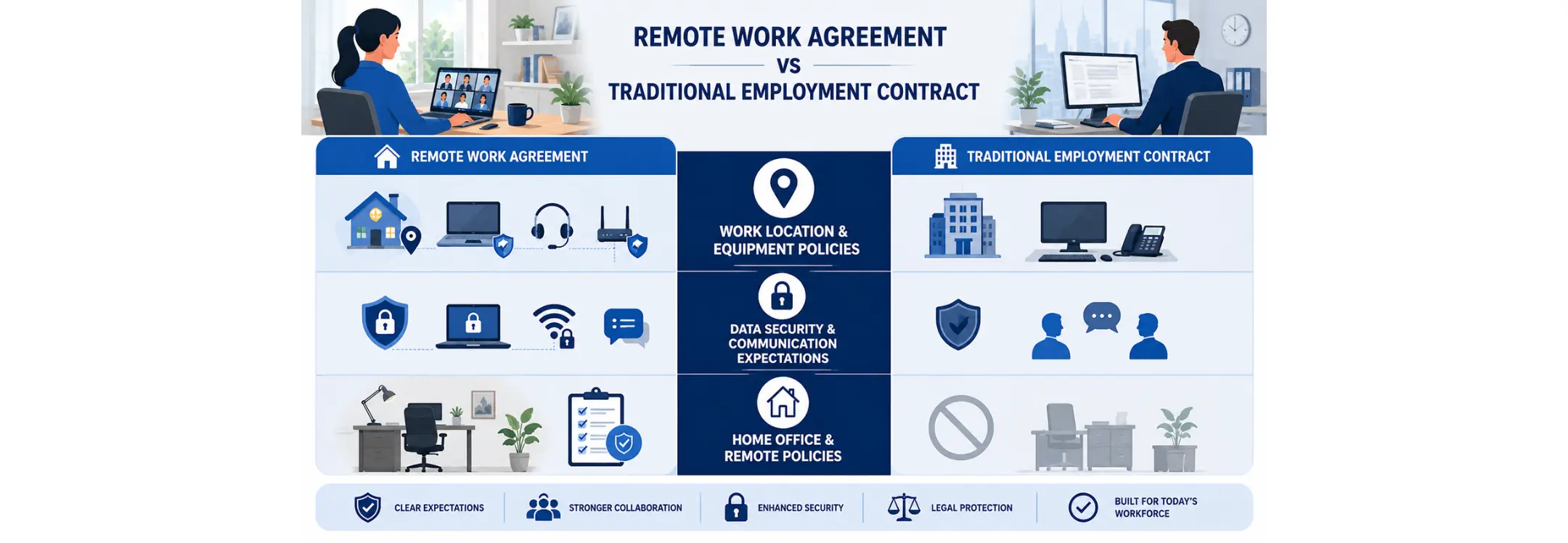
Remote Work Agreement vs Traditional Employment Contract
Work Location and Equipment Policies
When comparing a traditional Employment Agreement to a remote-focused document, several structural differences emerge. A traditional contract specifies an office-based physical work location where the employer maintains direct control over the physical environment. Equipment policies in traditional agreements are typically minimal because all work tools are provided on-site. In contrast, a Remote Work Employment Contract must explicitly define home-based coordinates and feature detailed equipment terms that outline maintenance, security, and return protocols.
Data Security and Communication Expectations
Furthermore, data security requirements differ substantially between the two structures. Traditional contracts rely on basic security measures because the work is completed within a secure corporate network. Remote agreements require extensive technical safeguards, mandating encrypted virtual private networks and private Wi-Fi rules to protect sensitive databases. Communication expectations are usually implied in a physical office, whereas remote agreements must clearly define approved digital channels, virtual meeting attendance, and response guidelines to keep teams aligned.
Home Office and Remote Policies
Finally, home office requirements are entirely absent from traditional contracts because the corporate facility is maintained by the employer. Remote agreements must incorporate specific health, safety, and workspace guidelines to support ergonomic standards and manage injury risks. While traditional agreements omit remote policies, a remote-focused Employment Contract template contains a comprehensive set of rules governing scheduling, virtual monitoring, and remote revocation privileges.
Legal Considerations for Multi-State Remote Employees
Tax Implications
Managing a distributed workforce across state lines requires a deep understanding of multi-state tax implications. Under the convenience of the employer rule enforced by several jurisdictions, a remote worker's wages may be taxed in the employer's home state even if they perform all duties out-of-state. This rule applies when the employee works remotely for their own convenience rather than out of corporate necessity, emphasizing the need for clear location terms in the contract.
Wage and Hour Compliance
Wage and hour compliance also varies significantly when employees work from different states. Under federal rules, employers must pay the minimum wage and overtime of the state where the employee physically performs the work. Because local wage rates and overtime calculations often exceed federal standards, organizations must carefully track the coordinates of each remote worker to prevent wage compliance violations.
State-Specific Employment Laws
Additionally, employers must comply with state-specific employment laws regarding mandatory meal and rest periods. Failing to provide legally required breaks can result in severe wage claims and statutory penalties. Local laws also govern leave and benefit requirements, mandating specific sick leave or medical leave benefits based on where the worker is physically based.
Leave and Benefit Requirements
Local rules also mandate unique benefit programs, including paid family leave, disability insurance, and local workers' compensation rates. These benefit programs are usually tied directly to the state where the work is performed rather than the employer's corporate headquarters. This jurisdictional shift requires employers to regularly update their benefit allocations to match the local mandates of each remote employee.
Why Employers Should Review Local Regulations
Because of these diverse local rules, employers must consistently review regional regulations to ensure ongoing compliance. Relying on a single national policy can lead to severe regulatory disputes, unpaid tax assessments, and expensive legal challenges. Businesses should align their agreements with local standards to protect their operations and maintain an equitable working relationship with every off-site worker.
How Ziji Legal Forms Helps
To simplify the drafting process, businesses can Create Employment Agreement documents tailored specifically for remote work using Ziji Legal Forms. This professional platform offers customizable templates that protect corporate interests and support regulatory compliance.
Using an Online Employment Agreement from a trusted provider ensures that the final document is structured logically and addresses vital virtual operational needs. This approach is ideal for growing organizations, startups, and small businesses that need legally sound contracts without the high expense of traditional legal consultations.
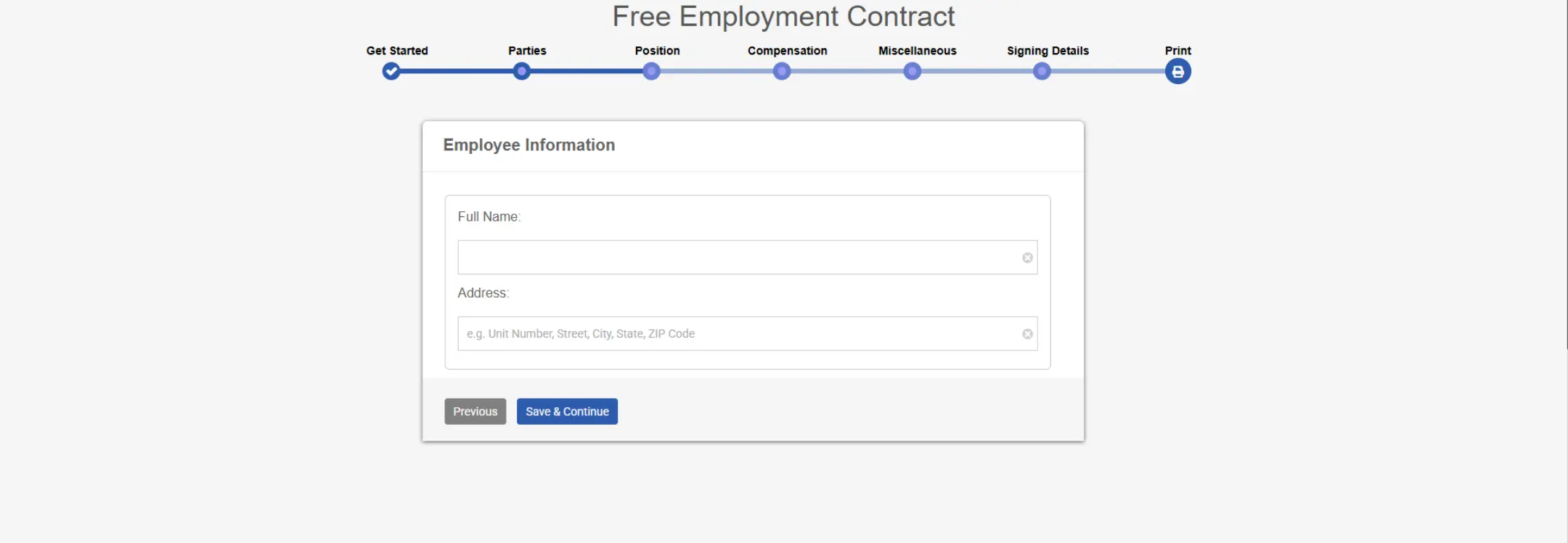
Steps to Create Your Agreement using Ziji Legal Forms
Creating a legally sound Remote Work Employment Agreement is a straightforward process when using the platform.
Enter the detailed organization and employee information to define the parties.
3. Add the Position and Job Role Details
Define the remote work arrangements, including the approved physical work address.
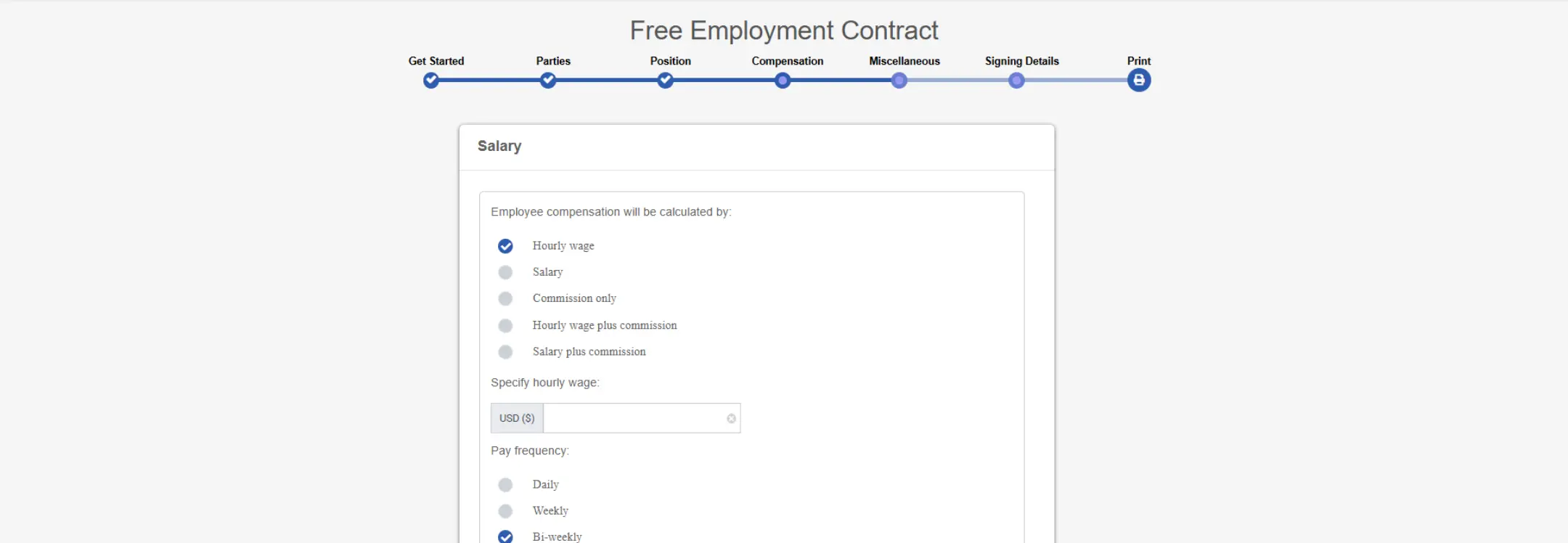
4. Add Copensation Details
Enter the specific compensation, schedule, and policy terms.
5. Download and Preview
Download the completed agreement and check thoroughly before electronic signing.
Conclusion
Drafting a tailored Remote Work Employment Contract is a vital step for any business employing off-site staff in the modern economy. Standard corporate agreements are simply not equipped to manage the complex wage, safety, and security challenges associated with remote operations. By formalizing clear clauses on location, data security, expense reimbursement, and monitoring, employers protect their intellectual property and support regulatory compliance. Utilizing professional resources like the templates on Ziji Legal Forms allows businesses to draft these documents efficiently and with confidence. A well-structured agreement establishes clear mutual expectations, ensuring a productive and legally secure virtual workplace.
Employment Contract FAQs
1. How does an Employment Contract protect employers and employees?
It clearly sets out the terms of employment, helping both parties understand their rights, obligations, and expectations.
2. Who benefits from an Employment Contract?
Both employers and employees benefit from having a written agreement that defines the employment relationship.
3. Is an Employment Contract the same as an Independent Contractor Agreement?
No. Employment Contracts are intended for employees, while Independent Contractor Agreements are used for independent contractors.
4. Should every employee have a written Employment Contract?
Yes. A written Employment Contract helps reduce misunderstandings and provides stronger legal protection for everyone involved.
5. Can a signed Employment Contract be modified?
Absolutely. Both parties may update the agreement at any time by documenting the changes in writing.
6. What jurisdictions are covered by the Ziji Legal Forms Employment Contract?
The Ziji Legal Forms Employment Contract can be used in all jurisdictions throughout the United States.
Author
Mandar Sonavane
|
Legal Content Writer at Ziji Legal Forms Inc.
Symbiosis International University
Mandar is a legal content writer specializing in the development of clear, practical, and easy-to-understand legal resources. With a strong focus on legal research, content creation, and plain-language writing, he works closely with our legal professionals to ensure that legal documents and educational materials are accurate, accessible, and user-friendly. At Ziji Legal Forms Inc., Mandar is responsible for researching legal topics, drafting and reviewing content, and helping transform complex legal concepts into straightforward guidance that empowers individuals and businesses to confidently navigate their legal needs.
Reviewed By
Histon Shek
|
General Counsel and Co-Founder at Ziji Legal Forms Inc.
University of Alberta
Histon Shek was called to the Alberta Bar in 2006. He holds a BA in Sociology and Philosophy and an LLB from the University of Alberta. As co-founder of Ziji Legal Forms Inc., he focuses on making legal documents accessible and affordable, overseeing legal integrity and content development.






 United States
 Canada