TL;DR- Temporary employment contracts provide short-term arrangements for seasonal work, event staffing, or project-based roles that may not continue beyond specific windows without guaranteed future employment.
- Fixed term employment contracts establish direct employment with predetermined end dates for defined periods, providing full employment rights during the contract duration.
- In the US, even fixed term roles are typically subject to termination without cause unless the contract explicitly limits the employer's right to terminate early.
- Temporary contracts typically involve shorter duration measured in days or weeks, while fixed term contracts specify clear start and end dates with broader responsibilities.
- Fixed term contracts work well for maternity leave coverage, grant-funded projects, and temporary replacements while temporary contracts suit seasonal surges, event staffing, and administrative support.
- Both contract types require clear clauses specifying duration, compensation, benefits eligibility, termination rights, and renewal conditions to ensure legal compliance and prevent disputes.
- Ziji Legal Forms provides customizable templates for employment contracts with guided fields helping employers select the correct structure for their staffing needs.
Introduction: Flexibility in Employment Arrangements
Not all hiring situations require permanent employees who will work indefinitely. Many businesses experience seasonal demand spikes, temporary project needs, or unexpected staffing gaps from employee leaves. Temporary employment contracts and fixed term employment contracts provide flexibility for these situations while establishing clear expectations and legal compliance.
Understanding when to use each contract type and what provisions to include protects employers from misclassification liability while ensuring employees receive appropriate rights and compensation for their arrangements. In the United States, the key principle of at will employment shapes how these contracts work. Employers can typically terminate employment at any time unless the contract explicitly prevents early termination which makes clarity about termination rights especially important.
What Is a Temporary Employment Contract
Definition and Purpose
A temporary employment contract establishes a short-term work arrangement without guaranteed future employment or expectation of continuation beyond a specific assignment. These contracts typically last days, weeks, or months, addressing immediate staffing needs without permanent position commitments.
Temporary arrangements often occur through staffing agencies that jointly employ the temporary worker while providing services to client companies. Alternatively, companies hire temporary workers directly for specific short-term needs. Either arrangement can be classified as temporary employment.
Common Temporary Work Situations
Seasonal work represents the most common temporary arrangement, including retail staffing during holiday shopping, tax preparation during tax season, or agricultural work during harvests. Event staffing for conferences, festivals, or special occasions provides another significant temporary employment category.
Short-term administrative support fills gaps from employee absences or handles temporary project needs. Holiday season hiring, back-to-school retail expansion, and inventory management during peak periods all utilize temporary workers.
Typical Durations and Renewal Rules
Temporary contracts typically specify durations ranging from a few days to several months. Unlike fixed term contracts with clear end dates, temporary arrangements often remain flexible regarding exact duration, though they should specify maximum time frames or renewal conditions.
Renewals of temporary contracts are not guaranteed and depend on continuing business need. Repeatedly renewing temporary contracts can potentially trigger permanent employee classification in some jurisdictions if the pattern suggests ongoing, indefinite work.
What Is a Fixed Term Employment Contract
Distinguishing Fixed Term from Temporary
A fixed term employment contract establishes direct employment between the company and employee with a predetermined end date specified in the contract. Unlike temporary arrangements that may involve agency employment or remain indefinite in duration, fixed term contracts create formal employment relationships with defined endpoints.
Fixed term employees are directly employed with full employment rights and protections equivalent to permanent employees during their contract duration, including anti-discrimination protections and wage and hour compliance. However, in the US context, these contracts may still preserve the employer's right to terminate without cause unless the agreement explicitly restricts that right.
Typical Use Cases for Fixed Term Contracts
Covering employee absences like maternity leave, medical leave, or sabbaticals represents a primary fixed term use. These contracts provide continuity while the permanent employee is absent, with understanding that the arrangement ends when the employee returns.
Grant-funded or time-limited projects require fixed term hiring when funding or project scope has predetermined endpoints. Employers bringing in specialized expertise for defined goals use fixed term contracts to align employment duration with project completion.
Full-Time and Part-Time Variations
Fixed term contracts can be structured as full-time or part-time positions depending on business needs. Part-time fixed term arrangements work well for project support, seasonal or periodic services, or supplementary staffing.
Benefits eligibility and compensation structures apply differently to part-time fixed term roles, though employees still maintain statutory protections and employment rights during the contract term.
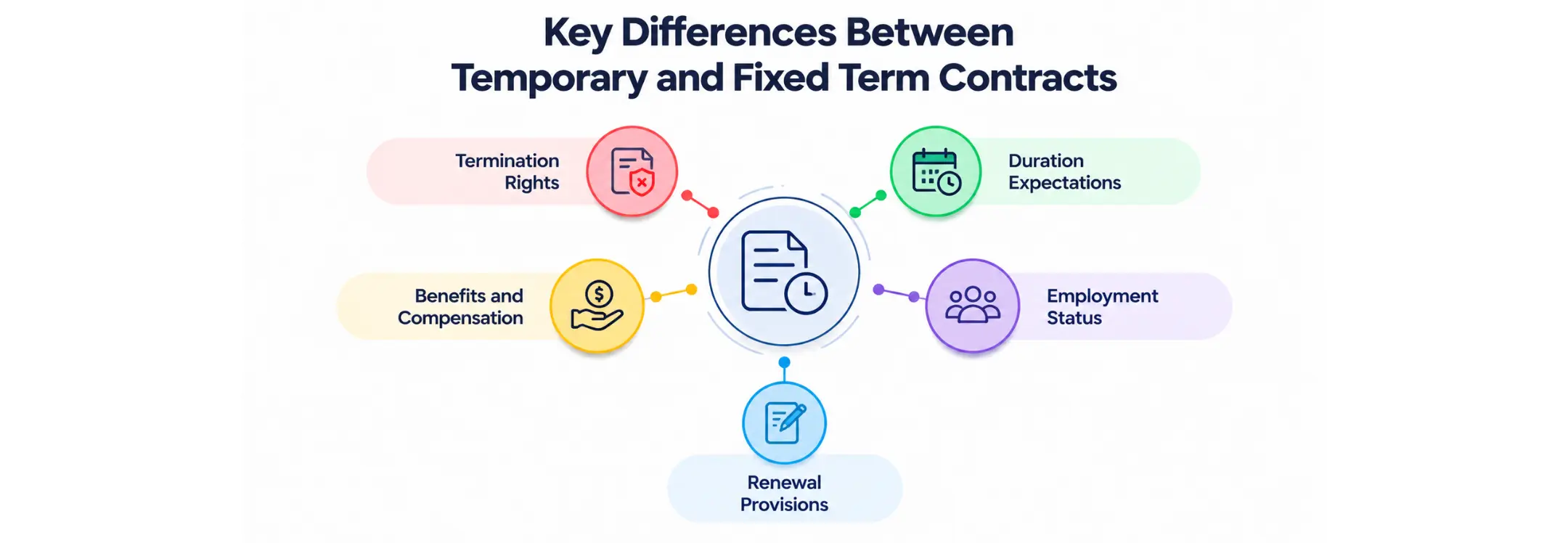
Key Differences Between Temporary and Fixed Term Contracts
Duration Expectations
Temporary contracts typically have shorter, less formally defined durations measured in days, weeks, or months. Fixed term contracts specify clear start and end dates with formal duration commitments measured in months or years.
Temporary arrangements often lack predetermined endpoints, with duration depending on ongoing business need. Fixed term contracts establish firm endpoints that determine when employment automatically terminates unless renewed.
Employment Status and Rights
Temporary workers, especially those through agencies, may have different employment status than direct employees. Fixed term employees are directly employed with full employment rights and protections equivalent to permanent employees during the contract period.
Both temporary and fixed term arrangements provide statutory minimum wage, holiday pay, and working time protections. However, fixed term employees typically qualify for unfair dismissal protections and redundancy rights sooner than temporary workers.
Termination Rights and Commitment Level
In the United States, a critical distinction lies in how the contract addresses early termination. Temporary contracts typically preserve the employer's right to terminate at any time without cause, consistent with at will employment principles. Fixed term contracts should clearly specify whether the employer can terminate early without cause or whether the employer commits to employment through the stated end date except for defined cause.
If a fixed term contract is silent on early termination, employees may argue that the employer promised employment for the entire term, potentially creating liability for breach if the employer ends the role prematurely. Explicit language about termination rights prevents this ambiguity.
Renewal and Continuation Provisions
Temporary contracts may or may not be renewed, depending on business needs. Renewal is optional and discretionary, with no obligation to continue employment beyond the original arrangement.
Fixed term contracts can be renewed through explicit new agreements, but automatic renewal does not occur. After multiple consecutive fixed term contracts, employees may gain permanent status through operation of law in some jurisdictions.
Benefits and Compensation Structures
Temporary employees may receive limited benefits, sometimes only statutory minimums like holiday pay and minimum wage. Fixed term employees typically receive comparable benefits to permanent employees on pro-rata bases reflecting their contract duration.
Fixed term contracts often provide pension contributions, health insurance eligibility, or other benefits equivalent to permanent staff. Temporary arrangements frequently exclude discretionary benefits unless specifically included.
Notice Periods and Termination Rights
Temporary contracts may allow minimal or no notice periods for termination, reflecting at will principles. Fixed term contracts should explicitly state whether the employer can terminate early without cause and what notice or pay (if any) applies in that scenario.
Fixed term contracts that limit early termination to defined cause provide stronger employee security but create corresponding employer obligations. Clarity on this point is essential to prevent disputes if business conditions change and the employer needs to adjust staffing.
When Employers Should Use a Temporary Contract
Seasonal Work and High-Demand Periods
Use temporary contracts for retail staffing during holiday seasons, agricultural work during harvests, or tax preparation during peak season. These arrangements clearly address predictable, periodic surges requiring additional workforce beyond permanent staff capacity.
Temporary classification for seasonal work requires documenting that the need is genuinely seasonal and that the employee understands no continued employment is guaranteed after the seasonal period ends.
Event Staffing and Campaign-Based Work
Temporary contracts suit event staffing for conferences, festivals, or special occasions with defined start and end dates. Campaign-based roles for limited-duration marketing initiatives or special projects also fit temporary classification.
These arrangements clearly have predetermined endpoints when events conclude or campaigns finish, making temporary classification appropriate and defensible.
Short-Term Administrative Support
Temporary contracts work for covering employee absences of a few weeks or less, handling one-time projects, or addressing temporary workload increases. Administrative support filling gaps for vacations, sick leave, or maternity leave pending permanent replacement hiring often uses temporary contracts.
The clear, temporary nature of these arrangements and their brief duration make temporary classification straightforward and legally defensible.
When Employers Should Use a Fixed Term Contract
Covering Extended Leave Periods
Use fixed term contracts for maternity leave coverage, medical leave replacements, or other extended employee absences. When the absence duration is substantial and predictable, fixed term contracts provide appropriate formality and clarity.
These contracts establish employee rights and benefits understanding from hire through the replacement period. Fixed term contracts clarify what happens if the original employee does not return as expected. If the employer wants the flexibility to end the replacement early without cause, the contract should explicitly preserve that right rather than implying the job is guaranteed for the full term.
Grant-Funded and Time-Limited Projects
Fixed term contracts suit hiring for projects with grant funding expiring on specific dates or initiatives with predetermined completion dates. The clear endpoint aligns employment duration with project scope and funding availability.
These contracts provide employee security while employed but establish understanding that employment terminates when project funding or scope ends. Employers in USA should clarify whether the fixed term date represents a guaranteed employment period or a planned endpoint subject to early termination if funding or priorities shift.
Hiring Specialized Expertise for Defined Goals
Fixed term contracts work for bringing in specialized skills needed for specific initiatives with clear completion points. These might include strategic consultants, specialized technical expertise, or temporary leadership roles.
The fixed term structure acknowledges that the position exists only for the defined period while providing employees with formal employment status and protections. The contract should specify whether it guarantees employment through the term or allows earlier termination based on project progress or other business needs.
Maintaining Stability During Transitions
Fixed term contracts help maintain workforce stability during business transitions like management changes, organizational restructuring, or system implementations. The fixed endpoint acknowledges temporary displacement while providing security.
These contracts often convert to permanent positions if the transition proceeds differently than expected or if the employee proves valuable beyond the transition period. Clear language about whether conversion is possible and what would trigger it helps manage expectations.
Essential Clauses to Include in These Contracts
Job Title and Responsibilities
Clearly define the position title and specific responsibilities, especially distinguishing whether the role is truly temporary or fixed term. Vague descriptions allow challenges to employment status classification later.
Describe the scope of work, key tasks, reporting relationships, and performance expectations. Specific descriptions support classification defensibility if employment status is later questioned.
Start Date, End Date and Duration Certainty
Specify exact start dates with clear identification of when work begins. For temporary contracts, specify either exact end dates or maximum duration timeframes. For fixed term contracts, establish firm end dates.
Clear temporal boundaries prevent disputes about when employment terminates and establish understanding about contract duration for both parties. Contracts in USA should explicitly state whether the end date represents a guaranteed employment period or a planning target.
Compensation and Benefits
Specify wages or salary amounts and payment frequency. Clarify whether the position qualifies for benefits like health insurance, retirement contributions, or paid time off. Even if benefits are limited, explicitly state what is excluded.
Document whether temporary workers receive holiday pay, sick leave, or other statutory benefits. Transparency about compensation structure prevents disputes and supports classification defensibility.
Work Schedule and Location
Specify expected working hours, days of the week, and location for performance. Clarify whether positions are on-site, hybrid, or remote. Document any availability requirements for temporary or variable schedules.
Clear schedule specifications prevent disputes about expected availability and working time calculations for wage and hour compliance.
Termination and Early Exit Rules
For temporary contracts, specify whether either party can terminate early and what notice is required. Document what happens to compensation or benefits if termination occurs before the planned end.
For fixed term contracts, explicitly address whether the employer can terminate early without cause. If the employer reserves that right, state it plainly along with any notice or pay obligations. If the employer intends to commit to employment through the end date (except for cause), say that clearly. This prevents disputes if staffing needs change during the contract term.
Renewal or Non-Renewal Conditions
For temporary contracts, clarify whether renewal is possible and what conditions trigger renewal decisions. Document whether the employee can request renewal and how such requests are handled.
For fixed term contracts, establish whether renewal is possible, how renewal requests are made, and what process determines whether the contract is renewed or allowed to expire.
Probation and Performance Evaluation
Specify whether probation periods apply, how long they last, and what performance standards must be met. Document evaluation processes and how performance affects contract continuation.
Clear performance standards support disciplinary action if performance issues arise and document expectations from hire date.
Legal and Compliance Considerations
Wage and Hour Law Compliance
Ensure temporary and fixed term employees receive at least minimum wage for all hours worked. Calculate overtime requirements correctly based on actual hours worked.
Document all hours worked through timekeeping systems to ensure compliance and defend against wage claims if disputes arise.
Anti-Discrimination and Equal Treatment
Temporary and fixed term employees must receive equal treatment compared to permanent employees performing similar work. Pay discrimination, harassment, or discriminatory termination are illegal regardless of employment type.
Federal law prohibits discrimination based on protected characteristics regardless of whether employment is permanent, fixed term, or temporary. Ensure recruitment, selection, compensation, and termination decisions are made on non-discriminatory bases.
Misclassification Risks
Employers must use appropriate classification. Repeatedly renewing temporary or fixed term contracts may trigger permanent employee status claims if patterns suggest indefinite, ongoing work.
Classify independent contractors correctly to avoid liability. Independent contractors cannot be temporary employees. Proper classification depends on actual working relationships, not just contract labels.
Understanding Termination Rights in the US
In the United States, employment relationships are generally at will, meaning employers can terminate for any lawful reason or no reason unless the employment contract explicitly restricts that right. This principle applies to temporary and fixed term contracts alike. A contract that is labeled "fixed term" does not automatically prevent early termination unless the language clearly commits the employer to employment through the stated end date.?
Employers should be clear about their termination flexibility so that both parties understand job security expectations. Fixed term contracts that guarantee employment through the term create obligations that employers must honor or face breach of contract claims.
Documentation Requirements
Document reasons why positions are temporary or fixed term rather than permanent. Keep records showing the temporary or project-based nature of work and justify the classification.
Maintain clear files showing the periodic nature of seasonal work, project completion deadlines, or other factors supporting temporary or fixed term classification defensibility. Also document the employer's understanding of termination rights and any commitment to employment through a specified term.
How to Create These Contracts Using Ziji Legal Forms
1. Choose template.
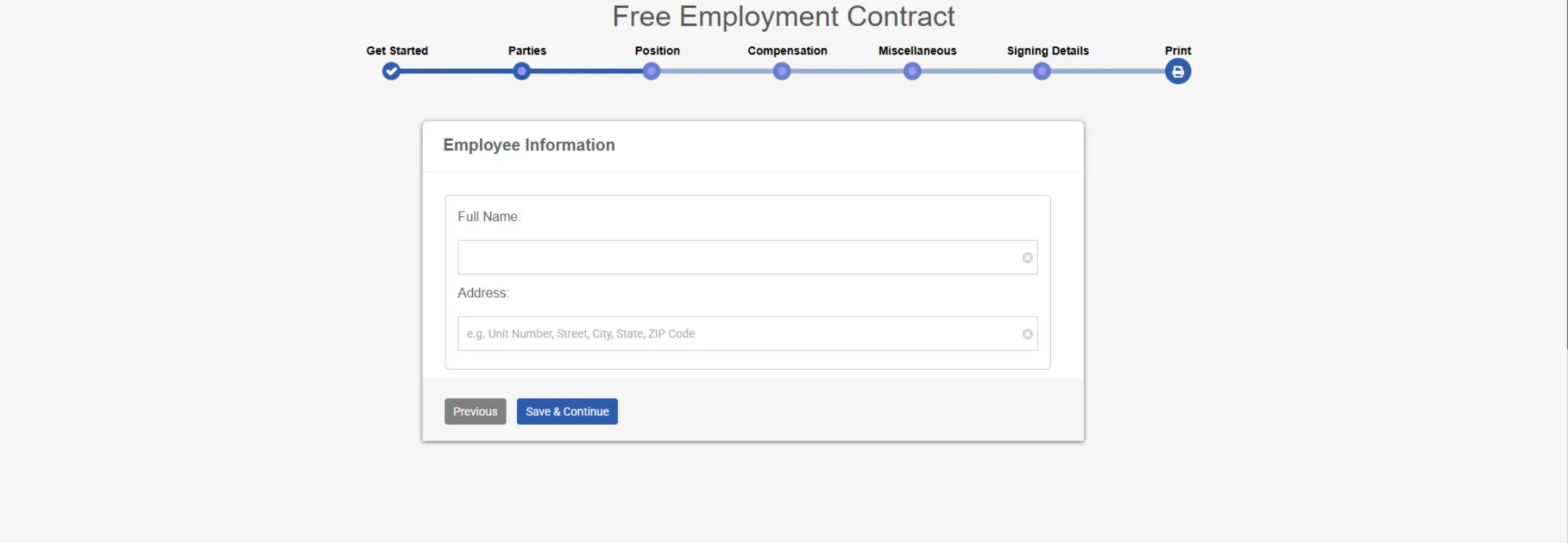
2. Add Parties Details
Enter the company name, employee name, and position information to clearly identify the employer, employee, and role in the contract.
3. Add Position Details
Specify the job title, key responsibilities, reporting relationships, location, and schedule information that defines the position and work expectations.
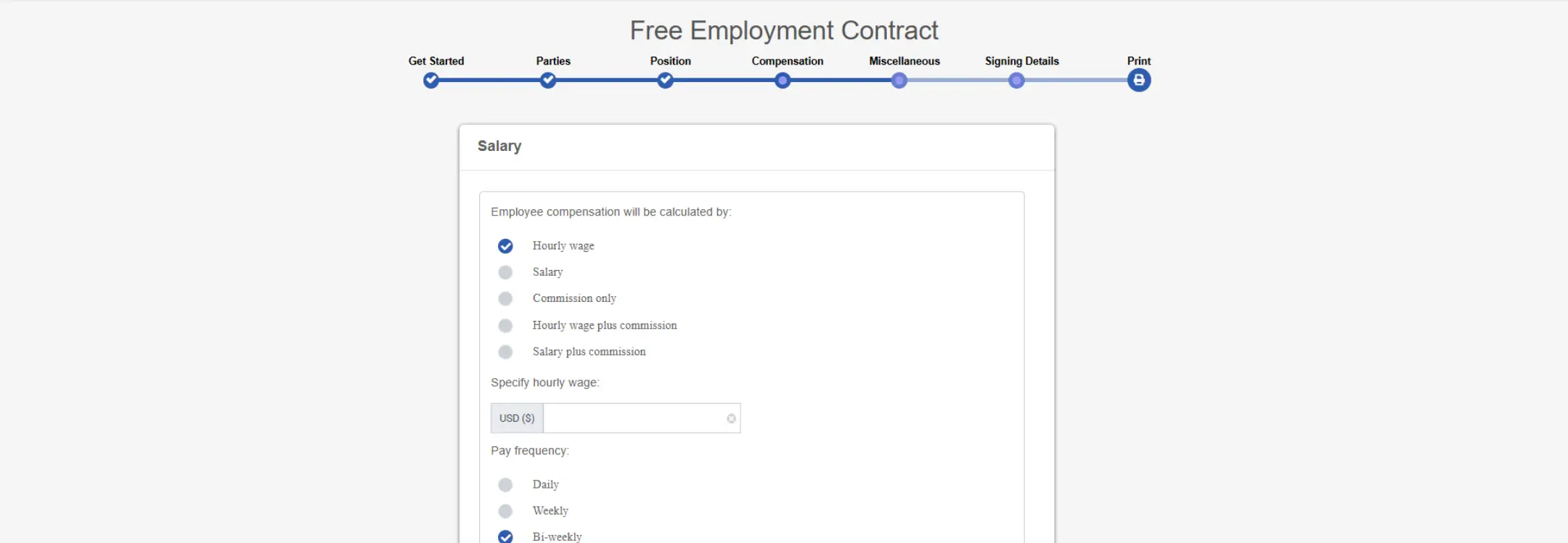
4. Add Compensation Details
Specify wages, payment frequency, benefits eligibility, overtime policies, and any special compensation provisions like bonuses or expense reimbursement.
5. Preview and print
Review the completed contract thoroughly to verify all information is accurate and complete, then download in PDF or Word format for signature by both parties with printed names and dates.
Template Features and Customization
Ziji's temporary contract templates include sections clarifying the temporary nature, maximum duration, renewal conditions, and whether benefits apply. Fixed term templates establish firm start and end dates, renewal options, and performance evaluation processes. Both templates incorporate essential clauses for proper classification, wage and hour compliance, and anti-discrimination protections. Customization options allow adjustment for specific roles, industries, and staffing situations while maintaining legal compliance.
Conclusion: Use the Right Contract for Your Staffing Needs
Temporary and fixed term employment contracts serve different staffing purposes and require appropriately structured language that reflects the employment arrangement. In the United States, paying attention to termination rights is as important as choosing the right contract type. Employers need to decide whether they want flexibility to end a fixed term role early or whether they want to commit to employment through the stated end date, and that choice must be clearly stated in the contract. Using Ziji Legal Forms' specialized templates for each contract type ensures proper classification, legal compliance, and clear expectations that protect both employers and employees throughout the engagement period.
Employment Contract FAQs
What is an employment contract also known as?
An employment contract is also known as the following: contract of employment, employment agreement, or employee contract.
What is an employment contract?
An employment contract is an agreement that governs the terms of the working relationship between the employer and the employee by outlining each party’s rights and obligations.
Why do you need an employment contract?
The contract will ensure both the employer and employees know their obligations and there will not be any ambiguity in the working relationship. An employment contract should be used if business owners, managers, human resource managers or recruiters are hiring an employee for their respective company. However, if an independent contractor is being hired for a fixed term or for on going services, an independent contractor agreement or service agreement should be used instead of an employment contract.
What areas are covered in an employment contract?
Typically an employment contract should cover the following topics:
- Duties of the employee: What type of work the employee will be responsible for and the type of daily tasks the employees will be expected to perform.
- Probation period: How long the probation period will be for the employee, if any.
- Terms of the employment: How long will the employee be working for the employer, such as whether the work will be full time or part time, or whether the position will be temporary or permanent.
- Working scheduling: specifying the employee’s working days, working hours and work location.
- Salary: How much monetary compensation will the employee receive, whether the employee will be paid per hour, paid by commission, or a paid by a fixed amount.
- Employee benefits: What other perks and benefits will the employee have in addition to the salary? Typically terms can include vacation time, health and dental insurance, paid leave, employee discounts, pension plan, and paid professional development.
- Confidentiality: Prevents the employee from sharing sensitive business information and trade secrets of the employer.
- Non-compete clause: Prevents the employee from working for a competing business after leaving the employer or inducing the employer’s other employees to leave their job.
What is employment at will?
Employment at will means the employee can be terminated for any reason as long as the reason is not illegal. (Some examples of illegal terminations include but not limited to: terminating an employee based on their sex, race, colour, creed, religion, national origin, pregnancy, age, disability etc.) All states have some form of employment at will with some restrictions. The exception is Montana which only allows employment at will during the 6 month probation period.
What is a confidentiality clause and why do you need one in an employment contract?
A confidentiality clause prohibits the employee from sharing confidential information about the employer’s business both during and after the employee’s employment. For example, sales data, marketing plans, product designs and ingredients, and any business information relating to the employer’s business are confidential needs to be protected.
Having a confidentiality clause or confidentiality agreement will be a good step to ensure the employer’s company will retain a competitive edge by preventing the employee from sharing or utilizing such sensitive information. The typical confidentiality clause lasts from 1 to 2 years but can also last indefinitely for some extreme cases for proprietary recipes and trade secrets, for example, the formula to Coca-Cola.
What is a non-compete clause and why do you need one in an employment contract?
A non-compete clause prohibits the employee from entering into competition against the employer both during and after the employee’s employment. This is also tied in with the confidentiality clause since the goal is to prevent the employee from using and sharing sensitive information from the employer. Typically, the non-compete clause will prevent the employee from working for a competitor of the employer in the same sector for a short period, or limit the geographic location in which the employee may work while working in the same sector. The limit however must be reasonable since the employer cannot prevent the employee from seeking meaningful work after leaving the position.
What is the difference between an employee and an independent contractor?
An employee works directly under the employer’s control and direction, typically following set schedules, using the employer’s tools or equipment, and receiving employee benefits. An independent contractor, on the other hand, operates as a separate business entity, controls how and when the work is done, and does not usually receive employee benefits. The distinction is important because employment laws, tax obligations, and contract requirements differ for each.
Can an employment contract be changed after it has been signed?
Yes, but any changes must be mutually agreed upon by both the employer and employee. Amendments to an employment contract should be made in writing and signed by both parties to ensure clarity and avoid misunderstandings. Verbal agreements are generally discouraged, as they can be difficult to prove if a dispute arises.
Is it necessary to have a written employment contract?
While some jurisdictions allow for verbal employment agreements, having a written contract is strongly recommended. A written agreement clearly outlines the rights and obligations of both parties, helps prevent disputes, and serves as evidence if legal issues arise.
What happens if an employment contract is breached?
If either the employer or the employee fails to fulfill the obligations outlined in the contract, it may be considered a breach. The non-breaching party may seek remedies such as compensation for losses, enforcement of the original terms, or termination of the contract. The available remedies depend on the severity of the breach and the laws of the applicable jurisdiction.
Does an employment contract need to comply with local labor laws?
Yes. Regardless of what is written in the contract, it must comply with the labor and employment laws of the jurisdiction where the employee works. Any clause that conflicts with statutory requirements, such as minimum wage laws, overtime pay rules, or mandatory leave entitlements, will generally be considered invalid.
What jurisdictions can use our employment contract?
You can use our template to create a legal and valid employment contract for the following jurisdictions:
|
Alabama
Alaska
Arizona
Arkansas
California
Colorado
Connecticut
Delaware
District of Columbia
Florida
Georgia
Hawaii
Idaho
Illinois
Indiana
Iowa
Kansas
Kentucky
Louisiana
Maine
Maryland
Massachusetts
Michigan
Minnesota
Mississippi
Missouri
Montana
Nebraska
Nevada
New Hampshire
New Jersey
New Mexico
New York
North Carolina
North Dakota
Ohio
Oklahoma
Oregon
Pennsylvania
Rhode Island
South Carolina
South Dakota
Tennessee
Texas
Utah
Vermont
Virginia
Washington
West Virginia
Wisconsin
Wyoming |
AL
AK
AZ
AR
CA
CO
CT
DE
DC
FL
GA
HI
ID
IL
IN
IA
KS
KY
LA
ME
MD
MA
MI
MN
MS
MO
MT
NE
NV
NH
NJ
NM
NY
NC
ND
OH
OK
OR
PA
RI
SC
SD
TN
TX
UT
VT
VA
WA
WV
WI
WY |
Author
Mandar Sonavane
|
Legal Content Writer at Ziji Legal Forms Inc.
Symbiosis International University
Mandar is a legal content writer specializing in the development of clear, practical, and easy-to-understand legal resources. With a strong focus on legal research, content creation, and plain-language writing, he works closely with our legal professionals to ensure that legal documents and educational materials are accurate, accessible, and user-friendly. At Ziji Legal Forms Inc., Mandar is responsible for researching legal topics, drafting and reviewing content, and helping transform complex legal concepts into straightforward guidance that empowers individuals and businesses to confidently navigate their legal needs.
Reviewed By
Histon Shek
|
General Counsel and Co-Founder at Ziji Legal Forms Inc.
University of Alberta
Histon Shek was called to the Alberta Bar in 2006. He holds a BA in Sociology and Philosophy and an LLB from the University of Alberta. As co-founder of Ziji Legal Forms Inc., he focuses on making legal documents accessible and affordable, overseeing legal integrity and content development.






 United States
 Canada