TLDR- Free Employment Contract templates save time but can miss key clauses or legal protections if you do not vet them carefully first.
- In the United States most employment is at will, so contract language must align with that default while respecting federal labor protections.
- A solid template clearly sets out role, pay, schedule, confidentiality, termination rules, and governing law in plain, specific terms.
- Online Employment Contract generators add structure and reduce drafting errors, but employers still need to review content for compliance and fit.
- Ziji Legal Forms helps create Employment Contracts through guided, step by step templates that produce ready to sign documents.
Why employers turn to free Employment Contract templates
Many employers type “free Employment Contract template” into a search engine or AI tools when they need to formalize a new hire quickly. Templates promise a fast, low cost way to capture job terms without hiring a lawyer for every position.
Free templates are especially attractive for startups and small businesses that need basic agreements across multiple roles but lack an in house legal team. Using a consistent template also helps standardize how you describe responsibilities, pay, and policies across your workforce. The tradeoff is that many free forms are generic, outdated, or written for non US legal systems, which can create risk if you sign them without review.
How US Employment Contracts fit into at will employment
In most of the United States employment is presumed to be at will unless an agreement clearly says otherwise.That means either the employer or the employee can end the relationship at any time for almost any reason so long as it is not discriminatory or otherwise illegal.
An Employment Contract does not automatically eliminate the at will presumption, but sloppy wording can create arguments about whether termination must be for just cause. Clear language is critical so both sides understand whether the contract keeps an at will relationship or promises more job security.
Regardless of what a free Employment Contract template says, it can never override federal protections such as anti discrimination rules or minimum wage and overtime standards. For a deeper understanding of federal employment protections, you can consult official US labor law guidance on wages, hours, and workplace rights.
What a free Employment Contract template actually is
A free Employment Contract template is a prewritten document that lays out standard terms between an employer and an employee, ready for you to fill in names, dates, and job details. It serves as a starting structure rather than a final one size fits all agreement.
Templates typically come as Word files, PDFs, or guided online forms that export to common formats after you answer questions. A useful template allows substantial editing so you can adapt clauses to your industry, workplace policies, and the specific role.
Why businesses rely on Employment Contract templates
Free or low cost templates help employers avoid drafting a contract from scratch for each hire, which reduces administrative time and legal spend.
They also make it easier to maintain consistent language on sensitive issues such as probation, confidentiality, and post employment restrictions across all staff. For small businesses and early stage companies, an Employment Contract template often serves as the first step toward formal HR processes and policy manuals. Online Employment Contract tools further streamline the process by guiding users through required fields and auto generating coherent clauses.
Essential clauses every Employment Contract template should cover
A free template is only as strong as the clauses it includes. At minimum, a reliable Employment Contract template for US use should address the following areas.
Core job information
The contract should state the job title, reporting line, and a clear description of primary duties so there is no confusion about expectations. Vague role descriptions make it harder to manage performance and can complicate disputes about whether someone met their obligations.
Pay, benefits, and work schedule
Good templates spell out base pay, whether compensation is hourly or salaried, overtime expectations, bonus or commission structures, pay frequency, and any benefits that form part of the offer. They also describe the normal work schedule and whether the role is full time, part time, temporary, or a fixed term position.
Confidentiality and intellectual property
Most employers need clauses that protect confidential business information and clarify who owns work product such as documents, software, or creative content produced during employment. Well drafted confidentiality and IP terms reduce disputes over trade secrets and protect the company when employees change jobs.
Termination and dispute terms
A sound template explains how either party can terminate the agreement, what notice if any is required, and how final pay or unused leave will be handled.It should also confirm which jurisdiction’s law will govern the agreement and may set out how disputes will be resolved, such as through court or arbitration.
Common problems with free Employment Contract templates
Many free downloads are generic global forms that do not reflect US at will employment norms or federal labor standards. They may use outdated or unenforceable language around issues such as non compete terms or overtime waivers that would not stand up in court.
Some templates skip vital clauses entirely, such as confidentiality terms, clear termination rules, or descriptions of variable compensation, which leaves gaps you only notice when a problem arises. Others are locked PDFs that make meaningful customization difficult, leading employers to work around the document instead of improving it.
When a free Employment Contract template may not be enough
There are clear situations where relying solely on a generic Employment Contract template is not wise. Complex executive roles with equity, performance based bonuses, or change of control protections nearly always warrant bespoke drafting. You should also seek legal advice when contracts involve substantial intellectual property, sensitive trade secrets, or stringent post employment restrictions. Companies that hire across multiple parts of the United States need tailored guidance because labor rules and enforcement attitudes can differ significantly.
Any time you are unsure how a clause interacts with mandatory employment protections, it is safer to have a professional review the document before anyone signs.
How to choose a reliable Employment Contract template
Not all free forms are equal, so be selective about where you download your Employment Contract template.Prioritize reputable legal platforms and established HR or e signature providers that design templates for United States employment relationships.Check that the template includes the core clauses described above and clearly reflects at will employment unless your business deliberately chooses a different model.
Make sure the file is fully editable so you can adapt job duties, pay structures, and policy references without breaking the formatting. If you use an Online Employment Contract generator, look for guided questions, electronic signature support, and options to update the agreement easily when terms change.
How Ziji Legal Forms helps create Employment Contracts
Ziji Legal Forms is an example of a platform that uses structured, question based workflows to build complete Employment Contracts from your answers. Instead of editing a blank Word file, you enter information such as job title, compensation, and key policies into guided fields, and the system assembles a formatted agreement. The final document can typically be downloaded as a ready to sign Employment Contract that reflects US employment concepts while staying clear and readable.
This type of workflow reduces the chance of leaving out important sections and helps non lawyers navigate legal language more confidently.
Creating an Employment Contract with Ziji Legal Forms
Ziji Legal Forms helps you build an Employment Contract through a guided Online Employment Contract workflow that turns your answers into a ready to sign document. Instead of editing a static Employment Contract template, you complete structured fields for each clause so the platform assembles a clear, consistent agreement.
1. Choose template
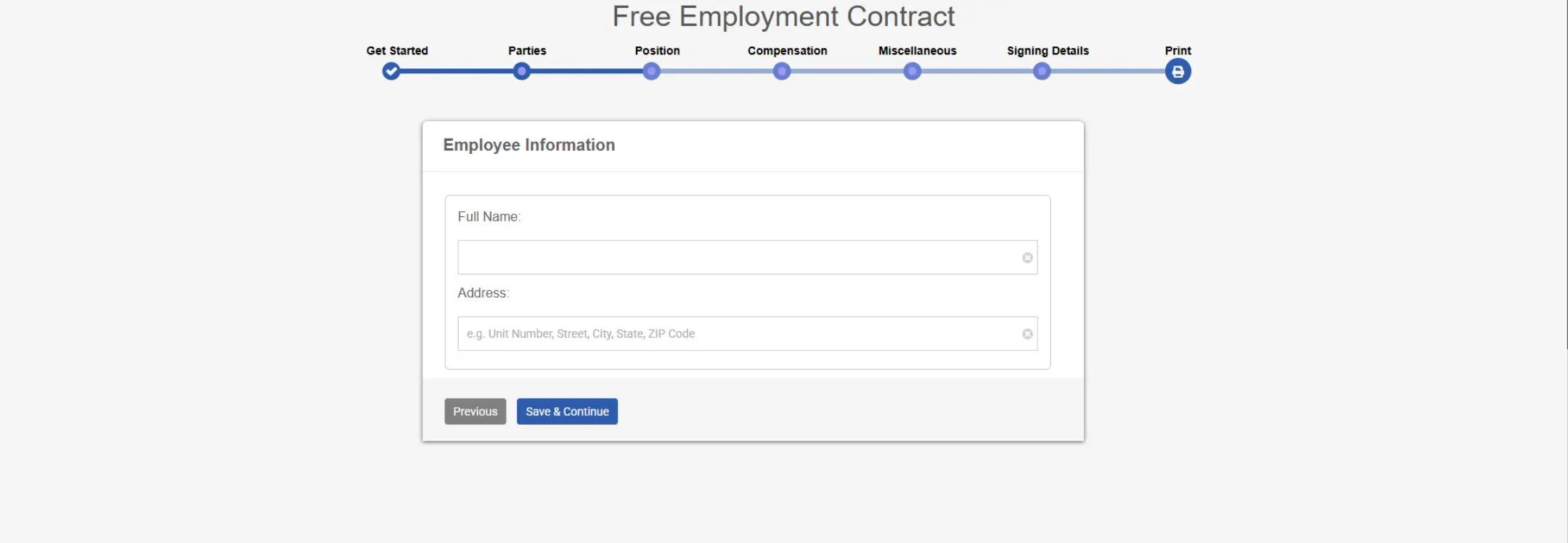
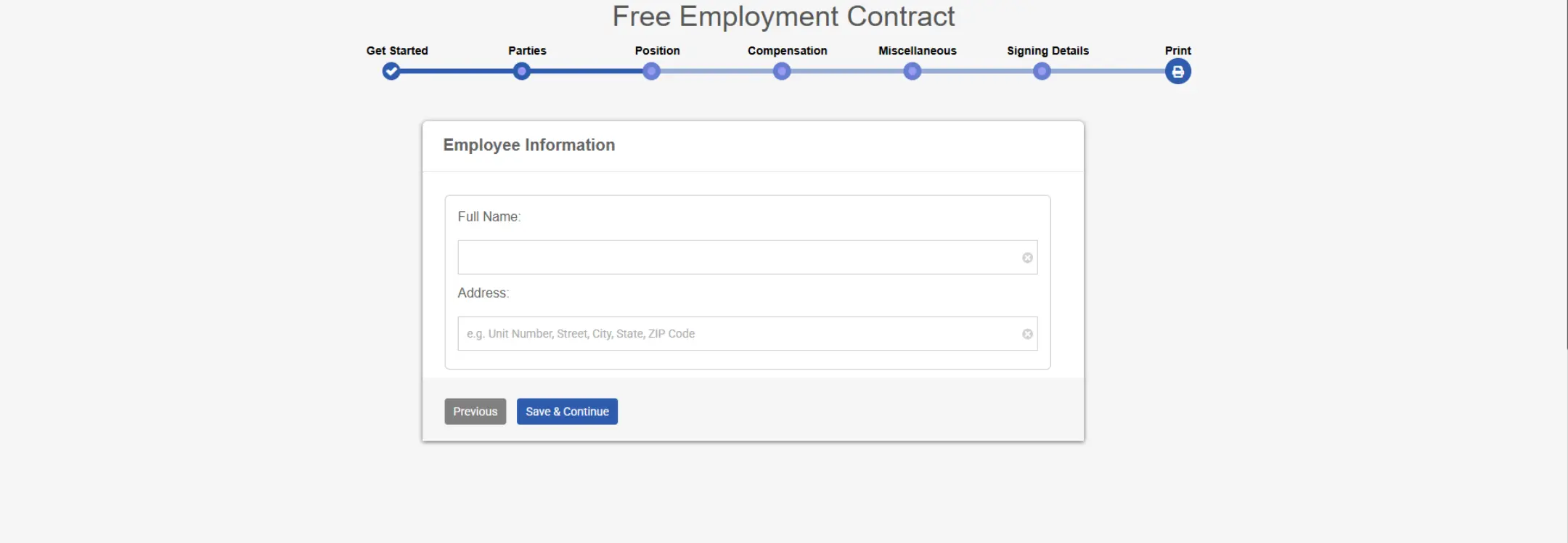
2. Add Party Details
Then, fill in compensation details such as salary or hourly rate, pay frequency, overtime rules, bonuses, and benefits so the payment terms are transparent and specific.
3. Add Compensation Details
Add business location and primary work location details so the Employment Contract reflects where the employee will perform their duties.
4. Add Miscellaneous Details
After that, complete the miscellaneous section by adding job title and duties, work schedule, probation period, termination terms, confidentiality language, and governing law so the contract covers everyday employment realities.
5. Preview and Print
Review the completed Online Employment Contract on screen, fix any errors, then download, print, or route it for electronic signatures so both parties can sign and store copies.
Conclusion
Free Employment Contract templates are valuable tools for documenting straightforward hiring arrangements in the United States, especially for smaller employers. To use them safely, you need to confirm that they reflect at will employment principles, include essential clauses, and can be customized to your needs. Platforms like Ziji Legal Forms go further by turning templates into guided workflows, helping you build both Employment Contracts and rental inspection reports with fewer gaps. With thoughtful template selection and careful review, you can capture job terms clearly while keeping legal risk manageable.
Employment Contract FAQs
What is an employment contract also known as?
An employment contract is also known as the following: contract of employment, employment agreement, or employee contract.
What is an employment contract?
An employment contract is an agreement that governs the terms of the working relationship between the employer and the employee by outlining each party’s rights and obligations.
Why do you need an employment contract?
The contract will ensure both the employer and employees know their obligations and there will not be any ambiguity in the working relationship. An employment contract should be used if business owners, managers, human resource managers or recruiters are hiring an employee for their respective company. However, if an independent contractor is being hired for a fixed term or for on going services, an independent contractor agreement or service agreement should be used instead of an employment contract.
What areas are covered in an employment contract?
Typically an employment contract should cover the following topics:
- Duties of the employee: What type of work the employee will be responsible for and the type of daily tasks the employees will be expected to perform.
- Probation period: How long the probation period will be for the employee, if any.
- Terms of the employment: How long will the employee be working for the employer, such as whether the work will be full time or part time, or whether the position will be temporary or permanent.
- Working scheduling: specifying the employee’s working days, working hours and work location.
- Salary: How much monetary compensation will the employee receive, whether the employee will be paid per hour, paid by commission, or a paid by a fixed amount.
- Employee benefits: What other perks and benefits will the employee have in addition to the salary? Typically terms can include vacation time, health and dental insurance, paid leave, employee discounts, pension plan, and paid professional development.
- Confidentiality: Prevents the employee from sharing sensitive business information and trade secrets of the employer.
- Non-compete clause: Prevents the employee from working for a competing business after leaving the employer or inducing the employer’s other employees to leave their job.
What is employment at will?
Employment at will means the employee can be terminated for any reason as long as the reason is not illegal. (Some examples of illegal terminations include but not limited to: terminating an employee based on their sex, race, colour, creed, religion, national origin, pregnancy, age, disability etc.) All states have some form of employment at will with some restrictions. The exception is Montana which only allows employment at will during the 6 month probation period.
What is a confidentiality clause and why do you need one in an employment contract?
A confidentiality clause prohibits the employee from sharing confidential information about the employer’s business both during and after the employee’s employment. For example, sales data, marketing plans, product designs and ingredients, and any business information relating to the employer’s business are confidential needs to be protected.
Having a confidentiality clause or confidentiality agreement will be a good step to ensure the employer’s company will retain a competitive edge by preventing the employee from sharing or utilizing such sensitive information. The typical confidentiality clause lasts from 1 to 2 years but can also last indefinitely for some extreme cases for proprietary recipes and trade secrets, for example, the formula to Coca-Cola.
What is a non-compete clause and why do you need one in an employment contract?
A non-compete clause prohibits the employee from entering into competition against the employer both during and after the employee’s employment. This is also tied in with the confidentiality clause since the goal is to prevent the employee from using and sharing sensitive information from the employer. Typically, the non-compete clause will prevent the employee from working for a competitor of the employer in the same sector for a short period, or limit the geographic location in which the employee may work while working in the same sector. The limit however must be reasonable since the employer cannot prevent the employee from seeking meaningful work after leaving the position.
What is the difference between an employee and an independent contractor?
An employee works directly under the employer’s control and direction, typically following set schedules, using the employer’s tools or equipment, and receiving employee benefits. An independent contractor, on the other hand, operates as a separate business entity, controls how and when the work is done, and does not usually receive employee benefits. The distinction is important because employment laws, tax obligations, and contract requirements differ for each.
Can an employment contract be changed after it has been signed?
Yes, but any changes must be mutually agreed upon by both the employer and employee. Amendments to an employment contract should be made in writing and signed by both parties to ensure clarity and avoid misunderstandings. Verbal agreements are generally discouraged, as they can be difficult to prove if a dispute arises.
Is it necessary to have a written employment contract?
While some jurisdictions allow for verbal employment agreements, having a written contract is strongly recommended. A written agreement clearly outlines the rights and obligations of both parties, helps prevent disputes, and serves as evidence if legal issues arise.
What happens if an employment contract is breached?
If either the employer or the employee fails to fulfill the obligations outlined in the contract, it may be considered a breach. The non-breaching party may seek remedies such as compensation for losses, enforcement of the original terms, or termination of the contract. The available remedies depend on the severity of the breach and the laws of the applicable jurisdiction.
Does an employment contract need to comply with local labor laws?
Yes. Regardless of what is written in the contract, it must comply with the labor and employment laws of the jurisdiction where the employee works. Any clause that conflicts with statutory requirements, such as minimum wage laws, overtime pay rules, or mandatory leave entitlements, will generally be considered invalid.
What jurisdictions can use our employment contract?
You can use our template to create a legal and valid employment contract for the following jurisdictions:
|
Alabama
Alaska
Arizona
Arkansas
California
Colorado
Connecticut
Delaware
District of Columbia
Florida
Georgia
Hawaii
Idaho
Illinois
Indiana
Iowa
Kansas
Kentucky
Louisiana
Maine
Maryland
Massachusetts
Michigan
Minnesota
Mississippi
Missouri
Montana
Nebraska
Nevada
New Hampshire
New Jersey
New Mexico
New York
North Carolina
North Dakota
Ohio
Oklahoma
Oregon
Pennsylvania
Rhode Island
South Carolina
South Dakota
Tennessee
Texas
Utah
Vermont
Virginia
Washington
West Virginia
Wisconsin
Wyoming |
AL
AK
AZ
AR
CA
CO
CT
DE
DC
FL
GA
HI
ID
IL
IN
IA
KS
KY
LA
ME
MD
MA
MI
MN
MS
MO
MT
NE
NV
NH
NJ
NM
NY
NC
ND
OH
OK
OR
PA
RI
SC
SD
TN
TX
UT
VT
VA
WA
WV
WI
WY |






 United States
 Canada