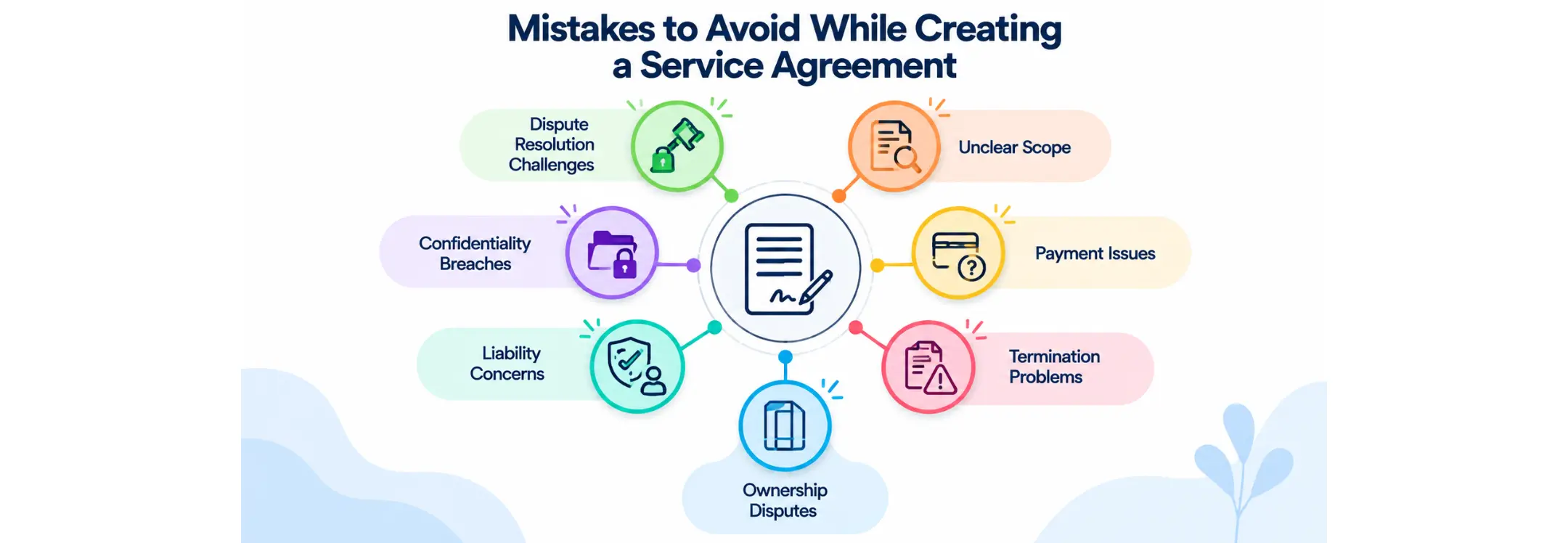
TL;DR- Vague scope definitions lead to scope creep, disputes over deliverables, and disagreements about what work was actually promised and completed
- Missing payment terms create billing conflicts, cash flow problems, and payment disputes that damage professional relationships and lead to collection issues
- Omitted intellectual property clauses cause ownership disputes over deliverables, creative materials, code, and other valuable work products created during the engagement
- Absent termination conditions leave contracts unclear about ending procedures, notice periods, and exit processes that confuse both parties when relationships end
- Insufficient dispute resolution language prevents clear pathways for handling disagreements and may force expensive litigation when conflicts arise between parties
- Using Ziji Legal Forms service agreement templates automatically includes all essential clauses, preventing costly drafting errors while ensuring legal compliance and comprehensive coverage
Introduction: Why Service Agreement Mistakes Matter
A well-crafted service agreement protects both service providers and clients by establishing clear expectations, payment structures, and dispute resolution procedures. However, common drafting errors create costly problems including payment disputes, scope conflicts, and damaged professional relationships that could have been prevented with proper documentation.
Understanding and avoiding these mistakes saves businesses time, money, and reputation damage while creating foundations for successful long-term professional relationships built on transparency and mutual respect.
Mistake 1: Failing to Define Scope of Work Clearly
How Vague Deliverables Lead to Scope Creep
Scope creep occurs when projects expand beyond original agreements without corresponding compensation adjustments or timeline modifications. Vague language like "provide marketing support" or "deliver consulting services" allows clients to request additional work under the assumption it was already promised.
This problem becomes especially costly in projects where subjective outcomes like design, writing, or strategy work are delivered. Without clear boundaries, clients continuously request revisions, additions, or variations, leaving providers unable to refuse additional requests without appearing uncooperative or unprofessional.
Real-World Impact
Scope creep costs service providers 30 to 50 percent of estimated profits on average when left uncontrolled. Projects that began with specific deliverables transform into open-ended engagements where providers continuously invest additional time without additional compensation.
How to Prevent This Mistake
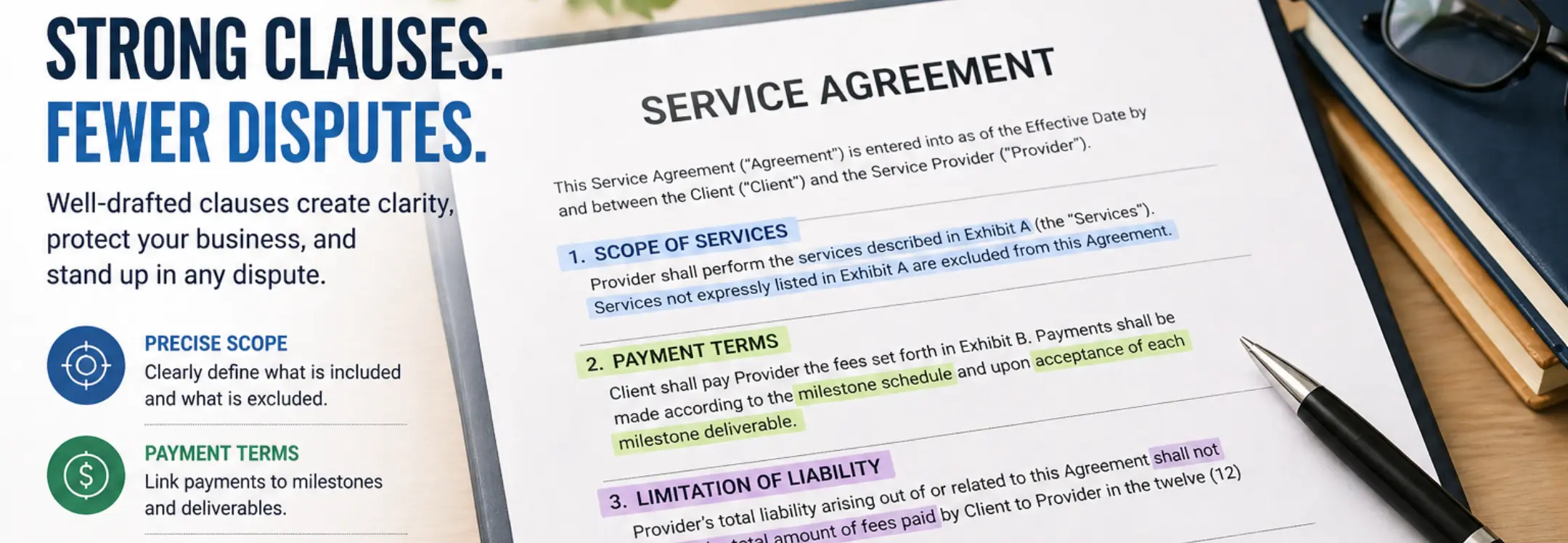
Detailed scope statements must specify exactly what services will be provided, what deliverables clients will receive, how many revisions are included, what timeline applies, and what activities explicitly fall outside the scope. Use specific language like "three rounds of revisions" rather than "unlimited revisions until satisfaction."
Mistake 2: Leaving Out Payment Terms and Schedule
Why Payment Terms Matter
Incomplete payment provisions represent one of the most frequent sources of service agreement disputes and collection problems. Agreements that fail to specify exact payment amounts, due dates, invoicing procedures, payment methods, or late fees create immediate confusion and payment conflicts.
Service providers who deliver completed work face payment delays, disputes about amounts owed, or clients claiming work did not meet quality standards despite accepting deliverables. Without clear payment schedules, cash flow becomes unpredictable, complicating business operations and financial planning.
Financial Impact on Businesses
Companies without detailed payment terms experience average payment delays of 30 to 45 days beyond agreed periods. When combined with disputed amounts or quality disagreements, collection can require expensive legal action or third-party collection agencies that recover only partial amounts while damaging business relationships.
Essential Payment Elements
Clear payment clauses must specify the total service fee or hourly rate, payment schedule with specific due dates, invoicing procedures including required information, accepted payment methods, late payment penalties or interest charges, expense reimbursement procedures, and milestone-based payments if applicable.
Mistake 3: Ignoring Termination and Renewal Clauses
Risks of Absent Termination Provisions
Unclear termination language creates uncertainty about how service agreements can be ended, what notice periods apply, how work-in-progress gets handled, and what final payment obligations exist. Providers get locked into relationships they wish to end while clients struggle to transition to alternative providers when service satisfaction declines.
Without clear termination procedures, either party might attempt to unilaterally end the relationship, triggering disputes about whether proper notice occurred or whether termination was legally justified.
What Balanced Termination Looks Like
Professional termination clauses specify conditions allowing agreement termination, required notice periods, procedures for stopping work in progress, handling of client materials and deliverables, final payment calculations, and transition assistance requirements. The clause should address termination for convenience (either party ending without cause with notice), termination for breach (immediate termination if material violations occur), and dispute resolution procedures.
Mistake 4: Not Addressing Ownership of Deliverables
Intellectual Property Ownership Disputes
Intellectual property ambiguity causes serious disputes about who owns creative work, code, designs, processes, methodologies, or other valuable outputs created during service delivery. One party assumes they retain ownership while the other assumes they obtained full rights to all work products.
This confusion becomes particularly problematic when service providers use methodologies, templates, or tools across multiple client engagements. Clients may believe they purchased exclusive ownership while providers believe they retained rights to use the same approaches for other clients.
Different Ownership Models
Freelancers and small service providers often retain rights to methodologies and pre-existing tools while clients receive ownership of specific deliverables. Agencies and larger firms frequently transfer all rights to clients in exchange for higher fees. Regardless of which model applies, explicit documentation prevents future disputes and licensing conflicts.
Mistake 5: Overlooking Liability and Indemnity Clauses
Why Liability Protection Matters
Missing liability clauses expose service providers to unlimited financial responsibility if clients claim service failures caused damages. Without defined liability limits, providers face potentially catastrophic claims from clients alleging losses, reputational harm, or business disruption caused by service defects.
Clients benefit from clearly defined liability provisions too, understanding exactly what recourse they have if service providers fail to deliver as promised while avoiding exposure to astronomical damage claims.
Common Liability Structures
Effective liability clauses typically cap provider liability at the amount paid for services, exclude certain damages (particularly consequential or punitive damages), require clients to mitigate losses by taking corrective action, and establish notification and cure periods allowing providers to fix problems before liability claims arise.
Mistake 6: Missing Confidentiality or Data Protection Clauses
Protecting Client Trust and Compliance
Absent confidentiality provisions leave sensitive client information vulnerable to unauthorized disclosure or competitive use. Clients who share trade secrets, financial data, customer lists, or proprietary strategies during service delivery receive no contractual protection if providers disclose this information to competitors or the general public.
Data protection requirements also apply in many industries, with service agreements needing specific clauses addressing privacy law compliance, data handling procedures, cybersecurity standards, and breach notification procedures.
Example Scenarios Requiring Protection
Marketing agencies learning unreleased product details or promotion strategies need confidentiality obligations. IT consultants accessing system passwords or network architecture need data security commitments. Legal or financial consultants handling sensitive business information need strict disclosure restrictions. Clear confidentiality language protects client interests while establishing professional standards for service delivery.
Mistake 7: Not Adding Dispute Resolution and Jurisdiction Clauses
Why Dispute Resolution Matters
Vague or absent dispute resolution provisions force expensive litigation when disagreements arise over whether contractual obligations were met. Without clear procedures for handling disputes, parties resort to lawsuits involving attorney fees, discovery costs, and business disruption from ongoing legal proceedings.
Clear dispute resolution procedures often include negotiation requirements allowing direct party communication before formal action, mediation or arbitration requirements that resolve disputes faster and cheaper than litigation, and defined jurisdictions specifying which courts have authority if litigation becomes necessary.
Common Dispute Resolution Approaches
Many service agreements require good faith negotiation first, escalating to mediation if negotiation fails, then arbitration if mediation cannot resolve the dispute. Arbitration typically costs less than litigation while providing faster resolution through private decision-makers rather than court systems. Agreements also benefit from specifying governing law ensuring consistent interpretation across different jurisdictions.
The Real Cost of "Legal Procrastination"
Many small businesses delay formalizing agreements because they fear the high cost of a lawyer or the time commitment of drafting a contract from scratch. However, this "legal procrastination" is often more expensive than the service itself. A single dispute over an unwritten "Scope of Work" can cost a business 30% to 50% of their estimated project profits.
Ziji Legal Forms eliminates this barrier to entry. Our platform provides templates created by legal experts and updated continuously based on the latest laws, ensuring you stay protected without the $300/hour legal fees. By automating the drafting process, you save hours of administrative work, allowing you to secure your revenue and start your projects immediately.
How to Create a Strong Service Agreement with Ziji Legal Forms
1. Comprehensive Template Selection
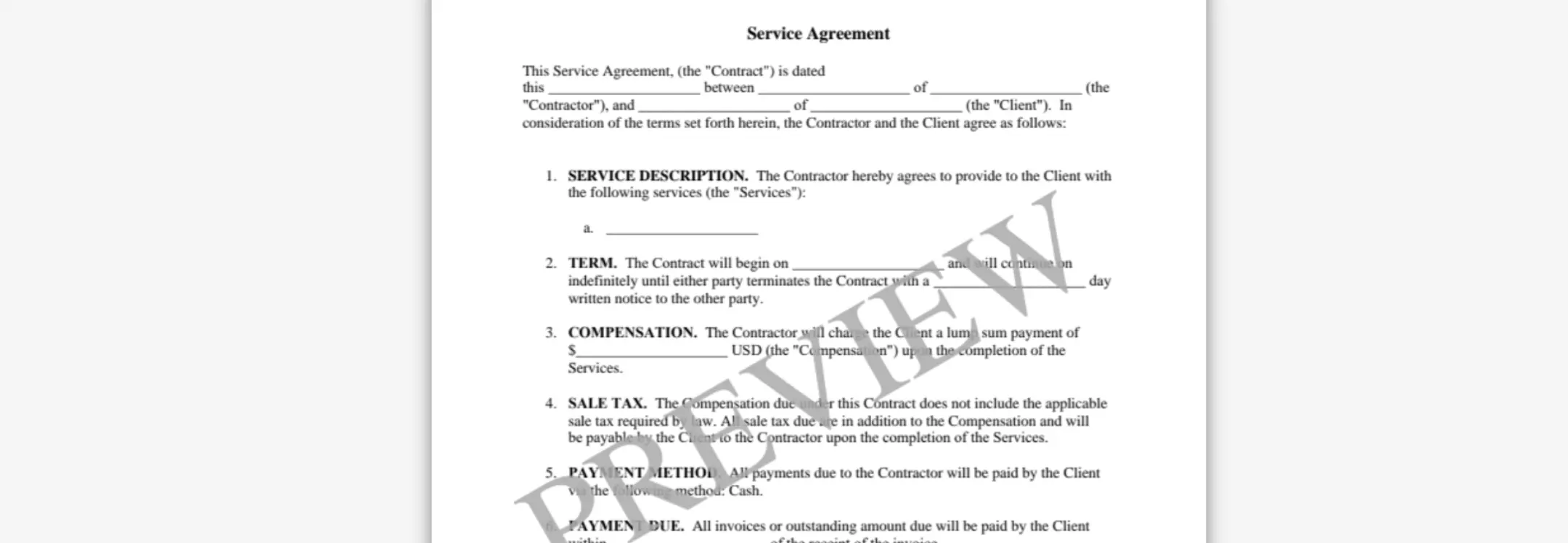
Choose template Access Ziji Legal Forms' Business section and select the Service Agreement Template appropriate for your service type including consulting, freelancing, maintenance, or general business services.
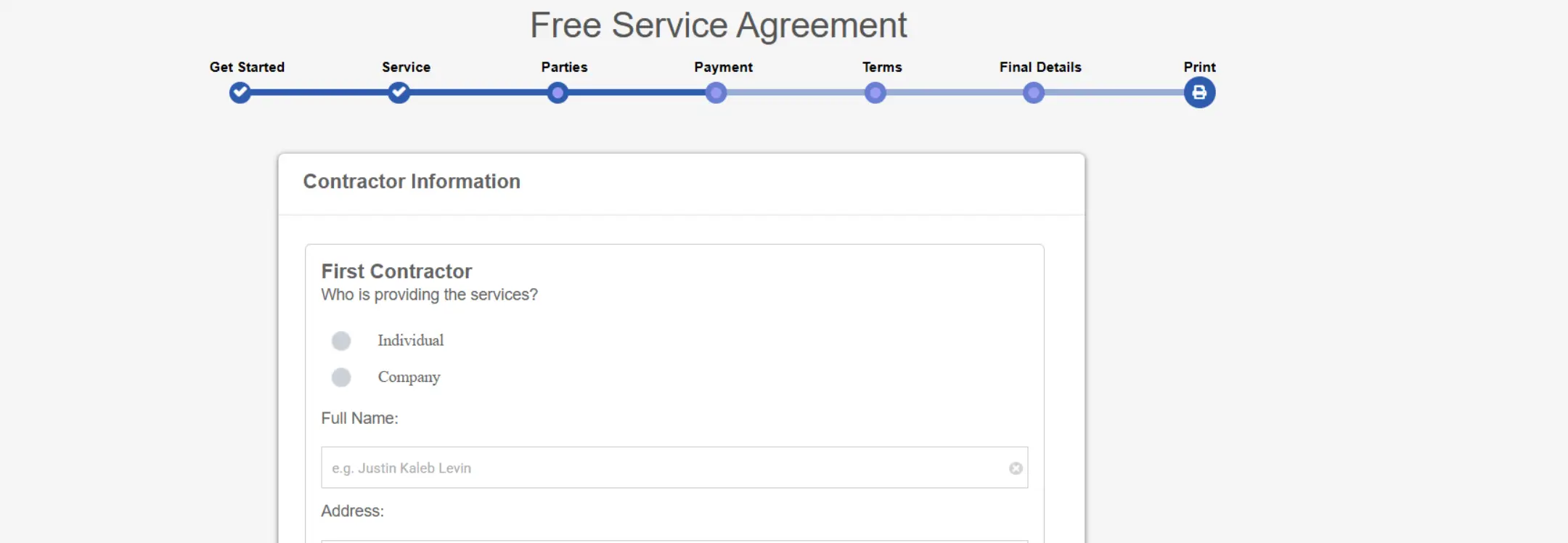
2. Add Party Details
Enter complete legal names, business information, and contact details for both service provider and client to clearly identify all contractual parties.
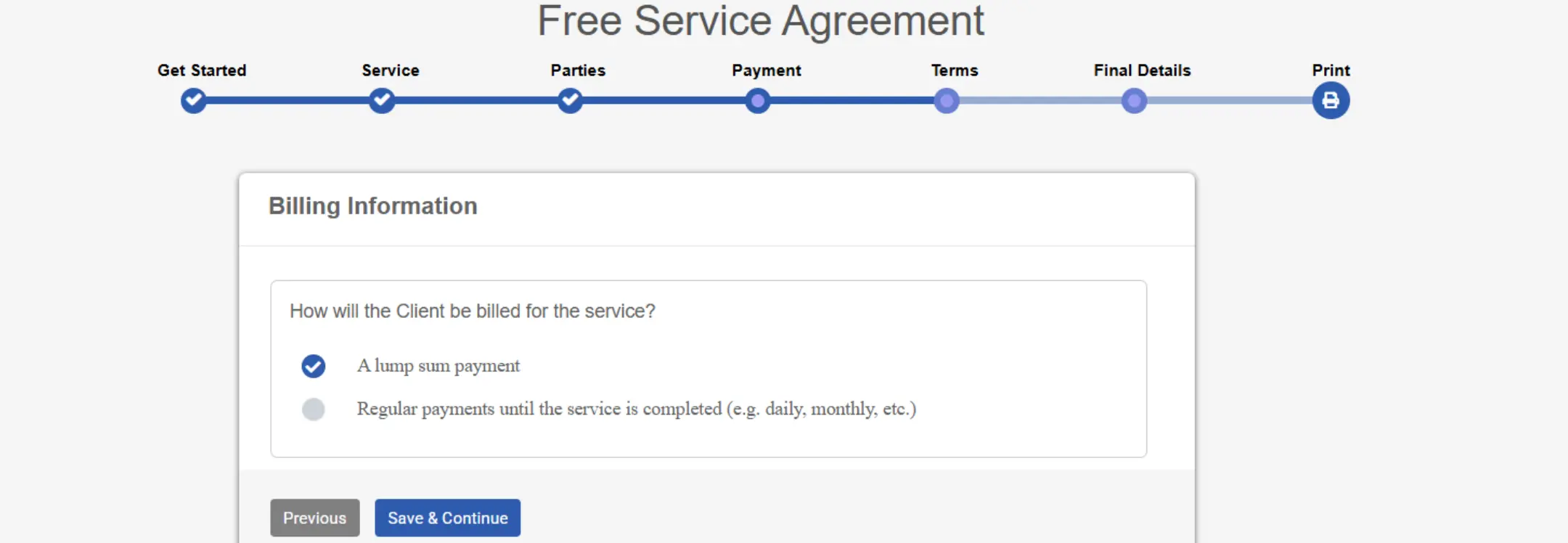
3. Add Payment Details
Specify service fees, payment structure, invoicing procedures, payment schedules, and late payment terms that provide financial clarity and prevent payment disputes.
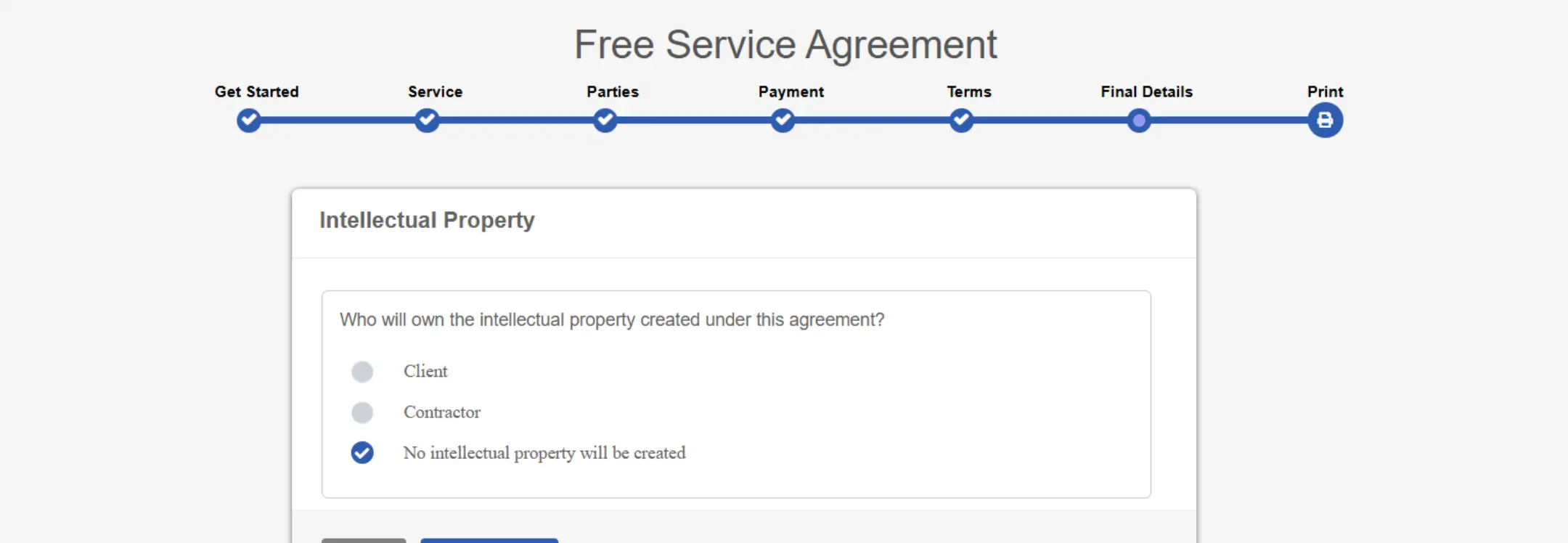
4. Add Term Details
Define service scope with detailed descriptions, establish timelines and delivery dates, include confidentiality provisions, specify intellectual property ownership, detail termination procedures, and add dispute resolution language.
5. Preview and Print
Review the completed agreement thoroughly to verify accuracy and completeness, then download in PDF or Word format for signing and execution by both parties.
Why Choose Ziji Legal Forms for Your Service Agreement?
Creating a professional service agreement should not be a legal or financial burden. Ziji Legal Forms provides a seamless solution with templates meticulously created by legal experts, ensuring your business is protected by industry-standard language. Unlike static PDF downloads, our platform is updated continuously to align with the latest laws, protecting you from using obsolete or unenforceable clauses.
By using our guided system, you save the high cost of hiring a private lawyer and the hours typically spent on manual drafting. This professional-grade precision allows you to secure your revenue and establish clear boundaries in minutes, giving you the peace of been that your professional relationships are built on a rock-solid legal foundation.
Digital Execution: Moving Beyond the Paper Trail
In a digital-first economy, the final mistake often occurs after the agreement is written: failing to execute it efficiently. Relying on physical signatures or scanning and emailing documents creates friction that can cause a lead to go cold or a project to start without a signed contract.
Modern service agreements should be paired with electronic signatures to ensure instant, legally binding execution. Ziji Legal Forms supports this workflow by providing clean, professional formats that are ready for digital signing. This not only streamlines your administrative burden but also establishes a professional tone from the first interaction, signaling to your client that your business is organized, secure, and ready to deliver.
Conclusion: Avoid Costly Mistakes with Professional Templates
Avoiding these seven mistakes in service agreement creation protects professional relationships while ensuring legal compliance and business success. Using Ziji Legal Forms' professionally designed templates eliminates most common drafting errors while incorporating all essential protective clauses that comprehensive agreements require.
Service Agreement FAQs
What is a service agreement also known as?
A service agreement is also known as the following: consulting service agreement, general service agreement, independent contractor agreement, or service contract.
What is a service agreement?
A service agreement is an agreement that outlines the terms and conditions of the service relationship between the contractor and the client. The independent contractor is not an employee of the client and generally will determine the process to achieve the client’s goal and target outcome.
What’s the difference between an employment agreement and a service agreement?
Employment agreement is reserved only for employees and it has specific tax implications and employment rights for the parties. Generally speaking, a service agreement should be used for contractors that are hired to perform certain services for the client. The contractor is independent from the client and will generally have more control in the work process used to meet the client’s goal.
When should I use a service agreement?
Virtually any service work provided by the contractor to the client will be applicable to the service agreement. Some common work where a service agreement is used are:
- Photographer
- Musician
- Caterer
- Decorator
- Cleaner
- Landscaper
- Consultant
- IT service provider
- Web designer
- Construction and home renovator (e.g. plumber, electrician, carpenter etc)
- Child care worker (e.g. babysitter, nanny, daycare worker etc)
- Instructional provider (e.g. math tutor, music tutor, personal fitness trainer etc)
What should be listed in a service agreement?
Some general topics that should be covered in a service agreement are:
- The Parties: The name and address of the contractor and the client.
- The Work: Describe the service the contractor will be performing for the client. Itemize the duties in detail to ensure both sides understand what the expectations are for the agreement so there will not be an ambiguity in the agreement.
- Duration: How long the contract will last, whether it’s a fixed term that has a specific end date, or whether it’s for an indefinite period that has no end date for an ongoing service.
- Payment: How the contractor will be paid, such as whether it’s a lump sum payment or whether it’s a regular periodic payment. Also list what payment method will be used to pay the contractor.
- Terms: What terms that the contractor and the client have agreed to in the contract in dealing with topics such as late payment and interest, work expenses, initial deposit, contract termination etc.
- Confidentiality: Prevents the contractor from sharing sensitive business information and trade secrets of the client.
- Intellectual property: Whether the service perform by the contractor will generate intellectual property rights and decide if the contractor or the client will own those intellectual property rights.
Can a service agreement be changed after it’s signed?
Yes, but any modifications must be agreed to by both the contractor and the client. Changes should always be put in writing and signed by both parties to avoid misunderstandings and to make sure the updated terms are legally binding.
Is a written service agreement always required?
While verbal agreements may be legally valid in some situations, having a written service agreement is strongly recommended. A written contract clearly sets out the rights, duties, and expectations of each party, which helps prevent disputes and provides a record if a disagreement occurs.
What happens if one party breaches the service agreement?
If either the contractor or the client fails to follow the agreed terms, this could be considered a breach of contract. The non-breaching party may be entitled to remedies such as payment for losses, cancellation of the agreement, or enforcing the original terms—depending on the situation and applicable laws.
How does intellectual property ownership work in a service agreement?
The contract should specify whether any intellectual property created during the work belongs to the contractor or the client. Without clear terms, disputes may arise over ownership of things like designs, written materials, software, or creative works produced during the project.
Do service agreements need to comply with local laws?
Absolutely. Regardless of what is written in the agreement, it must follow the laws and regulations of the jurisdiction where the work is being performed. If a clause conflicts with statutory requirements—such as licensing, payment timelines, or safety standards—it will generally be considered invalid.
What jurisdictions can use our service agreement?
You can use our template to create a legal and valid service agreement for the following jurisdictions:
|
Alabama
Alaska
Arizona
Arkansas
California
Colorado
Connecticut
Delaware
District of Columbia
Florida
Georgia
Hawaii
Idaho
Illinois
Indiana
Iowa
Kansas
Kentucky
Louisiana
Maine
Maryland
Massachusetts
Michigan
Minnesota
Mississippi
Missouri
Montana
Nebraska
Nevada
New Hampshire
New Jersey
New Mexico
New York
North Carolina
North Dakota
Ohio
Oklahoma
Oregon
Pennsylvania
Rhode Island
South Carolina
South Dakota
Tennessee
Texas
Utah
Vermont
Virginia
Washington
West Virginia
Wisconsin
Wyoming |
AL
AK
AZ
AR
CA
CO
CT
DE
DC
FL
GA
HI
ID
IL
IN
IA
KS
KY
LA
ME
MD
MA
MI
MN
MS
MO
MT
NE
NV
NH
NJ
NM
NY
NC
ND
OH
OK
OR
PA
RI
SC
SD
TN
TX
UT
VT
VA
WA
WV
WI
WY |
Author
Mandar Sonavane
|
Legal Content Writer at Ziji Legal Forms Inc.
Symbiosis International University
Mandar is a legal content writer specializing in the development of clear, practical, and easy-to-understand legal resources. With a strong focus on legal research, content creation, and plain-language writing, he works closely with our legal professionals to ensure that legal documents and educational materials are accurate, accessible, and user-friendly. At Ziji Legal Forms Inc., Mandar is responsible for researching legal topics, drafting and reviewing content, and helping transform complex legal concepts into straightforward guidance that empowers individuals and businesses to confidently navigate their legal needs.
Reviewed By
Histon Shek
|
General Counsel and Co-Founder at Ziji Legal Forms Inc.
University of Alberta
Histon Shek was called to the Alberta Bar in 2006. He holds a BA in Sociology and Philosophy and an LLB from the University of Alberta. As co-founder of Ziji Legal Forms Inc., he focuses on making legal documents accessible and affordable, overseeing legal integrity and content development.





 United States
 Canada