Service Agreement vs Independent Contractor Agreement: Key Differences
TL;DR
A service agreement establishes relationships where providers deliver specific results or services with flexibility in how work is completed
An independent contractor agreement formalizes business relationships with self-employed workers who control work methods while remaining responsible for taxes
Service agreements focus on deliverables and outcomes while contractor agreements emphasize work independence and classification protection
Key differences include control levels, tax implications, benefit eligibility, and legal compliance requirements for misclassification prevention
Ziji Legal Forms offers distinct templates for both agreement types, ensuring proper documentation that protects all parties while maintaining legal compliance
Introduction: Distinguishing Two Important Business Relationships
Businesses frequently engage outside professionals to perform services, but the type of agreement used can significantly affect legal rights, tax obligations, and compliance responsibilities. Two commonly used agreements are service agreements and independent contractor agreements. While they may appear similar at first glance, they address different aspects of a business relationship.
Understanding the distinction is important for both companies and service providers. Using the wrong agreement can create confusion around control, classification, and liability. In some cases, it may even lead to regulatory penalties or tax complications. Choosing the correct agreement helps establish clarity, protect both parties, and ensure the relationship aligns with applicable legal standards.
The Core Difference Between the Two Agreements
The key distinction lies in what the agreement is primarily designed to regulate.
Service Agreements Focus on Results
A service agreement primarily defines the services to be delivered and the expected results. It concentrates on scope, deliverables, timelines, and payment terms. The agreement is outcome oriented. It explains what work will be performed, how it will be evaluated, and how compensation will be structured.
This type of agreement can be used in many contexts, including relationships between companies or between a business and an independent professional. The focus remains on the service itself rather than on the employment classification of the provider.
Because it emphasizes deliverables and contractual obligations, a service agreement is often appropriate when the primary concern is defining project scope, intellectual property rights, confidentiality, and payment structure.
An independent contractor agreement focuses on the legal status of the individual or business providing services. Its primary purpose is to establish that the service provider is not an employee and does not receive employment benefits or protections.
This agreement highlights independence in areas such as control over work methods, tax responsibilities, and operational autonomy. It often includes language clarifying that the contractor controls how the work is performed and is responsible for their own equipment, taxes, and insurance where applicable.
The distinction is important because misclassifying a worker can lead to serious legal consequences. An independent contractor agreement addresses classification issues directly, which goes beyond simply defining scope and payment. Proper contractor classification protects businesses from IRS penalties, Department of Labor investigations, and wage violation claims.
Service agreements are versatile contracts that apply across industries and service models.
What Service Agreements Cover
Service agreements typically cover the scope of work, timelines, compensation, confidentiality obligations, intellectual property ownership, termination conditions, and dispute resolution procedures. They define the expectations between the parties in practical terms.
The agreement may apply to project based engagements, ongoing support arrangements, or consulting services. It clarifies how deliverables will be measured and what standards apply. In many cases, service agreements include provisions addressing revisions, change requests, and acceptance procedures.
The central objective is to ensure that both parties understand what is being provided and how payment and responsibilities are structured.
Key Elements of Service Agreements
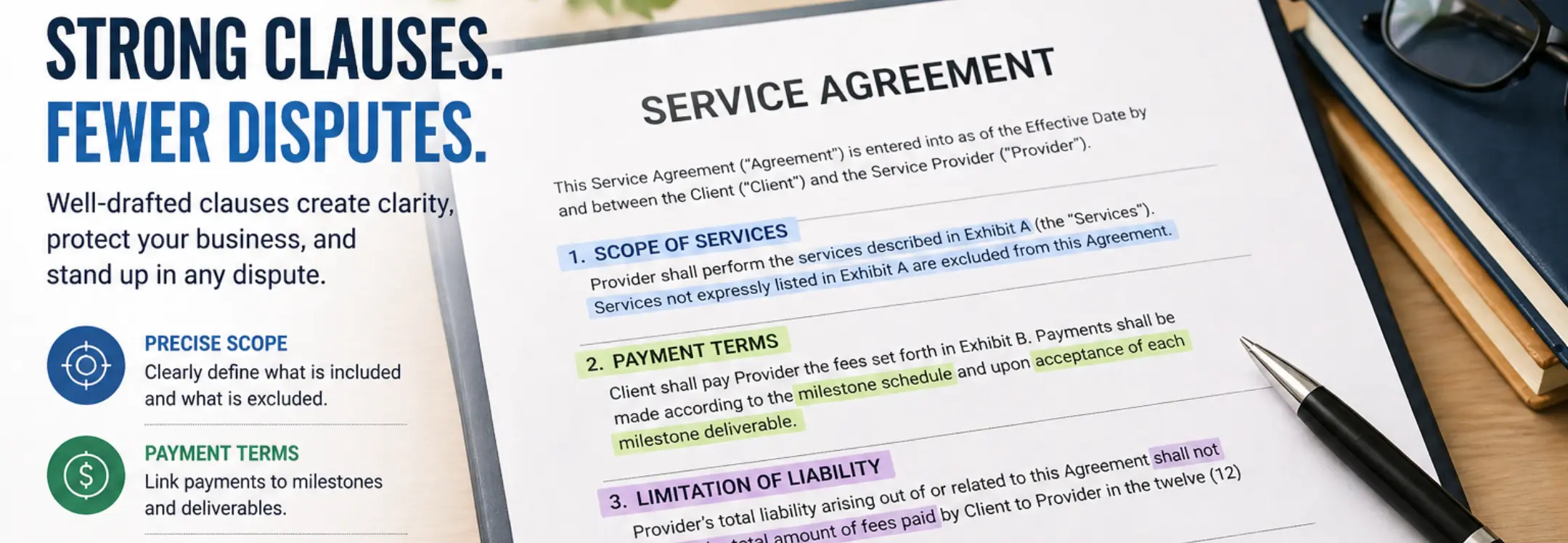
Core elements include identification of parties, detailed scope of services, payment terms, confidentiality clauses, intellectual property allocation, and termination rights. Each of these components contributes to enforceability and clarity.
The scope of services should be precise to prevent misunderstandings. Payment clauses should define timing and method of compensation. Intellectual property provisions must clarify ownership of work product created during the engagement.
Dispute resolution and governing law provisions provide a framework for resolving conflicts. Together, these elements create a comprehensive contract that manages risk and clarifies expectations.
Who Uses Service Agreements
Service agreements are used by consultants, marketing agencies, software developers, maintenance providers, and many other professionals. They are also used between businesses when one company provides services to another.
These agreements are suitable when the primary objective is to document the services being delivered rather than to define worker classification. Both individuals and business entities may enter into service agreements depending on the context of the relationship.
Independent Contractor Agreements Explained
Independent contractor agreements serve a more specific regulatory purpose.
Legal Classification Importance
Worker classification is a significant legal issue. Governments evaluate whether a worker is properly classified as an independent contractor or should be treated as an employee. Classification affects tax withholding, benefits, labor protections, and compliance obligations.
An independent contractor agreement includes language emphasizing independence, lack of employment benefits, and responsibility for taxes. However, the agreement alone does not determine classification. Actual working conditions must align with the stated terms.
Clear drafting reduces misclassification risk by defining autonomy in work performance and limiting employer style control over daily activities.
Core Elements of Contractor Agreements
Contractor agreements typically include provisions clarifying independent status, tax responsibility, control over work methods, confidentiality, intellectual property ownership, and termination rights.
They often specify that the contractor is responsible for their own tools, insurance, and business expenses. Payment terms are included, but the emphasis remains on the independent nature of the relationship.
These agreements help protect businesses from employment related liabilities while also clarifying expectations for the contractor.
The Risk of Misclassification: Beyond the Paperwork
While having a written agreement is essential, the "label" you put on the document is only part of the equation. Government agencies like the IRS and Department of Labor use a "substance over form" approach to determine if a worker is truly an independent contractor or a de facto employee.
If your agreement describes a contractor but your daily operations involve high levels of control such as setting their specific hours or providing their equipment you face a high risk of misclassification penalties. A robust agreement from a professional platform like Ziji Legal Forms helps by explicitly defining the boundaries of independence, providing a stronger defense in the event of an audit or dispute.
Key Differences Between Service Agreements and Contractor Agreements
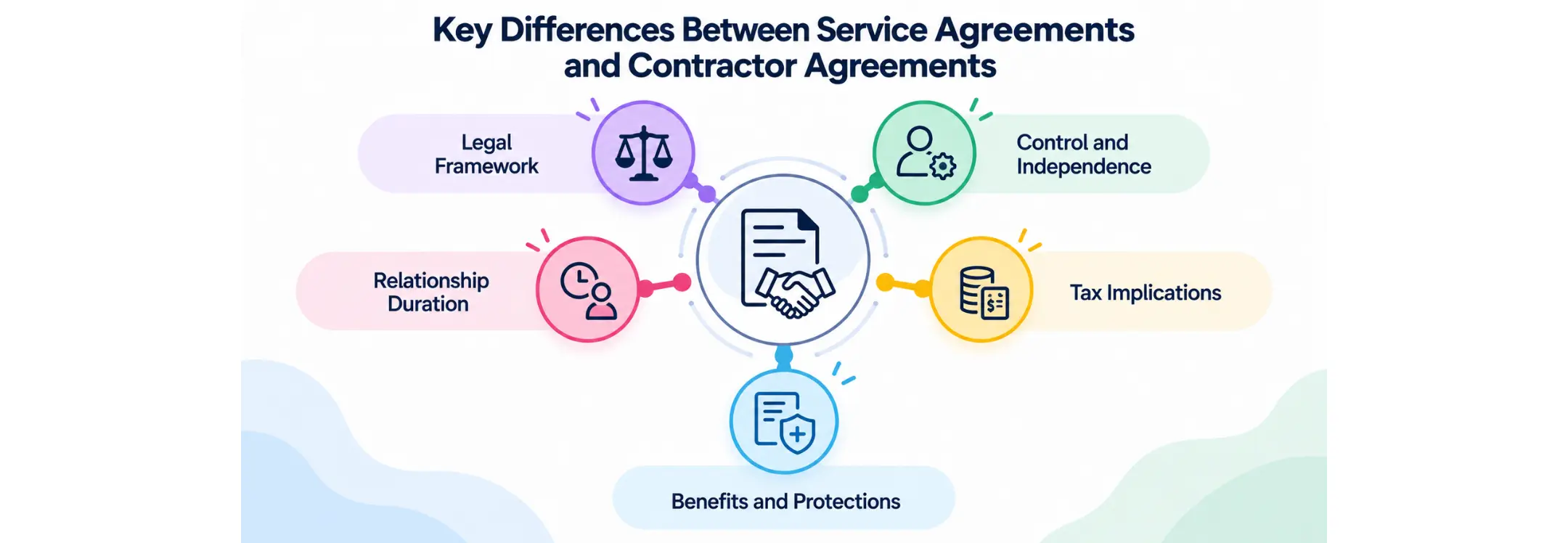
Control and Independence
Control is a defining factor. A service agreement may focus on results without deeply addressing how the work is performed. An independent contractor agreement explicitly emphasizes that the contractor controls the manner and method of performance.
The degree of control exercised by the hiring party can influence legal classification. Clear documentation of independence supports compliance.
Tax Implications and Responsibilities
Independent contractors are typically responsible for their own tax filings and payments. Contractor agreements often specify this responsibility to reduce ambiguity.
Service agreements may address payment but do not necessarily emphasize tax classification unless independence is relevant. Understanding tax responsibilities is critical to avoid regulatory issues.
Benefits and Employment Protections
Employees may be entitled to benefits such as health coverage, paid leave, or retirement contributions. Independent contractors are generally not entitled to such benefits.
Contractor agreements clarify that no employment benefits are provided. Service agreements may not focus on this distinction unless the relationship specifically involves an individual provider.
Relationship Duration and Nature
Service agreements can be project based or ongoing, depending on the services provided. Independent contractor agreements also may be short term or long term, but they are structured around independent status rather than deliverables alone.
The nature of the relationship, including degree of integration into the hiring business, may influence which agreement is appropriate.
Legal Framework and Compliance
Contractor agreements must align with labor and tax laws governing worker classification. Misclassification can result in penalties.
Service agreements primarily operate under general contract law, though they must still comply with applicable regulations. Choosing the correct framework ensures legal compliance and reduces risk.
How Courts Interpret Service Agreements vs Contractor Agreements in Disputes
When disputes arise, courts focus less on the title of the agreement and more on how the relationship actually functions. Judges examine factors such as control over work methods, payment structure, exclusivity, and whether the worker can subcontract the work. A document labeled as a service agreement may still be treated as a contractor agreement if the service provider operates independently and bears business risk.
Misclassification is a common issue in lawsuits involving unpaid taxes, benefits, or liability claims. Courts often rely on substance over form, meaning poorly drafted agreements can be ignored altogether. This makes precise language, role clarity, and alignment with real-world practices critical. Clearly defining independence, scope, and responsibility reduces enforcement risks and strengthens legal standing.
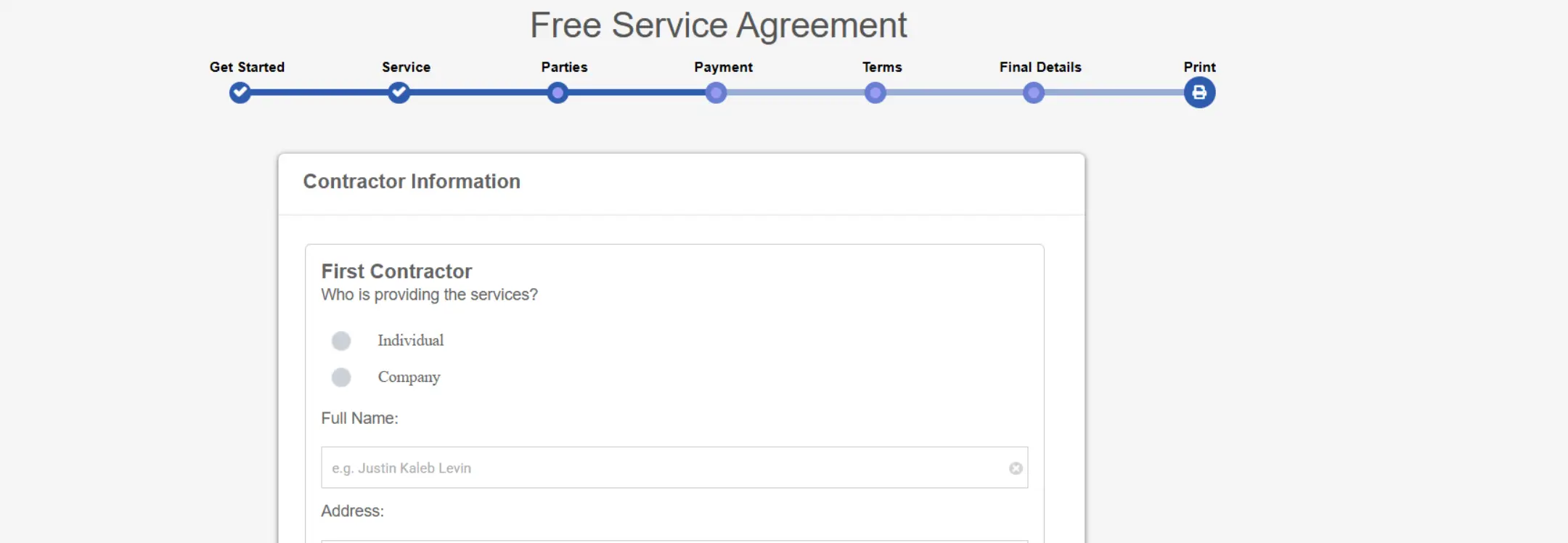
Creating Agreements Using Ziji Legal Forms in 5 Easy Steps
Enter the full legal names, business information, and contact details of both the service provider and client to clearly identify all parties.
3. Add Payment Details
Specify service fees, payment schedule, invoicing procedures, and any late payment terms to ensure clear financial agreement
4. Add Term Details
Define the scope of services, delivery timelines, confidentiality terms, termination conditions, and any industry-specific clauses relevant to your engagement.
5. Preview and print
Review the completed agreement thoroughly to confirm accuracy, then download it as a PDF or Word document for signing by all parties.
Avoiding Common Mistakes with Both Agreement Types
Unclear or vague scope language creates disputes about whether contracted work was completed satisfactorily. Be specific about deliverables, quality standards, quantities, and exactly what services are included or excluded from the agreement.
Failing to establish contractor independence in contractor agreements undermines proper classification and creates misclassification risk. Explicitly confirm the contractor maintains control over work methods, can work for other clients, and provides their own resources and tools.
Inadequate payment documentation in service agreements creates billing disputes and collection problems. Specify exact fees, payment schedules, invoicing requirements, and procedures for handling late payments.
Missing intellectual property provisions causes disputes about who owns work created during the engagement. Clarify ownership of deliverables, client materials, and contractor methodologies or pre-existing tools.
Incomplete tax documentation in contractor agreements creates IRS compliance issues. Ensure agreements clearly establish the contractor's self-employed status, responsibility for taxes, and that no tax withholding will occur.
How Ziji Legal Forms Helps You Avoid These Common Mistakes
Choosing between a service agreement and an independent contractor agreement requires legal precision. Ziji Legal Forms simplifies this decision by providing templates meticulously created by legal experts for each specific use case. Our documents are updated continuously to reflect the latest federal and state laws, ensuring your business remains compliant and protected.
By using our guided platform, you save the high costs and long turnaround times of hiring a private lawyer while still receiving professional-grade documentation. Whether you are scaling a startup or managing a freelance project, Ziji Legal Forms saves you time and provides the legal security you need to operate with confidence.
Which Agreement Is Better for Scaling Businesses and Startups
For growing businesses and startups, choosing the right agreement impacts flexibility, compliance, and cost control. Service agreements are often preferred when outsourcing defined outcomes such as marketing, IT support, or consulting because they emphasize deliverables rather than labor structure. This helps businesses scale without creating employment-like dependencies.
Contractor agreements are better suited when individuals are hired for ongoing, skill-based work that requires autonomy and minimal oversight. However, improper use can trigger worker misclassification risks as teams grow. Startups should also consider investor scrutiny, as unclear contracting practices can surface during due diligence. Selecting the right agreement early helps avoid renegotiation, compliance corrections, and operational friction later.
Conclusion: Choose the Right Agreement for Your Situation
Service agreements and independent contractor agreements serve different purposes in business relationships. Service agreements emphasize deliverables and outcomes while contractor agreements establish legally defensible independent contractor status. Using Ziji Legal Forms' specialized templates for each agreement type ensures proper documentation, legal compliance, and protection for all parties involved in professional business relationships.
Service Agreement FAQs
What is a service agreement also known as?
A service agreement is also known as the following: consulting service agreement, general service agreement, independent contractor agreement, or service contract.
What is a service agreement?
A service agreement is an agreement that outlines the terms and conditions of the service relationship between the contractor and the client. The independent contractor is not an employee of the client and generally will determine the process to achieve the client’s goal and target outcome.
What’s the difference between an employment agreement and a service agreement?
Employment agreement is reserved only for employees and it has specific tax implications and employment rights for the parties. Generally speaking, a service agreement should be used for contractors that are hired to perform certain services for the client. The contractor is independent from the client and will generally have more control in the work process used to meet the client’s goal.
When should I use a service agreement?
Virtually any service work provided by the contractor to the client will be applicable to the service agreement. Some common work where a service agreement is used are:
Photographer
Musician
Caterer
Decorator
Cleaner
Landscaper
Consultant
IT service provider
Web designer
Construction and home renovator (e.g. plumber, electrician, carpenter etc)
Child care worker (e.g. babysitter, nanny, daycare worker etc)
Instructional provider (e.g. math tutor, music tutor, personal fitness trainer etc)
What should be listed in a service agreement?
Some general topics that should be covered in a service agreement are:
The Parties: The name and address of the contractor and the client.
The Work: Describe the service the contractor will be performing for the client. Itemize the duties in detail to ensure both sides understand what the expectations are for the agreement so there will not be an ambiguity in the agreement.
Duration: How long the contract will last, whether it’s a fixed term that has a specific end date, or whether it’s for an indefinite period that has no end date for an ongoing service.
Payment: How the contractor will be paid, such as whether it’s a lump sum payment or whether it’s a regular periodic payment. Also list what payment method will be used to pay the contractor.
Terms: What terms that the contractor and the client have agreed to in the contract in dealing with topics such as late payment and interest, work expenses, initial deposit, contract termination etc.
Confidentiality: Prevents the contractor from sharing sensitive business information and trade secrets of the client.
Intellectual property: Whether the service perform by the contractor will generate intellectual property rights and decide if the contractor or the client will own those intellectual property rights.
Can a service agreement be changed after it’s signed?
Yes, but any modifications must be agreed to by both the contractor and the client. Changes should always be put in writing and signed by both parties to avoid misunderstandings and to make sure the updated terms are legally binding.
Is a written service agreement always required?
While verbal agreements may be legally valid in some situations, having a written service agreement is strongly recommended. A written contract clearly sets out the rights, duties, and expectations of each party, which helps prevent disputes and provides a record if a disagreement occurs.
What happens if one party breaches the service agreement?
If either the contractor or the client fails to follow the agreed terms, this could be considered a breach of contract. The non-breaching party may be entitled to remedies such as payment for losses, cancellation of the agreement, or enforcing the original terms—depending on the situation and applicable laws.
How does intellectual property ownership work in a service agreement?
The contract should specify whether any intellectual property created during the work belongs to the contractor or the client. Without clear terms, disputes may arise over ownership of things like designs, written materials, software, or creative works produced during the project.
Do service agreements need to comply with local laws?
Absolutely. Regardless of what is written in the agreement, it must follow the laws and regulations of the jurisdiction where the work is being performed. If a clause conflicts with statutory requirements—such as licensing, payment timelines, or safety standards—it will generally be considered invalid.
What jurisdictions can use our service agreement?
You can use our template to create a legal and valid service agreement for the following jurisdictions:
Alabama
Alaska
Arizona
Arkansas
California
Colorado
Connecticut
Delaware
District of Columbia
Florida
Georgia
Hawaii
Idaho
Illinois
Indiana
Iowa
Kansas
Kentucky
Louisiana
Maine
Maryland
Massachusetts
Michigan
Minnesota
Mississippi
Missouri
Montana
Nebraska
Nevada
New Hampshire
New Jersey
New Mexico
New York
North Carolina
North Dakota
Ohio
Oklahoma
Oregon
Pennsylvania
Rhode Island
South Carolina
South Dakota
Tennessee
Texas
Utah
Vermont
Virginia
Washington
West Virginia
Wisconsin
Wyoming
AL
AK
AZ
AR
CA
CO
CT
DE
DC
FL
GA
HI
ID
IL
IN
IA
KS
KY
LA
ME
MD
MA
MI
MN
MS
MO
MT
NE
NV
NH
NJ
NM
NY
NC
ND
OH
OK
OR
PA
RI
SC
SD
TN
TX
UT
VT
VA
WA
WV
WI
WY
Author
Mandar Sonavane
|
Legal Content Writer at Ziji Legal Forms Inc.
Symbiosis International University
Mandar is a legal content writer specializing in the development of clear, practical, and easy-to-understand legal resources. With a strong focus on legal research, content creation, and plain-language writing, he works closely with our legal professionals to ensure that legal documents and educational materials are accurate, accessible, and user-friendly. At Ziji Legal Forms Inc., Mandar is responsible for researching legal topics, drafting and reviewing content, and helping transform complex legal concepts into straightforward guidance that empowers individuals and businesses to confidently navigate their legal needs.
Reviewed By
Histon Shek
|
General Counsel and Co-Founder at Ziji Legal Forms Inc.
University of Alberta
Histon Shek was called to the Alberta Bar in 2006. He holds a BA in Sociology and Philosophy and an LLB from the University of Alberta. As co-founder of Ziji Legal Forms Inc., he focuses on making legal documents accessible and affordable, overseeing legal integrity and content development.








 United States
 Canada