
A doctor checking a child with a stethescope

Who Can Give Medical Consent for a Child

Last Updated: February 20, 2026

TL;DR
  • Parents have automatic legal authority to give medical consent for children, with both married parents typically having equal authority unless custody orders specify otherwise
  • Divorced or separated parents with joint custody both retain medical decision-making authority, and both parents' consent is often required for non-emergency treatment despite one parent being the child's primary caregiver
  • Legal guardians appointed by courts through formal guardianship proceedings have full medical decision-making authority equivalent to parents and must provide documentation proving their court-appointed status
  • Temporary caregivers like babysitters, nannies, and relatives have no automatic medical authority and require written consent forms to authorize even emergency medical care
  • Sole custody eliminates the other parent's authority to make medical decisions, meaning only the custodial parent can authorize treatment without the other parent's involvement
  • Emergency medical care can be provided without consent when delays would be life-threatening, but this emergency authority is limited and does not eliminate the need for advance consent planning
  • Ziji Legal Forms provides customizable child medical consent templates that clarify which individuals have decision-making authority in different custody and caregiving arrangements 

Introduction: Understanding Medical Consent Authority
Many parents and caregivers incorrectly assume that anyone caring for a child has authority to make medical decisions. In reality, medical consent authority is strictly defined by law and custody arrangements. Without proper understanding of who holds this authority, children can experience treatment delays or medical facilities may refuse to provide care even in emergencies.

Clarity about medical decision-making authority prevents dangerous confusion in medical situations and ensures children receive timely treatment when needed.  

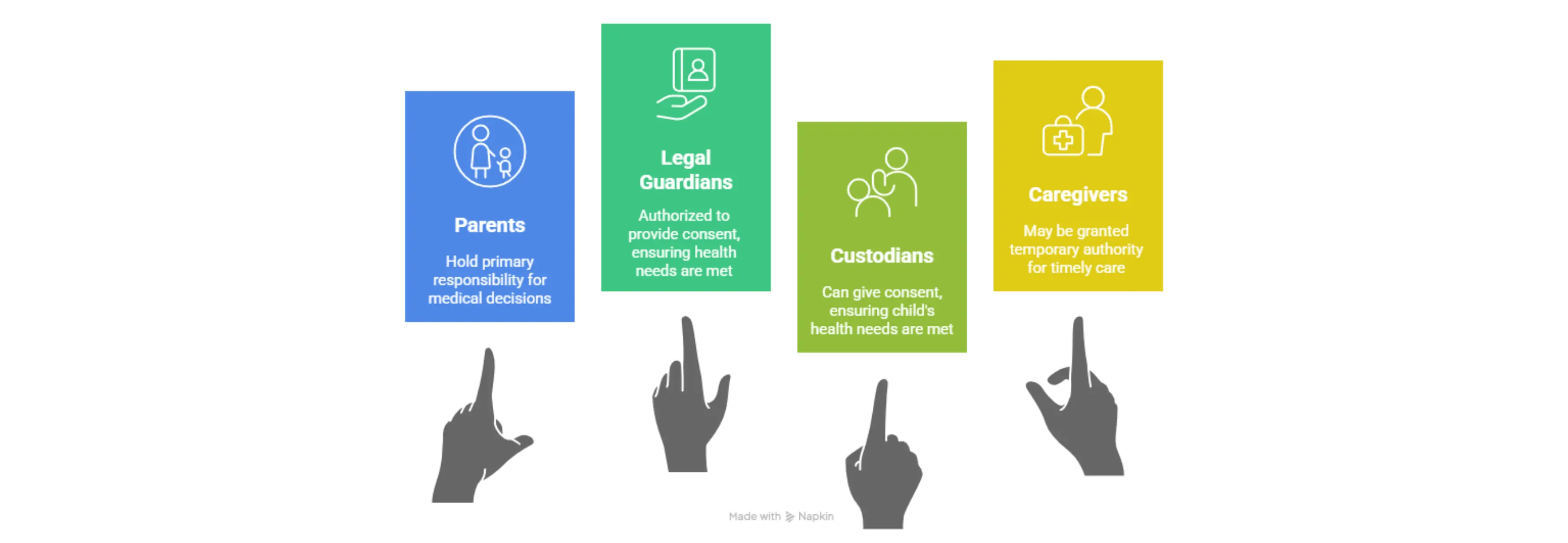
The below infographic highlights who can give medical consent for a child.

An infographic highlighting who can give child medical consent with 4 boxes labeled Parents, Legal Guardians, Custodians, and Caregivers

Parents and Legal Authority

Biological and Adoptive Parents

Both biological and adoptive parents hold equal legal authority to make medical decisions for their children. This authority comes automatically from parenthood without requiring court orders or formal appointment.

Adoptive parents hold identical medical decision-making authority as biological parents once adoption is finalized. The law treats all parental relationships equally regarding medical authority.

Both Parents Must Consent in Some Situations

Married parents typically both have independent authority to consent to medical care, meaning either parent can authorize treatment without the other parent's permission. However, medical practices often request both parents' consent for major decisions like surgeries to ensure coordination.

With unmarried parents living together, both parents generally retain equal authority unless formal custody proceedings have determined otherwise.

When One Parent May Not Have Authority

Custody orders can restrict one parent's medical authority. A parent with limited custody or no legal custody may lose authority to make medical decisions.

Non-parental adults raising children without legal guardianship have no automatic medical authority regardless of how long they have cared for the child.

Legal Guardians and Custodians

Distinguishing Guardianship from Custody

Legal guardianship is a court-appointed relationship giving someone full authority to make decisions for a child when parents cannot or will not. Guardians must be formally appointed through court proceedings and typically provide guardianship documentation to medical facilities.

Custody typically results from parental separation or divorce and establishes where the child lives and who makes parental decisions. Custody differs from guardianship because it involves parental relationships while guardianship involves court-appointed authority.

Court-Appointed Guardians and Medical Authority

Court-appointed guardians have full medical decision-making authority equivalent to parents. Their authority comes from court orders specifically appointing them as guardians and must be documented through guardianship papers or certified court orders.

Medical facilities typically require guardians to provide proof of guardianship through court documents before recognizing their authority.

Documentation Hospitals Typically Require

Medical facilities routinely request guardianship documentation proving that individuals claiming decision-making authority were actually appointed by courts. Certified copies of guardianship orders provide the strongest proof of authority.

Guardians should always carry copies of guardianship papers when taking children to medical appointments to avoid delays in treatment authorization.

Caregivers and Temporary Authority

Babysitters, nannies, teachers and other temporary caregivers have no automatic medical authority regardless of how regularly they care for children or how long they have been employed. These individuals require written parental consent before they can authorize any medical care.

Teachers, coaches, and school staff similarly lack authority to authorize medical treatment without advance written consent from parents or guardians.

What Caregivers Can and Cannot Authorize

Caregivers with written consent can authorize emergency medical care allowing hospitals to treat children without parental presence. They can arrange transportation to medical facilities and authorize diagnostic procedures like X-rays.

Caregivers cannot authorize elective procedures, experimental treatments, or procedures that parents have specifically prohibited in consent forms. Caregivers must follow the limitations established in written consent documents.

Why Written Consent Is Essential

Without written consent, medical facilities may refuse treatment even in emergencies because the caregiver lacks legal authority. Written consent documents establish objective proof that parents authorized the caregiver to make medical decisions.

Written consent prevents dangerous delays while protecting both parents and caregivers from legal liability.

Relatives Acting on Behalf of Parents

Grandparents, Aunts, Uncles, and Older Siblings

Grandparents and other relatives caring for children have no automatic medical authority even if they are primary caregivers. These relationships do not convey legal decision-making power absent formal guardianship or written parental consent.

Common assumptions that grandparents automatically have authority to make medical decisions create dangerous confusion in medical situations.

Common Confusion About Relative Authority

Many family members assume that long-term care giving relationships grant medical authority. In reality, even grandparents who have raised children from birth lack authority without written consent or formal guardianship.

Older siblings, regardless of age, cannot authorize medical care for younger siblings without written parental consent or formal guardianship.

Formalizing Authority Through Consent Forms

Parents can extend medical decision-making authority to relatives by providing written consent forms specifying what decisions the relative can authorize. These forms clarify authority boundaries and prevent disputes.

More extensive authority arrangements require formal legal guardianship or power of attorney documents establishing broader decision-making powers than simple medical consent.

Emergency Situations and Implied Consent

When Doctors Can Act Without Consent

In true medical emergencies where delays would be life-threatening or cause serious harm, medical professionals can provide treatment without advance consent. This "implied consent" doctrine allows emergency treatment when parents are unreachable and delay would endanger the child.

Emergency authority is limited to immediately necessary treatment and does not extend to optional procedures or treatment after the emergency is resolved.

Legal Limitations of Implied Consent

Implied consent only applies in genuine medical emergencies and cannot be relied upon for routine or non-emergency treatment. Once the emergency is stabilized, medical professionals must obtain parental consent before proceeding with further treatment.

The emergency doctrine does not eliminate the need for advance consent planning for situations where caregivers will be present.

Why Relying on Emergencies Alone Is Risky

Without advance consent documentation, even emergency medical care may be delayed while staff attempts to reach parents. Written consent enables immediate treatment without waiting for parental contact.

Depending solely on the emergency exception creates dangerous delays and prevents optimal medical care.  

How a Child Medical Consent Form Clarifies Authority

What Information the Form Legally Communicates

Medical consent forms establish written evidence that parents authorized specific individuals to make medical decisions. These forms communicate what decisions are authorized, what limitations apply, and for what time period the authority exists.

Forms provide objective proof of parental authorization that medical facilities require before recognizing caregiver authority.

Preventing Disputes and Delays

Clear consent forms prevent disputes about whether caregivers had authority to make medical decisions. They eliminate confusion about what treatment was authorized and prevent caregivers from exceeding their authority.

Written documentation prevents treatment delays because medical staff can immediately verify that caregivers have parental authorization.

Importance of Keeping Forms Updated

Consent forms should be dated with expiration dates, typically ranging from six months to one year. Parents must update forms periodically and provide fresh copies to caregivers and medical facilities.

Changes in custody arrangements, guardianship status, or medical conditions should be reflected in updated consent forms.

How to Create Child Medical Consent Forms Using Ziji Legal Forms

1. Choose template

Access Ziji Legal Forms' Family Law section and select the Child Medical Consent Form Template. 

2. Add Parties Details

Enter the child's full legal name, date of birth, address, and insurance information along with the parent or guardian's complete information and the caregiver's name, relationship, contact information, and address.
Ziji Legal Forms Child Medical Consent Template showing user input fields for parent or guardian contact information during form creation process.

3. Add Medical Details

Specify the child's medical history including allergies, existing health conditions, current medications, vaccination status, and any special medical considerations medical providers should know about immediately.

4. Add Consent Details

Establish what medical decisions the caregiver is authorized to make, what decisions require parental contact first, what medical treatments are prohibited, and any other limitations on the caregiver's decision-making authority.
Ziji Legal Forms Child Medical Consent Template interface displaying step-by-step wizard for setting effective start date for temporary caregiver medical authority.

5. Signing Details, Preview and print 

Have the parent or guardian sign and date the form clearly, consider having the form notarized for additional verification, establish an expiration date typically six to twelve months in the future, and then download in PDF or Word format with multiple copies for the caregiver, child's physician, school, and your records.
Preview of a printable Child Medical Consent form showing legal guardian and child information fields created using Ziji Legal Forms Child Medical Consent Template

Template Features Supporting Different Situations

Ziji Legal Forms' templates adapt to different caregiving arrangements from regular babysitting to extended family care to school activities. The templates include fields for detailed medical history, allergies, and specific medical conditions that caregivers must know immediately.

Templates provide clear language about what emergencies justify caregiver action versus situations where caregivers must contact parents before authorizing treatment. These provisions prevent disputes about what caregivers were authorized to do.

Conclusion: Establish Clear Authority Before Medical Situations Arise

Proper medical consent forms clarify who has authority to make medical decisions in different caregiving situations, preventing dangerous confusion during medical emergencies. Using Ziji Legal Forms' customizable child medical consent templates ensures that parents' wishes are clearly documented and that caregivers understand exactly what decisions they are authorized to make.  

Child Medical Consent FAQs


What is a child medical consent also known as?

A child medical consent is also known as the following: child medical release form, consent to treat minor children, medical release form for minor, or treatment authorization form for minor.


What is child medical consent?

A child medical consent form is a document that parents/legal guardians can use to authorize another adult to make medical decisions for a minor child.  Accidents and emergencies involving children are very common so it is prudent to plan for them by having a medical consent form for your child.  A child medical consent form can prevent delays in medical treatments in cases of emergency when doctors and other healthcare providers cannot reach you, for example, your child having allergic reaction while staying at summer camp, or suffering from injuries at a sporting tournament.


When should you use a child medical consent?

If your child will be away from the parents/guardians for extended period of time, you should use a child medical consent to authorize another supervising adult to grant medical consent on your behalf.  For example, you may be away for an extended period for work or travel or when the child will be traveling or staying with a supervising adult in your absence.


Who can be the temporary guardian that makes medical decision for your child?

Any adult who is at least 18 years old can be the temporary guardian.  The individual you pick should be someone responsible, and respects your beliefs and wishes relating to medical treatments.  For example, a temporary guardian that will be making medical decisions for your child could be:

  • A grandparent
  • An aunt or uncle
  • A close family friend
  • A teacher
  • A babysitter


What should you include in the child medical consent?

The child medical consent should cover the following:

  1. The parent’s full name and contact information including full address and phone number.
  2. The child’s full name and health information including the child’s allergies, special needs, medication and illness history, and health insurance if applicable.
  3. The temporary guardian’s full name and phone number.
  4. The specific medical treatments the temporary guardian will be allowed to grant consent for your child.  For example, blood transfusion or vaccine use.
  5. The full name and contact information of your child’s doctor, especially if the doctor is a specialist treating your child’s special medical conditions.
  6. A start date and end date to limit the duration of the power that’s granted for the temporary guardian. If you do not know how long you will be away from your child, you may leave out the end date then the child medical consent will be valid until you revoke it at a future date.


When should you use a child medical consent and a child travel consent?

A child travel consent only grants the permission to your child to travel alone or with a designated adult without the parents or legal guardians.  A child medical consent authorizes an adult that is not the parent or legal guardian to make medical decisions for your child.  They are often used together but they are different consent forms and cannot be substituted with each other.  It would be prudent to have both documents completed and notarized before your child travels in your absence.


Can I revoke a child medical consent after it has been given?

Yes. You can cancel or revoke the consent at any time by providing written notice to the temporary guardian and, if possible, to any healthcare providers who may have received a copy of the consent form. It is important to keep a record of the revocation to avoid confusion in an emergency situation.


Does a child medical consent need to be notarized?

While notarization is not always legally required, it is highly recommended. A notarized form helps confirm the authenticity of the signature and can make it more readily accepted by healthcare providers, schools, and other institutions.


How long is a child medical consent valid?

The validity of the consent depends on the dates specified in the form. You can set a specific start and end date, or allow it to remain in effect until you revoke it. It’s best to choose a timeframe that matches your child’s planned activities or travel schedule.


Can more than one temporary guardian be named in the form?

Yes. You can name multiple adults who are authorized to make medical decisions for your child. This is often helpful if the child will be in the care of different people at different times, but be sure to clearly outline whether each guardian has equal authority or if certain decisions require a specific person.


Is a child medical consent valid in another state or country?

Generally, a properly executed child medical consent will be recognized in other states, but the rules can vary. If your child will be traveling internationally, it is best to check the destination country’s requirements, as some may require additional documentation or translations.


What jurisdictions can use our child medical consent form?

You can use our template to create a legal and valid child medical consent form for the following jurisdictions:

Alabama
Alaska
Arizona
Arkansas
California
Colorado
Connecticut
Delaware
District of Columbia
Florida
Georgia
Hawaii
Idaho
Illinois
Indiana
Iowa
Kansas
Kentucky
Louisiana
Maine
Maryland
Massachusetts
Michigan
Minnesota
Mississippi
Missouri
Montana
Nebraska
Nevada
New Hampshire
New Jersey
New Mexico
New York
North Carolina
North Dakota
Ohio
Oklahoma
Oregon
Pennsylvania
Rhode Island
South Carolina
South Dakota
Tennessee
Texas
Utah
Vermont
Virginia
Washington
West Virginia
Wisconsin
Wyoming
AL
AK
AZ
AR
CA
CO
CT
DE
DC
FL
GA
HI
ID
IL
IN
IA
KS
KY
LA
ME
MD
MA
MI
MN
MS
MO
MT
NE
NV
NH
NJ
NM
NY
NC
ND
OH
OK
OR
PA
RI
SC
SD
TN
TX
UT
VT
VA
WA
WV
WI
WY
GET STARTED FOR FREE

Create your
Child Medical Consent
in minutes

Get Started For Free

Related Family Blogs