TL;DR- Child travel consent forms authorize minors to travel with adults other than both parents, protecting children from abduction and verifying that travel has parental authorization
- Domestic child travel consent forms are recommended but not federally required, though airlines and schools may request them when children travel without both parents
- International child travel consent forms face stricter scrutiny and many countries legally require notarized forms with supporting documents like birth certificates and custody orders
- Notarization strengthens consent form validity for international travel, with many countries requiring notarized signatures authenticated by certified notaries to verify document authenticity
- Domestic travel typically requires less documentation and notarization, while international travel demands comprehensive information and often requires official notarization and apostille certification
- Ziji Legal Forms provides customizable templates for child travel consent forms, adapting to different travel scenarios and notarization requirements
- One-parent travel internationally with a child warrants notarized consent from the other parent confirming authorization, especially when parents have different surnames or custody arrangements exist
Introduction: Why Domestic and International Travel Differ
Child travel consent forms serve different purposes depending on whether travel is domestic or international. Domestic travel usually involves simple airline or school requests for written parental authorization. International travel involves serious legal scrutiny from border authorities attempting to prevent child abduction and trafficking.
Understanding the differences between domestic and international requirements prevents travel delays, form rejection, and potential legal problems. Proper preparation ensures smooth travel whether crossing state lines or international borders.
What Is a Child Travel Consent Form
Definition and Primary Purpose
A child travel consent form is a written document authorizing a minor to travel without one or both parents. This document proves that people with parental authority actually authorized the trip and that the child is not being abducted or traveling against parental wishes.
These forms protect children by establishing legitimate travel authorization and preventing unauthorized travel that could indicate kidnapping, trafficking, or custody violation. Border officials and airlines use consent forms to verify that travel is legitimate and legally authorized.
Common Travel Situations
Consent forms are typically requested when children travel with relatives other than parents, when attending school trips or camps, when traveling with one parent rather than both, or when traveling with non-family members like coaches or family friends.
Even parents traveling with their own children benefit from consent forms in some situations, particularly international travel or situations where children do not share the traveling parent's surname.
Domestic Child Travel Consent
When Forms Are Typically Requested
Domestic consent forms are requested when children fly within the United States without both parents. Airlines may ask for written consent to verify that the traveling adult has permission to take the child.
School trips, sports events, summer camps, and other youth organization activities frequently require consent documentation before children travel without parents.
Common Scenarios and Situations
Children flying with grandparents, aunts, uncles, or other relatives typically need consent forms showing parental authorization. Sports teams traveling for competitions need consent from parents of all team members.
School field trips involving flights or overnight travel require parental consent documentation. Summer camps and other youth programs require consent verifying parental authorization for the activity.
Who May Request Domestic Consent Forms
Airlines may request consent documentation at check-in or boarding when children travel without both parents, particularly if traveling with adults who are not parents. Schools require consent before authorizing field trips or overnight activities.
Youth organizations, camps, sports leagues, and other organizations require consent from parents before accepting children into activities.
Practical Risks Without Domestic Consent Forms
Without domestic consent, airlines may prevent boarding if check-in staff question the traveling adult's authorization. Schools may deny field trip participation if consent is not provided. Organizations may refuse to accept children into activities without documented parental consent.
While federal law does not legally require domestic consent forms, practical consequences of lacking them can disrupt travel and activities significantly.
International Child Travel Consent
Why Border Authorities Impose Stricter Requirements
International border authorities face serious obligations preventing child abduction across borders. They scrutinize all international travel by minors much more carefully than domestic travel to prevent parental kidnapping and trafficking.
Many countries legally require notarized consent forms with supporting documentation before allowing minors to exit or enter their borders. Stricter requirements serve legitimate child protection purposes.
Role of Immigration and Customs Officers
Immigration officials assess whether minors are being trafficked, abducted, or traveling against custodial parents' wishes. They review consent forms, verify parental signatures, and examine supporting documentation establishing parental authority.
Officers may question consent form authenticity if signatures lack notarization or if documentation seems insufficient. Proper notarization and supporting documents facilitate smooth passage through borders.
Airline Requirements Versus Immigration Requirements
Airlines require consent documentation before allowing international flights with minors. Immigration authorities impose additional requirements when crossing borders, particularly when children arrive without both parents.
Airlines can refuse boarding without proper consent. Immigration authorities can deny entry or exit without required documentation even if airlines allowed boarding. Both layers of scrutiny protect children from unauthorized travel.
Key Differences - Domestic and International Child Travel Consent Forms
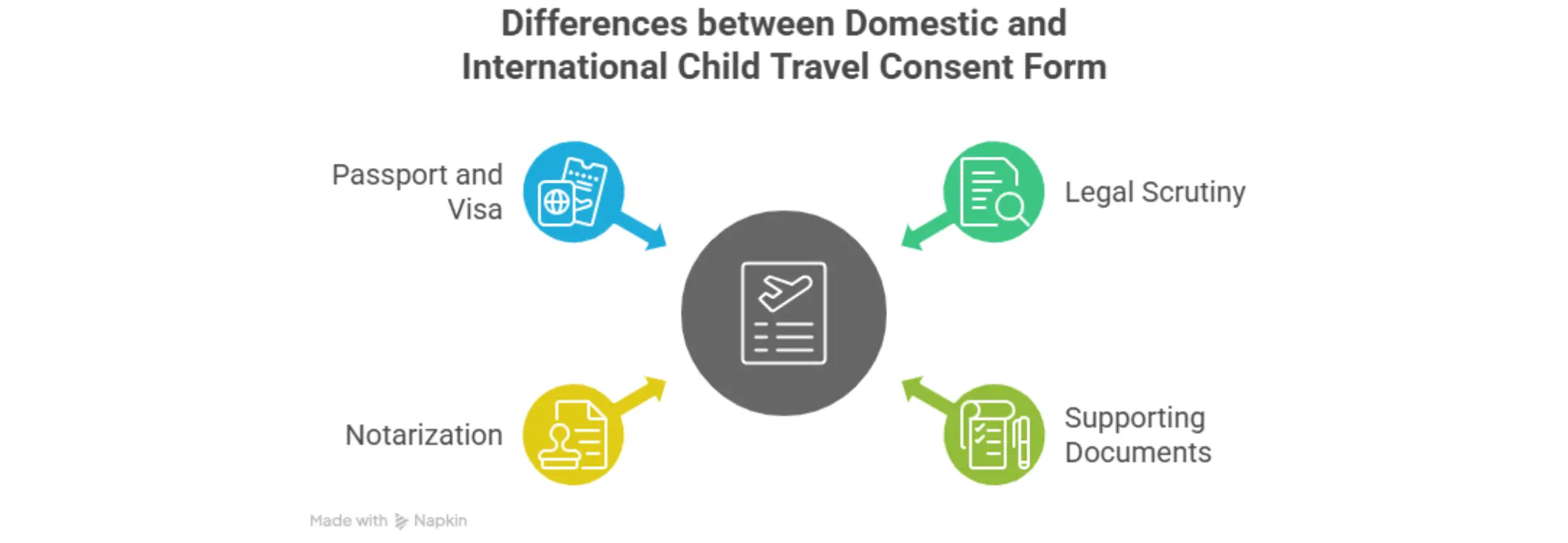
Legal Scrutiny Levels
Domestic travel receives lighter scrutiny with airlines and schools requiring basic written consent. International travel involves significant legal scrutiny from customs and immigration officials trained to identify trafficking and abduction.
Domestic procedures typically move quickly while international procedures involve detailed document review.
Supporting Documents Often Requested
Domestic travel typically requires only the consent form itself. International travel frequently requires birth certificates, custody orders, passports, and sometimes guardianship documentation proving signatory authority.
Border officials may request any documentation suggesting the child has other legal guardians whose consent may also be required.
Notarization Expectations
Domestic consent forms are recommended but not required to be notarized. International consent forms should be notarized to provide official authentication of parental signatures.
Many countries specifically require notarized forms. Some require additional apostille certification adding another layer of official verification.
Passport and Visa Linkage
Domestic travel requires only identification like birth certificates or school IDs. International travel requires valid passports and sometimes visas. Consent forms must clearly identify the child matching passport information exactly.
Mismatches between consent forms and passport information raise red flags that forms may be fraudulent or that the child's identity is unclear.
Special Considerations for Different Travel Scenarios
One Parent Traveling Internationally with a Child
When a single parent travels internationally with the child, the non-traveling parent should sign and notarize a consent form authorizing the trip. US Customs and Border Protection strongly recommends this documentation even when parents are married.
This prevents complications at borders where officials must verify that non-traveling parents authorized the trip. It particularly protects situations where children do not share the traveling parent's surname.
Traveling with Grandparents or Non-Family Members
When children travel internationally with grandparents, the parents must provide notarized consent forms specifically authorizing this travel. Non-family members like coaches or youth group leaders require consent documenting parental authorization.
Extra care in providing complete contact information and detailed travel itineraries becomes important when children travel with non-parents internationally.
Emergency Travel Situations
Emergency travel sometimes occurs without opportunity for normal notarization. In these situations, written parental authorization should be provided even without notarization, along with explanations of emergency circumstances.
Travel authorities may accept unnotarized emergency consent if parents provide additional verification through phone calls or other documentation.
How to Prepare the Right Form for Your Travel
What to Include Depending on Travel Type
Domestic consent forms should include the child's full name and date of birth, the traveling adult's name and relationship to the child, travel dates and destinations, parental authorization statement, and parent signatures.
International consent forms must add passport number information, detailed itinerary information, contact information for both parents and traveling adult, emergency contact information, medical authorization if needed, and notary authentication with signature.
Matching Consent Scope to the Trip
Consent forms should specify exact dates and destinations the child will visit. Vague language like "permission to travel during the month of July" creates ambiguity that border officials question.
Specific scope documentation like "travel from New York to London from July 1 to July 15, 2026" removes ambiguity about what was authorized.
Validity Period and Destination Clarity
International consent forms typically remain valid for the period specified. Separate forms are needed for different trips or substantially changed itineraries.
Clearly identifying all destinations prevents border disputes about whether travel to a particular country was actually authorized.
How to Create These Forms Using Ziji Legal Forms
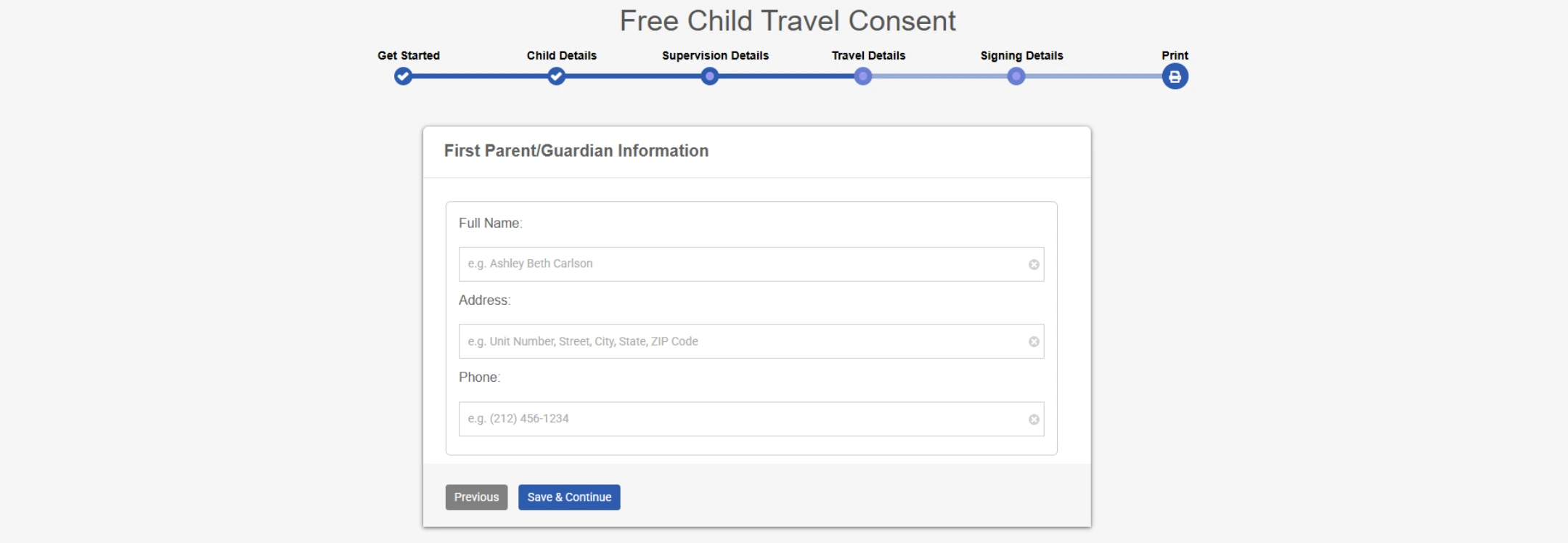
1. Choose template
2. Add Child Details
Enter the child's full legal name exactly as shown on birth certificates, date of birth, passport number if available, citizenship, and any identifying information border officials might require.
3. Add Supervision Details
Specify who will supervise the child during travel including their relationship to the child, contact information, address where the child will stay, and emergency contact procedures.
4. Add Travel Details
Specify exact travel dates including departure date and expected return date, all destinations including cities and countries, flight information if known, purpose of travel, and any other relevant travel logistics.
5. Signing Details, Preview and print
Identify which parent or guardian must sign based on custody arrangements, have all required signatories sign and date the form, consider having signatures notarized especially for international travel, attach supporting documents like birth certificates or custody orders, and then download in PDF format with multiple copies for the child and traveling adult.
Template Features and Customization Options
Ziji templates include guided sections adapting to domestic versus international travel requirements. The templates automatically incorporate appropriate language and requirements for your travel type.
International templates include prompts for notarization information and apostille certification. Domestic templates provide simplified consent language for local travel situations. Both templates include fields for supporting documentation references.
Conclusion: Proper Documentation Ensures Smooth Travel
Domestic and international child travel consent forms protect children while authorizing legitimate travel. Understanding the differences between domestic and international requirements and creating appropriate documentation with Ziji Legal Forms' specialized templates ensures smooth travel experiences free from border delays or form rejection.
Child Travel Consent FAQs
What is a child travel consent also known as?
A child travel consent is also known as the following: child travel consent form, consent letter for travel, travel consent letter, or travel authorization letter/form.
What is a child travel consent form?
The child travel consent is a consent letter that grants authorization for a minor to travel alone or with another adult, and without their parents or legal guardians. This travel consent is required for both domestic and international travels when the parents or legal guardians are not present for the trip. Consider having a child travel consent form for each leg of the travel if the itinerary has multiple stops, especially for longer trips.
What age is considered a minor?
In most jurisdictions, once a person turns 18, that is the age of majority and that individual is considered an adult, however there are other jurisdictions that use 19 to 21 as the threshold. Typically, child travel consent forms are used for individuals under 18 years of age.
Why do you need a child travel consent form?
Child abduction is an issue that’s taken seriously by the authorities at the borders. A child travel consent is proof that the child has received parental consent to travel. Without signing a child travel consent, authorities at the border may prevent or delay your child’s travel plans.
There are many situations that require the use of a child travel consent, for example:
- When the parents are legally separated, the child is traveling with only one parent.
- When the child is traveling with a sports team, religious organization, or during a school trip.
- When the child is studying away from home in a boarding school.
- When the child is traveling with extended family such as aunts, uncles, and grandparents.
- When the child is traveling alone to meet extended family or parent/legal guardian.
Do I need to notarize my child travel consent form?
It is strongly recommended to have your child travel consent form notarized despite that it is not required in all jurisdictions. Having a notarized child travel consent form is the best proof that your child has permission to travel and will prevent any potential delays from border agents during your child’s travel.
Can a child travel consent cover multiple trips?
Yes. You can draft the form to cover more than one trip if the travel will be recurring, such as regular visits to relatives or ongoing participation in an extracurricular activity. However, including specific travel dates and destinations is recommended to avoid confusion with authorities.
Who can be authorized to travel with the child?
Any responsible adult who is at least 18 years old can be named in the form. This could include relatives, family friends, coaches, teachers, or group leaders. The chosen individual should be someone you trust to supervise your child and handle any travel-related issues that may arise.
What information should be included in a child travel consent form?
The form should list the child’s full name, date of birth, travel dates, destinations, and the accompanying adult’s full name and contact information. It should also include the parents’ or legal guardians’ names, contact details, and signatures, as well as any special instructions or relevant medical information.
Is a child travel consent required for domestic flights?
Some airlines may require additional documentation for minors traveling without both parents, even on domestic routes. It’s best to check with the airline in advance and have a consent form ready to avoid last-minute complications.
Why is notarizing a child travel consent recommended?
Notarization is not always required by law, but it adds an extra layer of authenticity to the document. A notarized form confirms that the signatures are genuine, which makes it more likely to be accepted by border officials, airline staff, and foreign authorities—reducing the risk of delays during travel.
What jurisdictions can use our child travel consent form?
You can use our template to create a legal and valid child travel consent form for the following jurisdictions:
|
Alabama
Alaska
Arizona
Arkansas
California
Colorado
Connecticut
Delaware
District of Columbia
Florida
Georgia
Hawaii
Idaho
Illinois
Indiana
Iowa
Kansas
Kentucky
Louisiana
Maine
Maryland
Massachusetts
Michigan
Minnesota
Mississippi
Missouri
Montana
Nebraska
Nevada
New Hampshire
New Jersey
New Mexico
New York
North Carolina
North Dakota
Ohio
Oklahoma
Oregon
Pennsylvania
Rhode Island
South Carolina
South Dakota
Tennessee
Texas
Utah
Vermont
Virginia
Washington
West Virginia
Wisconsin
Wyoming |
AL
AK
AZ
AR
CA
CO
CT
DE
DC
FL
GA
HI
ID
IL
IN
IA
KS
KY
LA
ME
MD
MA
MI
MN
MS
MO
MT
NE
NV
NH
NJ
NM
NY
NC
ND
OH
OK
OR
PA
RI
SC
SD
TN
TX
UT
VT
VA
WA
WV
WI
WY |





 United States
 Canada