TL;DR- Both legal parents must sign child travel consent forms unless one has sole custody established through court order, which eliminates the requirement for the other parent's signature
- Married parents both need to sign unless one parent is deceased or has completely lost parental rights through legal proceedings that formally granted sole custody to the other parent
- Divorced or separated parents must sign if they have custody rights or decision-making authority, even if the child is not traveling with them, unless a court order explicitly waives this requirement
- Legal guardians and custodians can sign instead of parents only if they have formal legal guardianship established through court proceedings, not simply based on temporary caregiving arrangements
- Sole custody eliminates the requirement for the other parent's signature because that parent no longer holds legal authority over the child, though proof of custody status may be required
- Non-legal caregivers like relatives or babysitters cannot sign consent forms because they lack parental authority regardless of how long they care for the child
- Ziji Legal Forms provides customizable child travel consent templates that adapt to different custody scenarios, ensuring the correct signatories are identified and proper authorization language is used
Introduction: Why the Signer Matters as Much as the Form
Many parents and guardians assume that getting a child travel consent form signed is simply a matter of filling out paperwork. In reality, who signs the form matters just as much as the form's content. Using the wrong signer, failing to obtain signatures from all required parents, or having non-authorized individuals sign can result in travel delays, form rejection, or border officials preventing the child from traveling.
Airlines and border officials care deeply about who signs these forms because valid signatures verify that people with legal authority over the child actually authorized the travel. Understanding who has signing authority prevents last-minute travel disruptions.
What Signing Authority Means in Child Travel
Legal Authority Versus Caregiving Roles
Legal authority over a child differs fundamentally from temporary caregiving roles. Grandparents, aunts, uncles, babysitters, and other family members may care for children regularly but lack legal authority to authorize travel or medical treatment.
Legal authority comes through parenthood, court-ordered guardianship, or custody arrangements. Having a court-ordered relationship to the child establishes the legal standing required to sign binding consent forms that travel authorities recognize.
Why Airlines and Border Officials Care About Signers
Travel authorities verify signatory authority because child abduction and unauthorized travel represent serious legal concerns. Requiring authorized signatures prevents non-custodial parents from unauthorized travel with children, protects children from trafficking, and ensures custody orders are respected across state and international borders.
Border officials understand that valid signatures from people with genuine authority provide the best protection that travel is actually authorized. This is why they scrutinize consent forms and request supporting documentation proving signatory authority.
Parents as Signatories
Both Parents Versus One Parent
Married parents living together typically both need to sign consent forms unless one parent has obtained sole custody through court order. Many people incorrectly believe that the parent traveling with the child only needs to sign, but travel authorities generally require signatures from all parents with legal authority.
This requirement exists because non-traveling parents retain legal authority over custody decisions even if the traveling parent has the child physically. Both parents' consent protects the child and confirms that neither parent objects to the travel.
Married Parents and Default Parental Rights
When parents are married and have not been through custody proceedings, both typically hold equal legal authority over the child. This equal authority means both must consent to travel arrangements outside the home.
Custody courts do not automatically award sole custody in marriage situations. Default authority belongs to both parents equally unless they have divorced or formally separated with custody orders.
Divorced or Separated Parents
Divorced or separated parents must sign consent forms according to custody orders established by courts. If a custody order grants one parent sole custody, only that parent needs to sign. If the order grants joint custody, both parents need to sign even if only one is traveling with the child.
Custody orders may also specify that one parent has decision-making authority for certain matters like education or travel while the other maintains general custody. Understanding specific custody order language determines which parents must sign.
Sole Custody Situations
Sole custody eliminates the requirement for the non-custodial parent's signature because that parent no longer has legal authority. Courts award sole custody through formal proceedings that explicitly state that one parent has exclusive authority while the other's parental rights are limited.
Death of one parent automatically results in sole custody for the surviving parent. Proof of the deceased parent's death may still be required through death certificates.
Legal Guardians and Custodians
Who Qualifies as a Legal Guardian
Legal guardians are individuals appointed by courts to have authority over children when parents cannot or will not exercise that authority. Legal guardianship requires formal court proceedings where judges determine that guardianship is in the child's best interest.
Common guardianship situations include when both parents have died, when parents have abandoned the child, or when parents are unable to provide care due to incarceration, serious illness, or incapacity.
Difference Between Guardianship and Custody
Custody typically results from parental separation or divorce and establishes which parent or parents make decisions about the child's residence, education, and major life choices. Guardianship exists when people who are not parents take full responsibility for the child through court appointment.
Both guardianship and custody create legal authority to sign consent forms. Temporary guardianship arrangements without formal court orders do not provide sufficient authority.
Foster Parents and Temporary Guardians
Foster parents typically do not have legal authority to sign child travel consent forms unless they have been formally appointed as legal guardians through court proceedings. Foster parents provide temporary care under supervision of child welfare agencies, but this temporary role does not grant independent legal authority.
Grandparents, aunts, and other relatives serving as temporary guardians while parents are traveling, incarcerated, or otherwise unavailable may lack formal legal authority if courts have not appointed them as guardians. Temporary care arrangements differ fundamentally from legal guardianship.
Supporting Documents Often Requested
Custody Orders and Court Documents
Travel officials frequently request custody orders as proof of signatory authority. These court documents establish which parent or parents have decision-making responsibility and confirm that signatories actually hold legal authority.
Court-certified copies provide stronger proof than informal copies. Carrying certified custody documents prevents disputes about whether signatories have claimed authority they do not actually hold.
Guardianship Papers and Formal Appointments
Legal guardianship documents confirm that individuals were formally appointed as guardians with full legal authority. Court order appointing guardians provides definitive proof of authority.
Foster parents should carry letters from child welfare agencies confirming their status and that they are authorized to transport the child.
Birth Certificates
They identify the child's legal parents and establish parentage. When custody status is unclear or no custody order exists, birth certificates establish which parents are legally responsible for the child.
International travel frequently requires certified long-form birth certificates showing parents' names, as these documents have more legal weight than casual birth certificates.
Court-Issued Travel Permissions
In some custody disputes, courts issue specific travel authorizations allowing one parent to travel internationally with the child without the other parent's consent. These court orders supersede normal requirements for both parents' signatures.
Such orders prove that courts have specifically determined that one parent's authorization is sufficient despite ongoing parental authority in both parents.
How to Avoid Consent Form Rejection
Verifying Who Must Sign Before Travel
Before completing consent forms, determine what custody arrangement applies to the specific child. This requires reviewing custody orders if they exist or understanding parental status if no formal custody determination has been made.
Contacting a family law attorney for clarification ensures correct identification of required signatories before completing forms that might be rejected.
Aligning Consent Language with Custody Status
Consent form language should accurately reflect custody status. Forms should not claim sole custody if joint custody exists, should not claim one parent has authority if both do, and should identify signatories accurately based on actual legal status.
Customizable templates that adapt language to specific custody situations prevent misstatements of authority that officials might question.
Keeping Documentation Consistent
Travel documents should tell consistent stories about custody and parental authority. Consent forms, custody orders, birth certificates, and passport documents should all identify parents consistently.
Discrepancies between documents create red flags that officials investigate, potentially delaying travel or preventing it entirely.
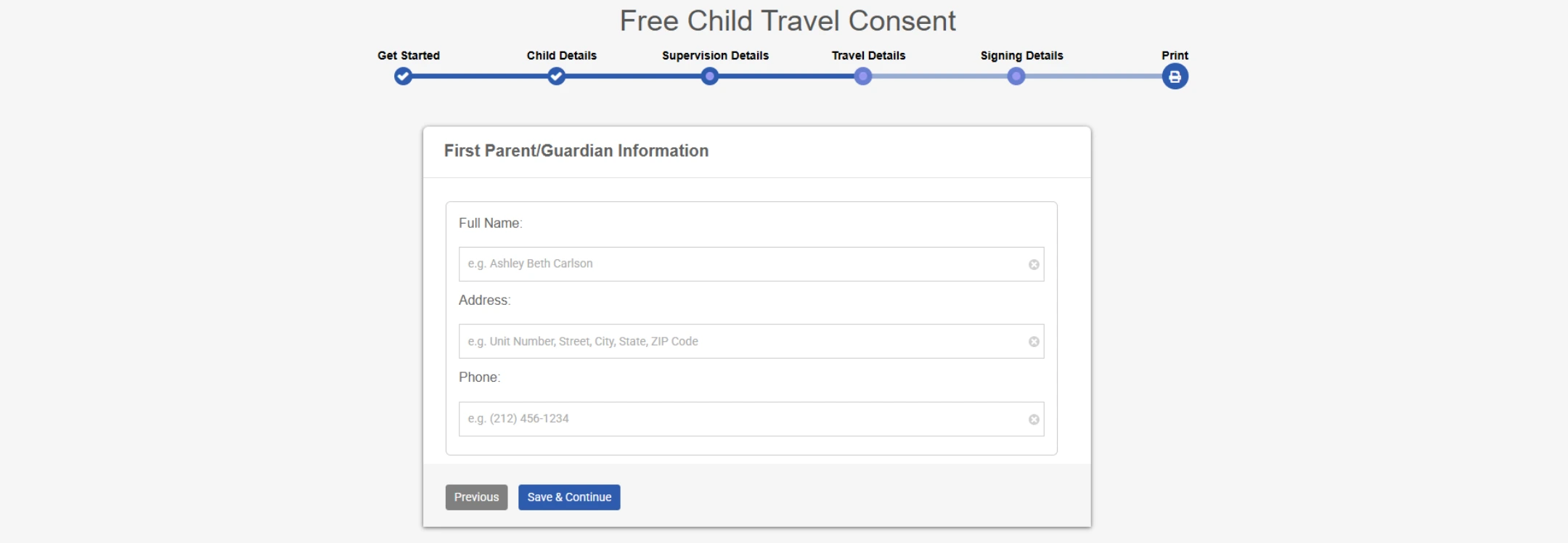
How to Create Proper Child Travel Consent Forms Using Ziji Legal Forms
1. Choose template
2. Add Child Details
Enter the child's full legal name, date of birth, passport number if available, and citizenship information to clearly identify the child traveling.
3. Add Supervision Details
Specify who will be supervising the child during travel, their relationship to the child, their contact information, and where the child will stay, ensuring authorities know who is caring for the child during the absence.
4. Add Travel Details
Specify destinations, departure and return dates, flight information if applicable, and the nature of the trip to clearly establish travel scope and duration.
5. Signing Details, Preview and Print.
Identify which parent or guardian must sign based on custody arrangement, have appropriate signatories sign and date the form, consider having signatures notarized for international travel, and then download in PDF or Word format with multiple copies for all necessary parties.
Template Features Supporting Correct Signatories
Ziji templates include guided questions about custody status that help users identify which parents or guardians must sign. The templates automatically adjust language based on custody arrangements selected.
For sole custody situations, templates eliminate requirements for non-custodial parent signatures. For joint custody, templates require both signatures. For guardianship situations, templates prompt for guardianship documentation information.
Conclusion: Get Signatories Right to Prevent Travel Delays
Proper signer identification and accurate authority documentation prevent travel delays, form rejections, and border disputes. Using Ziji Legal Forms' customizable child travel consent templates that adapt to your specific custody situation ensures correct signatories are identified and proper authorization language is used throughout the form.
Child Travel Consent FAQs
What is a child travel consent also known as?
A child travel consent is also known as the following: child travel consent form, consent letter for travel, travel consent letter, or travel authorization letter/form.
What is a child travel consent form?
The child travel consent is a consent letter that grants authorization for a minor to travel alone or with another adult, and without their parents or legal guardians. This travel consent is required for both domestic and international travels when the parents or legal guardians are not present for the trip. Consider having a child travel consent form for each leg of the travel if the itinerary has multiple stops, especially for longer trips.
What age is considered a minor?
In most jurisdictions, once a person turns 18, that is the age of majority and that individual is considered an adult, however there are other jurisdictions that use 19 to 21 as the threshold. Typically, child travel consent forms are used for individuals under 18 years of age.
Why do you need a child travel consent form?
Child abduction is an issue that’s taken seriously by the authorities at the borders. A child travel consent is proof that the child has received parental consent to travel. Without signing a child travel consent, authorities at the border may prevent or delay your child’s travel plans.
There are many situations that require the use of a child travel consent, for example:
- When the parents are legally separated, the child is traveling with only one parent.
- When the child is traveling with a sports team, religious organization, or during a school trip.
- When the child is studying away from home in a boarding school.
- When the child is traveling with extended family such as aunts, uncles, and grandparents.
- When the child is traveling alone to meet extended family or parent/legal guardian.
Do I need to notarize my child travel consent form?
It is strongly recommended to have your child travel consent form notarized despite that it is not required in all jurisdictions. Having a notarized child travel consent form is the best proof that your child has permission to travel and will prevent any potential delays from border agents during your child’s travel.
Can a child travel consent cover multiple trips?
Yes. You can draft the form to cover more than one trip if the travel will be recurring, such as regular visits to relatives or ongoing participation in an extracurricular activity. However, including specific travel dates and destinations is recommended to avoid confusion with authorities.
Who can be authorized to travel with the child?
Any responsible adult who is at least 18 years old can be named in the form. This could include relatives, family friends, coaches, teachers, or group leaders. The chosen individual should be someone you trust to supervise your child and handle any travel-related issues that may arise.
What information should be included in a child travel consent form?
The form should list the child’s full name, date of birth, travel dates, destinations, and the accompanying adult’s full name and contact information. It should also include the parents’ or legal guardians’ names, contact details, and signatures, as well as any special instructions or relevant medical information.
Is a child travel consent required for domestic flights?
Some airlines may require additional documentation for minors traveling without both parents, even on domestic routes. It’s best to check with the airline in advance and have a consent form ready to avoid last-minute complications.
Why is notarizing a child travel consent recommended?
Notarization is not always required by law, but it adds an extra layer of authenticity to the document. A notarized form confirms that the signatures are genuine, which makes it more likely to be accepted by border officials, airline staff, and foreign authorities—reducing the risk of delays during travel.
What jurisdictions can use our child travel consent form?
You can use our template to create a legal and valid child travel consent form for the following jurisdictions:
|
Alabama
Alaska
Arizona
Arkansas
California
Colorado
Connecticut
Delaware
District of Columbia
Florida
Georgia
Hawaii
Idaho
Illinois
Indiana
Iowa
Kansas
Kentucky
Louisiana
Maine
Maryland
Massachusetts
Michigan
Minnesota
Mississippi
Missouri
Montana
Nebraska
Nevada
New Hampshire
New Jersey
New Mexico
New York
North Carolina
North Dakota
Ohio
Oklahoma
Oregon
Pennsylvania
Rhode Island
South Carolina
South Dakota
Tennessee
Texas
Utah
Vermont
Virginia
Washington
West Virginia
Wisconsin
Wyoming |
AL
AK
AZ
AR
CA
CO
CT
DE
DC
FL
GA
HI
ID
IL
IN
IA
KS
KY
LA
ME
MD
MA
MI
MN
MS
MO
MT
NE
NV
NH
NJ
NM
NY
NC
ND
OH
OK
OR
PA
RI
SC
SD
TN
TX
UT
VT
VA
WA
WV
WI
WY |






 United States
 Canada