TL;DR- Verbal agreements are legally binding in the United States if they include an offer, acceptance, and mutual exchange of value, but proving these terms in court is incredibly difficult without a physical paper trail.
- Under the Statute of Frauds, any service agreement that cannot be completed within one year from its start date must be in writing to be legally enforceable.
- Relying on spoken deals exposes your business to major financial risks, including scope creep, payment delays, and expensive legal battles that often cost more than the project itself.
- If a verbal agreement is disputed, courts rely on supporting evidence like text messages, emails, and invoices, or they may award equitable remedies like quantum meruit to cover the reasonable market value of the work performed.
- You can easily prevent these legal headaches by using Ziji Legal Forms to create a customized, professional Service Agreement that clearly defines your scope of work and payment terms.
Introduction
Modern commercial interactions frequently initiate without formal paperwork, especially in fast-paced service industries. Many freelancers, consultants, contractors, and small business owners routinely begin work based on a simple phone call, an informal email exchange, or a traditional handshake. These rapid project initiations are driven by mutual trust and the immediate desire to capitalize on new opportunities.
In the United States, verbal agreements can be legally enforceable under general contract law. If the fundamental requirements of a contract are met, spoken promises carry legal weight. However, proving the specific terms of a verbal agreement is difficult when disputes arise. Without an objective record, resolving a conflict often leads to a lengthy, expensive credibility contest in court. Consequently, executing a written Service Agreement USA is the most reliable method to secure strong legal protection for both parties.
What Is a Verbal Service Agreement?
Definition of an Oral Contract
An oral contract is a binding agreement established through spoken words rather than a physical or digital document. It represents a mutual agreement between parties who commit to perform specific duties.
The core of this transaction involves the exchange of services for compensation, which serves as the legal consideration required to bind the parties. No formal written contract is required to establish this relationship, meaning that a spoken deal is legally valid from the moment the parties reach an understanding.
Common Situations Where Verbal Agreements Occur
These informal agreements frequently happen in fast-moving industries where immediate action is valued over administrative compliance. Freelance projects often start immediately after a brief introductory call. Home repair services are commonly initiated based on a verbal estimate and a handshake.
Consulting engagements also utilize verbal agreements, particularly when an advisor is brought on to address an urgent challenge. Additionally, small business service arrangements and repeat business relationships rely on verbal renewals, as the established trust makes formal documentation seem unnecessary.
Are Verbal Service Agreements Legally Binding in the United States?
The Basic Elements of an Enforceable Contract
Under US common law, a verbal contract must satisfy four primary criteria to be considered legally valid. First, one party must make a definite offer proposing clear terms of service. Second, the other party must provide an unequivocal acceptance of that offer without proposing new modifications. Third, the contract must feature consideration, meaning there is a mutual exchange of value.
This consideration typically involves a promise to perform work in exchange for financial compensation. Finally, there must be mutual intent, showing that both parties intended to create a legally binding relationship.
When Courts May Enforce Oral Agreements
A court will enforce a spoken agreement if sufficient evidence is presented to substantiate the claim. When credible evidence exists showing that both parties agreed to the same terms, the contract is upheld. The strongest proof is often that services were performed by the provider and accepted by the client, indicating active performance.
Furthermore, evidence that payments were made and accepted demonstrates a clear course of business conduct. Finally, witness testimony from neutral third parties who observed the verbal agreement can provide essential validation in court.
State Laws May Differ
Although general contract principles are consistent, the enforcement of verbal agreements is heavily governed by state-level statutes. For instance, state laws vary regarding the statutes of limitations for filing a lawsuit based on a breach of an oral contract, which is often shorter than the timeframe allowed for written agreements. Additionally, different states maintain unique requirements for what constitutes sufficient written evidence under their local commerce regulations.
For these reasons, service providers must verify the local legal requirements of their specific jurisdictions to avoid enforceability failures.
Situations Where a Written Agreement Is Usually Required
Understanding the Statute of Frauds
The Statute of Frauds is a foundational legal doctrine adopted across the United States that prevents the enforcement of certain high-stakes contracts unless they are documented in writing. The primary purpose of this statute is to prevent fraudulent claims by requiring a signed written record for specific transactions. If a service agreement falls under the scope of this law, an oral contract is deemed unenforceable, meaning it cannot be legally enforced in a breach of contract lawsuit.
Examples
Several key categories of contracts fall directly under the Statute of Frauds. Any agreement involving the sale or transfer of real estate always requires written documentation. Crucially for service providers, any agreement that cannot be completed within one year from its start date must be in writing.
Additionally, certain high-value transactions, such as the sale of commercial goods valued at five hundred dollars or more, must be written. Other state-specific requirements, such as agreements to assume the debt of another party or complex intellectual property transfers, also necessitate written contracts.
The Biggest Risks of Relying on a Verbal Service Agreement
Disputes Over Scope of Work
Operating under a verbal agreement exposes businesses to immense operational risks. Without a written description of deliverables, the parties often form different interpretations of what was promised. This mismatch leads to scope creep, where the client expects additional revisions or services without an increase in compensation. The service provider must then choose between absorbing the cost of unpaid labor or refusing the request, which often destroys the business relationship.
Payment Disagreements
Financial transactions are highly susceptible to disputes when terms are only spoken. Disagreements frequently arise over hourly rates, overall project fees, and payment schedules. Furthermore, verbal agreements rarely address critical details such as payment deadlines, upfront deposits, or late payment interest charges.
The reimbursement of business expenses incurred during the project can also become a source of contention when there is no written record. When an invoice does not align with the client's subjective memory of the conversation, payments are often delayed or withheld entirely.
No Clear Deadlines or Deliverables
Spoken agreements routinely lack structured timelines, which leads to significant project delays. The contractor may progress at a pace they consider reasonable, while the client becomes increasingly frustrated by perceived delays. Because there are no documented deadlines, holding either party accountable for delays is difficult.
Furthermore, without a detailed list of completed deliverables, determining when a project is officially finished becomes highly subjective, allowing clients to delay final sign-off and project closure.
Difficulty Proving Contract Terms
In a legal dispute, the primary hurdle of an oral agreement is the lack of physical evidence. When a conflict arises, the court is presented with conflicting recollections from each party. Without a signed document, the outcome depends entirely on a subjective credibility contest between the litigants.
If neither side can produce corroborating evidence, a judge may determine that the verbal contract terms are too vague to be legally enforced, leaving the injured party without a remedy.
Increased Litigation Costs
Resolving a verbal contract dispute in court is exceptionally expensive. Attorneys must spend extensive billable hours gathering circumstantial proof, interviewing witnesses, and conducting depositions to reconstruct the spoken agreement. This complex process dramatically increases litigation costs, which can quickly exceed the actual monetary value of the disputed services.
Additionally, the high level of legal uncertainty increases the risk of an unfavorable judicial outcome, making litigation a highly inefficient route for small businesses.
Why Written Evidence Matters in Court
In a verbal service agreement dispute, the strongest case usually comes from clear records. A court may review emails, text messages, invoices, bank transfers, signed estimates, and project notes to understand what both parties agreed to. These records help prove the scope of work, payment terms, timeline, and conduct of each party.
This is important because a judge cannot enforce unclear promises. If the terms are vague, the court may decide that no enforceable agreement exists. A written service agreement reduces this risk by giving both parties one clear source of truth before the work begins.
How Courts Determine Whether a Verbal Agreement Exists
Emails and Text Messages
Modern courts heavily analyze digital communications to reconstruct the terms of a spoken contract. Emails and text messages serve as valuable supporting evidence of an active business relationship. If a service provider sends a follow-up email summarizing the verbal discussion and the client replies with confirmation, this digital exchange provides written evidence of mutual agreement. These records are critical for demonstrating that both parties shared the same understanding of the project.
Invoices and Payment Records
Financial documentation provides powerful proof of a commercial relationship. Courts examine sent invoices, bank deposits, and payment receipts to establish a course of dealing. When a client consistently pays invoices sent by a service provider, this conduct demonstrates that both parties recognized and accepted the terms of the verbal agreement. These financial records provide an objective baseline that contradicts any claim that no contract existed.
Witness Statements
When physical documentation is lacking, courts rely on witness statements to verify the verbal contract. Statements from neutral third parties who observed the negotiations or witnessed the work being performed are highly valuable.
However, courts apply strict scrutiny to witness credibility, as statements from friends, relatives, or close business associates may be viewed as biased. Independent witnesses who have no financial stake in the project provide the most persuasive evidence.
Conduct of the Parties
The actual behavior of the parties is a primary factor in determining contract validity. If a contractor performs services with the client's knowledge, and the client accepts the benefits of those services, this conduct indicates that both parties treated the deal as real. The completion of project milestones and the acceptance of completed work demonstrate a mutual understanding.
Under these circumstances, courts may find that an implied-in-fact contract exists, overriding any lack of formal paperwork.
What Quantum Meruit Means for Service Providers
When a verbal agreement cannot be fully proven, a court may still consider whether the service provider deserves payment for the reasonable value of the work performed. This legal principle is often called quantum meruit. It does not enforce every claimed contract term. Instead, it focuses on whether one party received a benefit and whether it would be unfair to keep that benefit without paying.
For service providers, this can offer limited protection. However, it is not as strong as a written contract. The court may award less than the original amount discussed. A written agreement gives better protection because it states the exact price, payment schedule, and scope.
Verbal Service Agreement vs Written Service Agreement
Comparing a verbal service agreement to a written service agreement highlights the profound differences in security and clarity. Regarding the proof of terms, a verbal agreement remains exceptionally difficult to verify, while a written agreement provides clear and immediate documentation of all conditions. When examining scope definition, a verbal contract is often unclear and prone to misunderstandings, whereas a written contract outlines detailed and specific deliverables.
Payment protection is also highly limited in verbal arrangements, leaving service providers vulnerable to withheld compensation. In contrast, a written contract provides strong payment protection by codifying exact rates and schedules. Dispute resolution is highly challenging under a spoken deal, often requiring expensive court intervention. Conversely, a written agreement makes dispute resolution much easier by establishing predefined mediation or arbitration procedures.
Ultimately, the legal risk associated with verbal agreements is much higher, while written agreements significantly lower liability exposure. Furthermore, executing an Online Service Agreement elevates business professionalism. Operating with a written Service Agreement America signals credibility to clients, which helps build sustainable long-term business partnerships.
Real-World Examples of Problems Caused by Verbal Agreements
Example 1: Freelancer Scope Dispute
An independent graphic designer verbally agreed to create a branding package for a small retailer. No written agreement was executed, and work began immediately. After the initial design was delivered, the retailer demanded three additional marketing banners, claiming these were discussed during the initial phone call. The designer, believing the project was already finished, refused to provide the extra work without additional compensation. Because there was no written record to define the exact deliverables, the relationship disintegrated, leaving the designer unpaid and the retailer without the final design files.
Example 2: Consultant Payment Disagreement
A business consultant agreed to optimize a logistics firm's operations during an informal meeting. The parties verbally agreed on a flat monthly rate, but did not document the agreement in writing. When the consultant submitted the first invoice, the client disputed the total amount, claiming the payment was contingent on achieving specific efficiency metrics. Without a signed contract specifying the payment rate and terms, the consultant lacked the leverage to enforce the full invoice. This dispute forced the consultant to accept a massive discount to avoid the high costs of litigation.
Example 3: Contractor Timeline Conflict
A residential contractor agreed to renovate a homeowner's kitchen based on a handshake and a verbal completion target of six weeks. Due to unexpected shipping delays, the renovation took twelve weeks to complete. The homeowner, highly frustrated by the delay, refused to make the final payment, claiming the contractor breached the verbal timeline. Since no written agreement existed to outline a schedule or address unexpected delays, the parties ended up in an expensive legal battle over who was responsible for the delay.
Best Practices for Protecting Yourself
When Providing Services
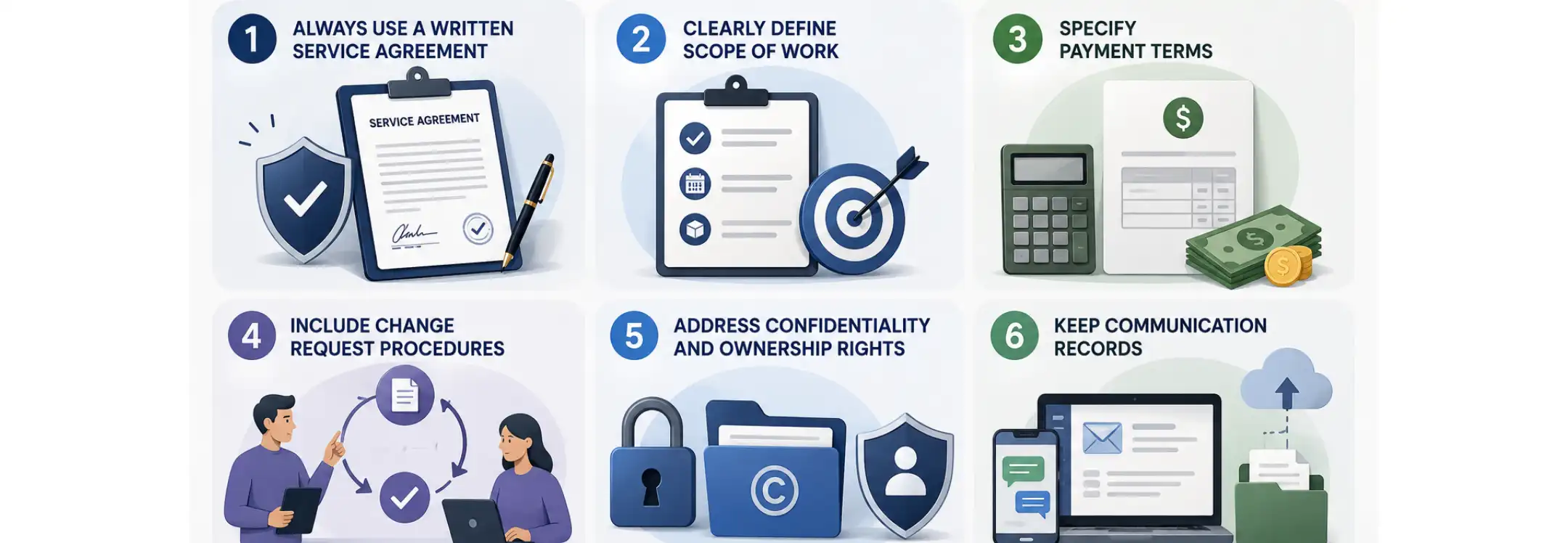
Always Use a Written Service Agreement
Operating without a written contract is a significant business risk. Service providers must make it a standard policy to never begin work until a formal written contract is fully executed by both parties. Utilizing a high-quality Service Agreement USA provides immediate protection and ensures legal recourse.
Clearly Define Scope of Work
To prevent scope creep, every contract must include an exhaustive description of the services to be performed. This section must detail all deliverables, deadlines, and project boundaries. Defining these details early prevents clients from demanding unpaid revisions later.
Specify Payment Terms
Written contracts must explicitly state the exact compensation rates, billing frequencies, and acceptable payment methods. Including clauses that outline late payment interest rates or deposit requirements provides essential leverage to ensure timely compensation.
Include Change Request Procedures
Projects frequently evolve, and a written contract must accommodate these changes. A comprehensive agreement must outline a process for change requests, requiring any deviations from the original scope to be documented in writing. This ensures that additional work is accompanied by an increase in pay.
Address Confidentiality and Ownership Rights
Protecting intellectual property and business data is critical. The contract must clearly state who retains ownership of the deliverables upon completion. Additionally, confidentiality clauses must restrict the unauthorized disclosure of sensitive business information shared during the project.
Keep Communication Records
Maintaining an archive of all project-related communications is essential for evidence. Service providers must document every verbal agreement by sending a summary email to the client immediately. This continuous paper trail makes resolving disputes far easier before they escalate.
Send a Confirmation Email Before Starting Work
If a project begins after a call or meeting, send a short confirmation email before starting any work. The email should summarize the service scope, fee, payment date, project timeline, and key deliverables. Ask the client to reply with written approval.
This simple step can create useful evidence if a dispute happens later. It also gives the client a chance to correct any misunderstanding before time and money are spent. While a confirmation email is not a full replacement for a service agreement, it is far better than relying only on memory. For stronger protection, use it along with a signed written contract.
How Ziji Legal Forms Can Help
Ziji Legal Forms provides a sophisticated online platform to create professional contracts. The platform features a customized Service Agreement template that can be tailored to specific business needs. Whether a business operates in consulting, contracting, or freelancing, this tool helps users generate a legally sound document quickly and easily.
Steps to Create Your Service Agreement
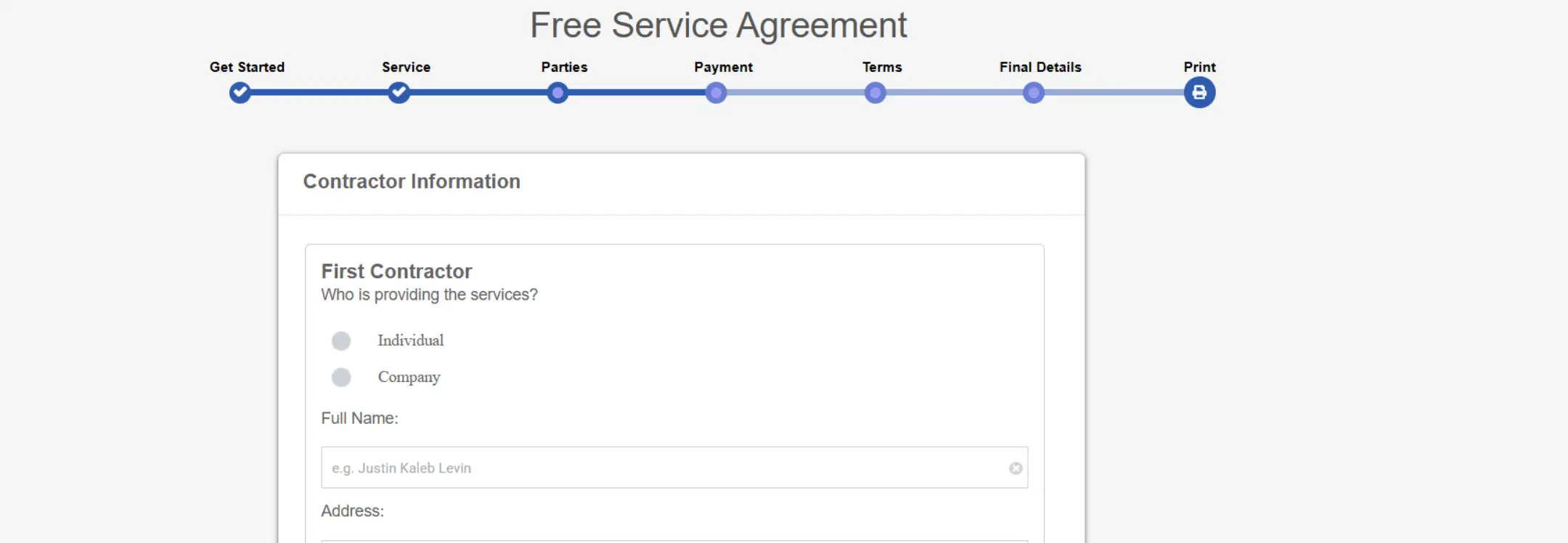
1. Choose Template
2. Add Party Details
Enter party details by accurately inputting the legal names and contact information of both the service provider and the client.
3. Add Details of the Scope of Services
Define services and scope by outlining the exact deliverables and project boundaries to prevent potential misunderstandings.
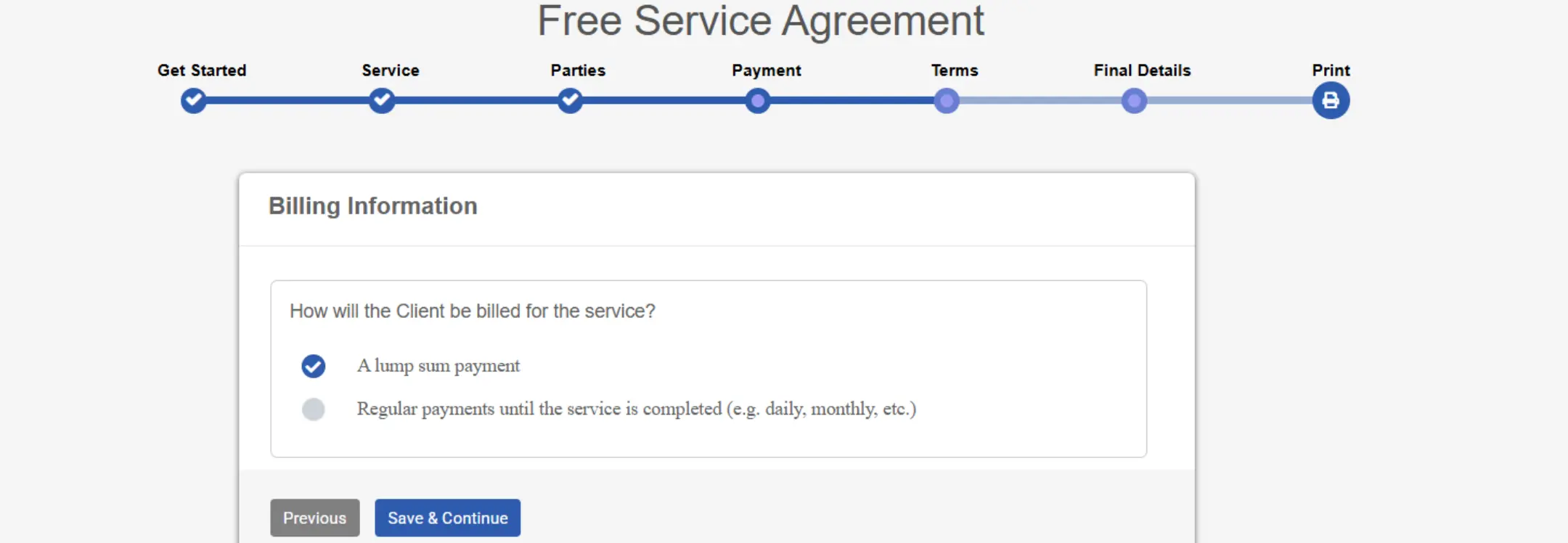
4. Define Payment Structure
Add payment terms and timelines to establish clear compensation rates, invoicing schedules, and milestone deadlines.
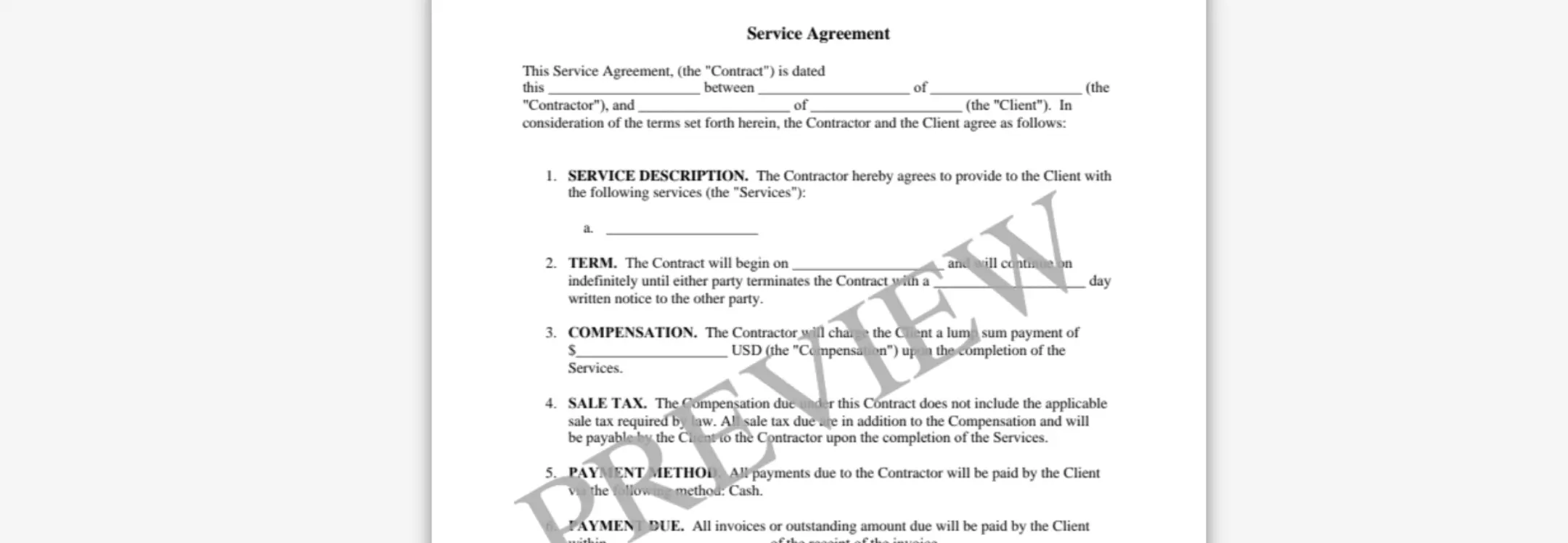
5. Preview and Download
Download and finalize the document to review the completed contract before obtaining signatures from both parties.
Conclusion
Spoken deals are legal in America, but relying on them brings massive risks to your business. Without a written contract, any future dispute quickly becomes a costly battle over conflicting memories. Under the Statute of Frauds, any service deal lasting longer than one year must be in writing. You can easily protect your cash flow by documenting clear payment schedules and work scopes before you start. Using simple tools like Ziji Legal Forms helps you make a secure written contract in minutes.
Service Agreement FAQs
What is a service agreement also known as?
A service agreement is also known as the following: consulting service agreement, general service agreement, independent contractor agreement, or service contract.
What is a service agreement?
A service agreement is an agreement that outlines the terms and conditions of the service relationship between the contractor and the client. The independent contractor is not an employee of the client and generally will determine the process to achieve the client’s goal and target outcome.
What’s the difference between an employment agreement and a service agreement?
Employment agreement is reserved only for employees and it has specific tax implications and employment rights for the parties. Generally speaking, a service agreement should be used for contractors that are hired to perform certain services for the client. The contractor is independent from the client and will generally have more control in the work process used to meet the client’s goal.
When should I use a service agreement?
Virtually any service work provided by the contractor to the client will be applicable to the service agreement. Some common work where a service agreement is used are:
- Photographer
- Musician
- Caterer
- Decorator
- Cleaner
- Landscaper
- Consultant
- IT service provider
- Web designer
- Construction and home renovator (e.g. plumber, electrician, carpenter etc)
- Child care worker (e.g. babysitter, nanny, daycare worker etc)
- Instructional provider (e.g. math tutor, music tutor, personal fitness trainer etc)
What should be listed in a service agreement?
Some general topics that should be covered in a service agreement are:
- The Parties: The name and address of the contractor and the client.
- The Work: Describe the service the contractor will be performing for the client. Itemize the duties in detail to ensure both sides understand what the expectations are for the agreement so there will not be an ambiguity in the agreement.
- Duration: How long the contract will last, whether it’s a fixed term that has a specific end date, or whether it’s for an indefinite period that has no end date for an ongoing service.
- Payment: How the contractor will be paid, such as whether it’s a lump sum payment or whether it’s a regular periodic payment. Also list what payment method will be used to pay the contractor.
- Terms: What terms that the contractor and the client have agreed to in the contract in dealing with topics such as late payment and interest, work expenses, initial deposit, contract termination etc.
- Confidentiality: Prevents the contractor from sharing sensitive business information and trade secrets of the client.
- Intellectual property: Whether the service perform by the contractor will generate intellectual property rights and decide if the contractor or the client will own those intellectual property rights.
Can a service agreement be changed after it’s signed?
Yes, but any modifications must be agreed to by both the contractor and the client. Changes should always be put in writing and signed by both parties to avoid misunderstandings and to make sure the updated terms are legally binding.
Is a written service agreement always required?
While verbal agreements may be legally valid in some situations, having a written service agreement is strongly recommended. A written contract clearly sets out the rights, duties, and expectations of each party, which helps prevent disputes and provides a record if a disagreement occurs.
What happens if one party breaches the service agreement?
If either the contractor or the client fails to follow the agreed terms, this could be considered a breach of contract. The non-breaching party may be entitled to remedies such as payment for losses, cancellation of the agreement, or enforcing the original terms—depending on the situation and applicable laws.
How does intellectual property ownership work in a service agreement?
The contract should specify whether any intellectual property created during the work belongs to the contractor or the client. Without clear terms, disputes may arise over ownership of things like designs, written materials, software, or creative works produced during the project.
Do service agreements need to comply with local laws?
Absolutely. Regardless of what is written in the agreement, it must follow the laws and regulations of the jurisdiction where the work is being performed. If a clause conflicts with statutory requirements—such as licensing, payment timelines, or safety standards—it will generally be considered invalid.
What jurisdictions can use our service agreement?
You can use our template to create a legal and valid service agreement for the following jurisdictions:
|
Alabama
Alaska
Arizona
Arkansas
California
Colorado
Connecticut
Delaware
District of Columbia
Florida
Georgia
Hawaii
Idaho
Illinois
Indiana
Iowa
Kansas
Kentucky
Louisiana
Maine
Maryland
Massachusetts
Michigan
Minnesota
Mississippi
Missouri
Montana
Nebraska
Nevada
New Hampshire
New Jersey
New Mexico
New York
North Carolina
North Dakota
Ohio
Oklahoma
Oregon
Pennsylvania
Rhode Island
South Carolina
South Dakota
Tennessee
Texas
Utah
Vermont
Virginia
Washington
West Virginia
Wisconsin
Wyoming |
AL
AK
AZ
AR
CA
CO
CT
DE
DC
FL
GA
HI
ID
IL
IN
IA
KS
KY
LA
ME
MD
MA
MI
MN
MS
MO
MT
NE
NV
NH
NJ
NM
NY
NC
ND
OH
OK
OR
PA
RI
SC
SD
TN
TX
UT
VT
VA
WA
WV
WI
WY |
Author
Mandar Sonavane
|
Legal Content Writer at Ziji Legal Forms Inc.
Symbiosis International University
Mandar is a legal content writer specializing in the development of clear, practical, and easy-to-understand legal resources. With a strong focus on legal research, content creation, and plain-language writing, he works closely with our legal professionals to ensure that legal documents and educational materials are accurate, accessible, and user-friendly. At Ziji Legal Forms Inc., Mandar is responsible for researching legal topics, drafting and reviewing content, and helping transform complex legal concepts into straightforward guidance that empowers individuals and businesses to confidently navigate their legal needs.
Reviewed By
Histon Shek
|
General Counsel and Co-Founder at Ziji Legal Forms Inc.
University of Alberta
Histon Shek was called to the Alberta Bar in 2006. He holds a BA in Sociology and Philosophy and an LLB from the University of Alberta. As co-founder of Ziji Legal Forms Inc., he focuses on making legal documents accessible and affordable, overseeing legal integrity and content development.





 United States
 Canada