Warranty Deed Filing Process: Guide to Recording Property Ownership
TL;DR
A warranty deed is a legal document that transfers property ownership while guaranteeing the seller holds clear title free from hidden claims or liens
Recording your deed at the county recorder's office converts it from a private agreement into a public record that protects your ownership rights legally
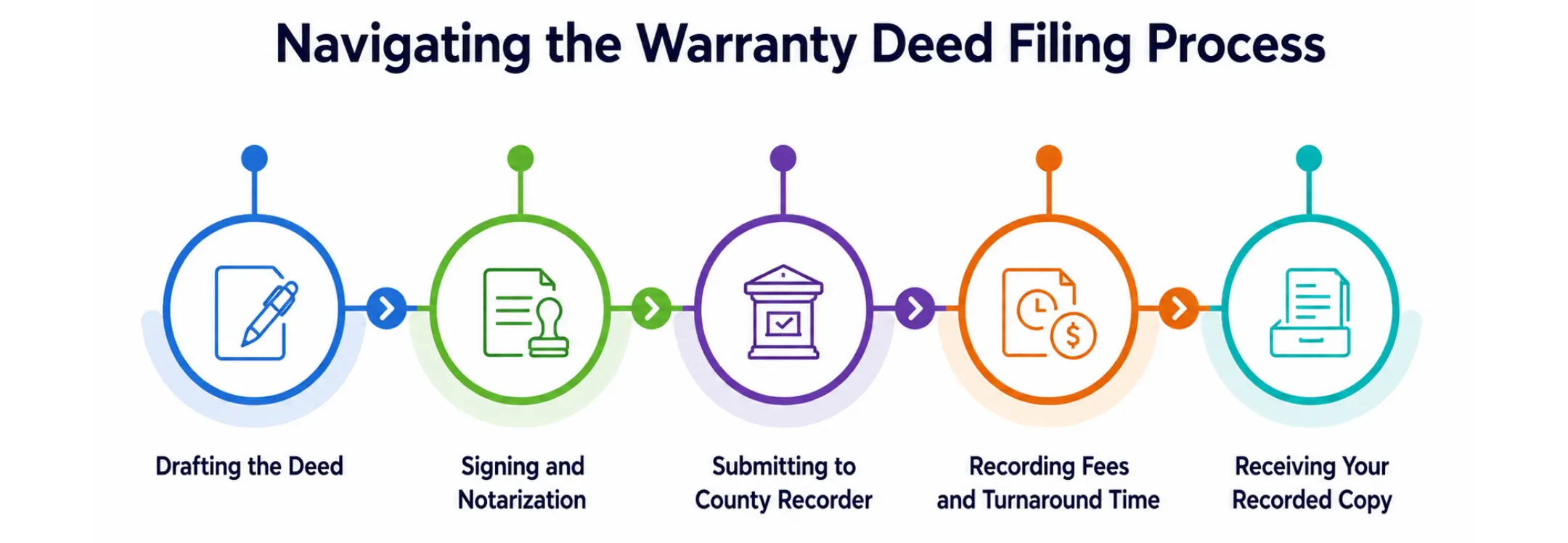
The filing process includes drafting with accurate party information, obtaining notarization, submitting to the county recorder, paying fees, and receiving the recorded copy
Proper formatting with required margins, fonts, and notary acknowledgments ensures county recorders accept your deed without rejection or delays
Ziji Legal Forms provides pre-formatted warranty deed templates that meet all county recording requirements, eliminating formatting errors and ensuring smooth filing
Introduction: Why Filing a Warranty Deed Matters
A warranty deed represents far more than a simple transfer document. It is a legal instrument that guarantees ownership rights and protects both buyers and sellers through enforceable promises about property title clarity. Understanding the filing process ensures your property transfer receives proper legal recognition while establishing your ownership in permanent public records.
Recording transforms your warranty deed from a private agreement between two parties into an official document that the entire world can access. This public notification prevents future conflicts by informing potential creditors, lienholders, and subsequent buyers that you legally own the property.
The Role of a Warranty Deed in Real Estate Transactions
How It Differs from Other Deeds
A warranty deed provides comprehensive ownership guarantees, meaning the seller warrants that they own the property free and clear with no hidden claims against it. This contrasts sharply with quitclaim deeds, which offer no ownership promises whatsoever, and special warranty deeds, which only guarantee conditions during the current owner's tenure.
The full ownership guarantee in warranty deeds means sellers remain legally responsible for resolving any title defects discovered later, even those originating before their ownership period. This significant responsibility makes warranty deeds the preferred choice for traditional home sales where lenders and buyers demand maximum protection.
Understanding Full Ownership Guarantees
Full ownership guarantees assure buyers that no undisclosed mortgages, tax liens, judgment liens, or other encumbrances burden the property. If any claims later surface, the original grantor remains obligated to resolve them or compensate the buyer for financial losses incurred.
This protection level provides peace of mind for property buyers while establishing clear accountability for sellers regarding title integrity and ownership validity.
Why Recording Is Essential
Recording your warranty deed creates a permanent public record establishing your ownership in official county systems. Without recording, your deed remains a private agreement between parties, leaving you vulnerable to competing claims or fraudulent transfers by others.
Public recording provides legal notice to the entire world of your ownership, preventing others from claiming they purchased the property in good faith from someone lacking authority to sell. Recording also establishes your priority in cases where multiple people claim ownership rights to the same property.
Step-by-Step Warranty Deed Filing Process
Drafting the Deed
Accurate drafting forms the foundation for successful recording and future legal clarity. Your deed must include the grantor's full legal name exactly as it appears on prior deeds or government documents, the grantee's full legal name as the new owner wishes it recorded, and the complete legal property description matching official county records.
Errors in names or property descriptions can result in recording rejections or create title defects that plague future sales or refinancing. Taking time to verify every detail prevents costly corrections later.
Proper signing and notarization authenticate your deed and prevent fraud. The grantor must sign the deed in the presence of a public notary who verifies the signer's identity and confirms that signing occurred voluntarily without coercion.
The notary's official seal and signature transform your document into a certified instrument that county recorders recognize as legitimate. Deeds lacking proper notarization will be rejected during the recording process, leaving your ownership transfer incomplete.
Submitting to County Recorder
County recorder submission involves delivering your completed, notarized deed to the local county clerk or recorder's office in the county where the property is located. You may submit the deed in person, by mail, or through electronic filing if your county offers this service.
Include the completed deed, any required cover sheets or recording request forms, payment of applicable recording fees, and clear instructions about where the recorded copy should be returned. Some counties may require additional information or specific form variations.
Recording Fees and Turnaround Time
Recording fees vary significantly by county, typically ranging from fifteen to fifty dollars depending on deed length and county fee structures. Some counties charge flat fees while others charge per page. Payment must accompany your deed submission or the recording office will reject it.
Turnaround times generally range from several days to a few weeks depending on county workload and submission method. In-person submissions often receive faster processing than mailed documents. Electronic submissions, where available, typically process the most quickly.
Receiving Your Recorded Copy
The recorded copy is your official proof of ownership filed in public records. The county recorder returns this certified document with official stamps, recording numbers, and index information proving your deed has been properly recorded in the county system.
Store this recorded copy in a secure location alongside your title insurance policy and other important property documents. You will need this recorded deed when refinancing, selling the property, or proving ownership in legal disputes.
Understanding Warranty Deed Structure and Formatting
Structure for Legal Clarity
Well-structured warranty deeds include clearly defined sections for grantor and grantee information, legal property descriptions, consideration amounts, covenants of title, signature blocks, and notary acknowledgments. This consistent formatting enables county recorders to properly index and file documents while making information easily accessible for future title searches.
Standardized structure also helps county personnel quickly verify that all essential elements are present before accepting the deed for recording. Missing sections or incomplete information triggers rejection and requires resubmission.
Language Precision and Legal Meaning
Precise legal language carries centuries of accumulated meaning that protects ownership rights in specific ways. Phrases like "conveys and warrants" or "in fee simple" have precise legal definitions that establish the type of ownership interest being transferred and the level of guarantees provided.
Using standard legal terminology ensures your deed receives consistent interpretation across different jurisdictions while maintaining enforceability in future legal proceedings or title disputes.
County Recording Requirements
County formatting standards ensure documents can be properly scanned, indexed, and retrieved for future reference. Standard requirements include eight and one-half by eleven inch white paper, black ink, readable fonts that is typically at least a 12pt font, and specific margin allocations for official county stamps and index information.
Margins, Fonts, and Formatting Rules
Margin requirements typically specify three inches of blank space at the top of the first page for county recording stamps and information. Side margins must be one-half to one inch wide with similar bottom margins to ensure readable reproduction and proper indexing in county systems.
Font requirements mandate readable type sizes with legible printing that survives copying, scanning, and reproduction over decades. The typical size required is a 12pt font. County recording systems often include optical character recognition technology that requires clear, standard fonts for accurate data extraction and indexing.
Notary Acknowledgment Block
The notary section validates your deed's authenticity and confirms that signatures appear genuinely made by identified parties acting voluntarily. Without proper notary acknowledgment, county recorders will reject your deed as unverified and not having satisfied statutory requirements.
The notary block must include the notary's seal in black ink, the notary's signature and printed name, commission expiration date, and jurisdiction information. Incomplete notary sections cause recording rejections and document delays.
Common Filing Errors to Avoid
Missing or incorrect legal descriptions represent the most common filing error. Copy legal descriptions directly from prior deeds or tax documents without modification or interpretation. County recorders will reject deeds with vague or incomplete property descriptions.
Incomplete notary sections cause automatic rejection. Verify that your notary included all required information including seal, signature, printed name, and commission dates before submitting your deed.
Spelling inconsistencies in grantor or grantee names between the deed and prior documents create title defects and complicate future transactions. Verify that names appear identically to how they appear in previous official documents.
Missing recording fees delay or prevent recording. Calculate fees based on your county's current schedule and include exact payment with your submission.
Inadequate margins result in rejection by county recorders scanning systems. Always maintain full required blank space at top and sides for official county processing and identification.
Simplifying the Process with Ziji Legal Forms
Creating compliant warranty deeds becomes straightforward using properly designed templates that incorporate all county recording requirements.
1. Choose template
Log into Ziji Legal Forms, navigate to the Real Estate section, and select the Warranty Deed Template matching your transaction type.
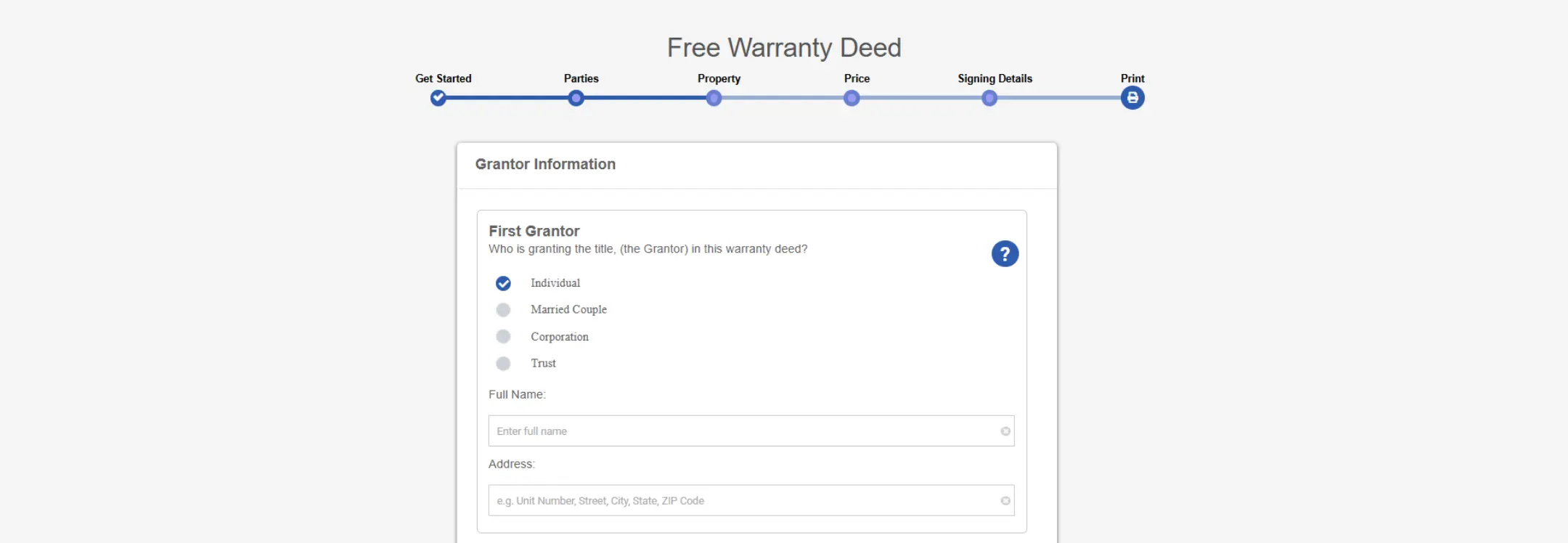
2. Add Party Details
Enter complete legal names, addresses, and roles for both grantor and grantee exactly as they appear in prior official documents and identification.
3. Add Property Details
Include the complete legal property description, parcel number, and property address matching county records precisely to prevent rejection or title defects.
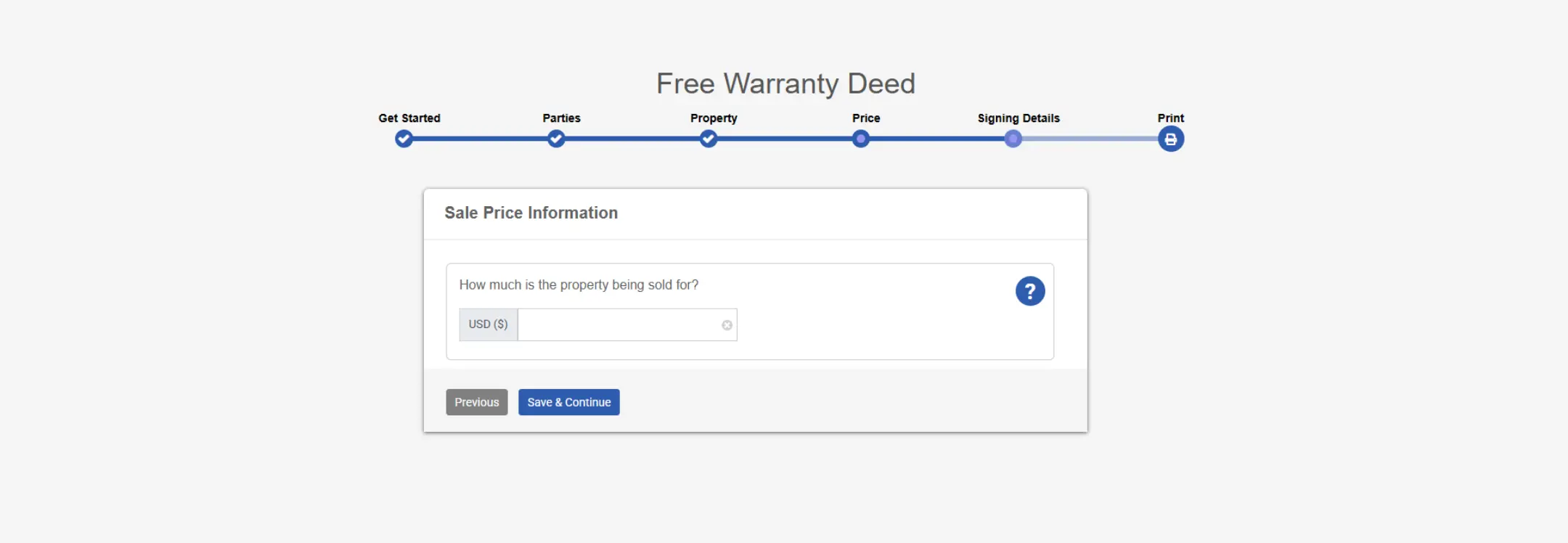
4. Add Price Details
Specify the consideration amount representing the purchase price or other valuable exchange for the property transfer that provides legal value to the deed.
5. Preview and print
Review the completed deed carefully for accuracy and completeness, then print for notarization and county recorder submission with all required fees and documentation.
Filing your warranty deed correctly through county recorders transforms your property transfer into an official permanent record that protects your ownership rights legally. Using Ziji Legal Forms' professionally formatted templates ensures compliance with county standards while preventing the common errors that cause rejection and processing delays.
Warranty Deed FAQs
1. What does a Warranty Deed do?
A Warranty Deed transfers ownership of real estate while providing the buyer with guarantees about the property's title.
2. Which type of Warranty Deed offers the most protection?
A General Warranty Deed provides the broadest protection because it guarantees the title against defects from any previous owner.
3. Is notarization required for a Warranty Deed?
Yes. A Warranty Deed generally must be notarized before it can be recorded in the public land records.
4. Is recording the deed necessary?
Yes. Recording the deed helps establish the new owner's legal interest in the property.
5. Should I use a Warranty Deed to add a family member to my property?
In most cases, a Quitclaim Deed is the preferred document for adding a family member or co-owner.
6. Where can the Ziji Legal Forms Warranty Deed be used?
The Ziji Legal Forms Warranty Deed is valid for use throughout all U.S. jurisdictions.
Author
Mandar Sonavane
|
Legal Content Writer at Ziji Legal Forms Inc.
Symbiosis International University
Mandar is a legal content writer specializing in the development of clear, practical, and easy-to-understand legal resources. With a strong focus on legal research, content creation, and plain-language writing, he works closely with our legal professionals to ensure that legal documents and educational materials are accurate, accessible, and user-friendly. At Ziji Legal Forms Inc., Mandar is responsible for researching legal topics, drafting and reviewing content, and helping transform complex legal concepts into straightforward guidance that empowers individuals and businesses to confidently navigate their legal needs.
Reviewed By
Histon Shek
|
General Counsel and Co-Founder at Ziji Legal Forms Inc.
University of Alberta
Histon Shek was called to the Alberta Bar in 2006. He holds a BA in Sociology and Philosophy and an LLB from the University of Alberta. As co-founder of Ziji Legal Forms Inc., he focuses on making legal documents accessible and affordable, overseeing legal integrity and content development.







 United States
 Canada